All published articles of this journal are available on ScienceDirect.

Safety and Tolerability of Biologic Therapies for Chronic Rhinosinusitis with Nasal Polyps: A Systematic Review of Randomized Controlled Trials

Abstract
Introduction/Objective
Biologic therapies targeting type 2 inflammation are increasingly used for severe Chronic Rhinosinusitis with Nasal Polyps (CRSwNP). Because individual trials are generally powered for efficacy rather than uncommon harms, this review aimed to synthesize randomized evidence on the safety and tolerability of biologic therapies in adults with CRSwNP.
Methods
This systematic review followed the PRISMA 2020 guidelines. Eligible studies were parallel-group randomized trials in adults with CRSwNP that compared a biologic with placebo or standard care and reported extractable safety outcomes. Trial families were reconciled to prevent double counting. Risk of bias was assessed using Cochrane RoB 2. Risk Ratios (RRs) were synthesized with Paule-Mandel random-effects models and modified Hartung-Knapp confidence intervals. Certainty was assessed using GRADE.
Results
Twenty unique randomized controlled trials reported in 17 primary publications comprised 3,598 randomized participants and eight biologic agents. Thirteen trials were at low overall risk of bias, and seven raised some concerns; none was high risk. Twelve independent safety-analysis units involving 2,962 participants showed little or no difference in any adverse event/treatment-emergent adverse event (RR 1.00, 95% CI 0.94-1.05; I2=18%; high-certainty evidence). Nine units involving 2,329 participants showed no statistically significant difference in serious adverse events (RR 0.75, 95% CI 0.48-1.19; I2=0%; moderate-certainty evidence). Adverse-event-related discontinuation was numerically less frequent with biologics across seven units involving 2,569 participants, but remained imprecise (RR 0.55, 95% CI 0.28-1.08; I2=0%; moderate-certainty evidence).
Discussion
The pooled randomized evidence indicates no clinically significant generalized increase in short- to medium-term adverse-event burden with biologic therapy. Estimates for serious adverse events and adverse-event-related discontinuation were less precise, so uncommon, delayed, and agent-specific harms remain important targets for longer-term surveillance.
Conclusion
Biologic therapy for CRSwNP results in little or no difference in overall short- to medium-term adverse-event risk compared with placebo or standard care. Serious adverse events were not demonstrably increased, while a possible reduction in adverse-event-related discontinuation remains uncertain. Randomized trials cannot exclude uncommon, delayed, or agent-specific harms.
1. INTRODUCTION
Chronic Rhinosinusitis with Nasal Polyps (CRSwNP) is a chronic inflammatory disorder of the nasal and paranasal sinus mucosa associated with nasal obstruction, loss of smell, facial pressure, sleep disturbance, impaired quality of life, and substantial healthcare use [1]. Severe disease is frequently recurrent despite intranasal corticosteroids and endoscopic sinus surgery, and repeated systemic corticosteroid exposure carries cumulative metabolic, skeletal, endocrine, ocular, and infectious risks [2]. CRSwNP commonly exhibits type 2 inflammation characterized by eosinophilic inflammation and signaling through Interleukin (IL)-4, IL-5, IL-13, and immunoglobulin E pathways, particularly in patients with comorbid asthma or aspirin-exacerbated respiratory disease [3].
Biologic therapies targeting these pathways have changed the treatment landscape for severe, inadequately controlled CRSwNP. Contemporary guidance recognizes biologics as an option for appropriately selected patients with persistent disease despite standard care [4]. Randomized trials have evaluated several targets, including IL-4 receptor alpha, IgE, IL-5, IL-5 receptor alpha, and thymic stromal lymphopoietin. As these agents may be administered for prolonged periods, their tolerability and safety are central to shared decision-making, monitoring, health-technology assessment, and long-term treatment sequencing.
Previous systematic reviews and meta-analyses have generally found biologic therapy to be well tolerated, but safety has often been secondary to efficacy, definitions and denominators vary across trials, and newer agents have substantially expanded the evidence base [5-7]. Rare adverse events are particularly difficult to evaluate because randomized trials are usually not powered for uncommon or delayed harms. In addition, companion reports and trials reported in paired publications can create a risk of double counting if the evidence base is organized by publication rather than by unique randomized trial.
The objective of this review was therefore to synthesize randomized evidence on the safety and tolerability of biologic therapies in adults with CRSwNP, quantify the relative risk of any Adverse Event/Treatment-Emergent Adverse Event (AE/TEAE), Serious Adverse Events (SAEs), and adverse-event-related treatment discontinuation where compatible data were available, evaluate risk of bias and certainty of evidence, and identify residual uncertainties regarding uncommon, delayed, and agent-specific harms.
2. METHODS
2.1. Reporting Framework, Protocol Status, and Revision-Stage Amendments
This systematic review was prepared in accordance with PRISMA 2020 [8, 9]. A review question, eligibility framework, and planned screening and extraction procedures were agreed by the review team before the original screening process, but the review was not prospectively registered, and no publicly accessible protocol was deposited. During peer-review revision, substantial methodological amendments were required to address inconsistencies identified in the submitted version. These amendments included trial-family reconstruction; removal of non-separable asthma safety populations; incorporation of newly published CRSwNP randomized trials through 28 August 2026; adoption of outcome-specific Cochrane RoB 2 assessment; addition of quantitative meta-analysis, sensitivity analyses, reporting-bias assessment, and GRADE certainty assessment. These changes are reported transparently.
2.2. Eligibility Criteria
Studies were eligible if they met all of the following criteria: (1) randomized parallel-group or multi-arm controlled design; (2) adults aged 18 years or older with clinically diagnosed CRSwNP or nasal polyposis, with or without comorbid asthma or aspirin-exacerbated respiratory disease; (3) treatment with a biologic targeting type 2 inflammatory pathways; (4) placebo or standard-care comparator; (5) numerical safety data for the eligible randomized CRSwNP population, including at least one AE/TEAE, SAE, adverse-event-related discontinuation, or another clinically relevant safety outcome; and (6) full-text peer-reviewed publication in English. Trials conducted primarily for another indication, such as asthma, were excluded when CRSwNP-specific randomized safety outcomes could not be extracted separately. Mixed CRS populations were excluded unless CRSwNP data were separable. Phase 1 studies, non-randomized studies, open-label extensions without separable randomized safety data, reviews, editorials, protocols, and conference abstracts without full data were excluded from the primary synthesis.
2.3. Information Sources and Search Strategy
The original review searched MEDLINE via PubMed, Embase, Web of Science Core Collection, and the Cochrane Central Register of Controlled Trials (CENTRAL) from database inception. The evidence base was updated through 28 August 2026. Search concepts combined CRSwNP/nasal polyposis terms with biologic and monoclonal-antibody terms, including dupilumab, omalizumab, mepolizumab, benralizumab, reslizumab, depemokimab, tezepelumab, stapokibart/CM310, and GR1802. Randomized-trial terminology was used to improve specificity. Safety terms were not required as a mandatory search block in the revision-stage strategy because eligible efficacy trials can report adverse events only in full text. Reference lists of eligible trials and relevant systematic reviews were also checked. Complete database-specific strategies are provided in Supplementary Table S1. The original database-specific retrieval logs and the database-specific record counts from the revision-stage update were unavailable and were not retrospectively estimated.
2.4. Study Selection and Trial-Family Reconciliation
In the original review process, two reviewers independently screened titles/abstracts and full-text reports using predefined eligibility criteria, with disagreements resolved through discussion and, when necessary, consultation with a third reviewer. During revision, eligibility was reassessed at the unique-trial level. Reports were grouped into trial families using registration identifiers, intervention and dosing characteristics, randomized sample sizes, recruitment periods, study acronyms, and explicit parent-substudy relationships. Publications reporting two independent randomized trials were counted as two trials, whereas companion, subgroup, and secondary publications were linked to their parent trial and did not contribute additional participants. When paired trials were reported only as a pooled safety population for a specific outcome, that pooled dataset was entered once as a single independent analysis unit for that outcome.
2.5. Data Extraction and Data Items
Two reviewers independently extracted study design, participant characteristics, biologic agent and regimen, comparator, randomized and safety-population denominators, controlled treatment duration, occurrence of at least one AE/TEAE, occurrence of at least one SAE, adverse-event-related discontinuation, deaths, hypersensitivity events, infections, injection-site reactions, eosinophilia, and other repeatedly reported adverse events. Disagreements were resolved by consensus. The unit of analysis was the number of participants experiencing at least one event, not the number of adverse-event episodes. Rounded percentages were not reverse-engineered into event counts. Data that remained unavailable or non-separable were recorded as not reported and retained only in the narrative synthesis where appropriate.
2.6. Risk of Bias Assessment
Risk of bias was assessed using the Cochrane RoB 2 framework for individually randomized parallel-group trials, focusing on the effect of assignment to intervention and on the safety outcomes contributing to this review [10]. The five domains were: bias arising from the randomization process; bias due to deviations from intended interventions; bias due to missing outcome data; bias in measurement of the outcome; and bias in selection of the reported result. Trial reports, supplementary materials, trial registrations, protocols, and statistical analysis plans were consulted where available. Each domain and the overall judgment were categorized as low risk, some concerns, or high risk. Because RoB 2 is outcome-specific, risk-of-bias judgments reported elsewhere for efficacy outcomes were not automatically transferred to safety outcomes. A sensitivity analysis restricted the quantitative synthesis to trials judged overall to be at low risk of bias.
2.7. Outcomes and Effect Measures
The three principal quantitative safety outcomes were: (1) occurrence of at least one AE/TEAE; (2) occurrence of at least one SAE; and (3) permanent treatment discontinuation attributable to an adverse event. The principal effect measure was the Risk Ratio (RR) with 95% Confidence Interval (CI) comparing biologic therapy with placebo or standard care. Individual adverse events were summarized narratively because definitions, coding systems, reporting thresholds, and event frequencies were not sufficiently consistent for reliable pooled comparison across agents.
2.8. Statistical Synthesis and Sensitivity Analyses
Meta-analysis was undertaken when at least two independent randomized comparisons reported compatible arm-specific participant counts. Pooled RRs were estimated on the log scale using a random-effects model with Paule-Mandel estimation of between-study variance (tau2) and modified Hartung-Knapp confidence intervals. Statistical heterogeneity was summarized with Cochran Q, tau2, and I2. For studies with zero events in one arm, a continuity correction of 0.5 was applied to all cells of the corresponding 2x2 table. Trials with zero events in both arms were retained descriptively but did not contribute information to a conventional RR estimate. Pooled safety programs were entered once, and their component trials were not simultaneously entered separately for the same outcome.
Sensitivity analyses included fixed-effects inverse-variance models, exclusion of studies requiring a continuity correction, exclusion of pooled program-level safety estimates where relevant, leave-one-out analyses, and analyses restricted to studies judged at low overall risk of bias. Formal subgroup meta-analysis or meta-regression by individual biologic was not undertaken because several agents were represented by too few directly comparable trials. Revision-stage statistical calculations and figures were produced in Python 3.13.5 using NumPy, pandas, SciPy, statsmodels, and Matplotlib. Statistical inference emphasized effect estimates and confidence intervals rather than P values alone.
2.9. Risk of Bias Due to Missing Evidence
Potential bias from missing or selectively reported safety results was considered at both the study and synthesis levels. Trial registrations, protocols, statistical analysis plans, publications, and supplementary materials were compared where available to determine whether prespecified safety outcomes were incompletely reported. For meta-analyses containing at least 10 independent analysis units, small-study effects were explored by funnel-plot inspection and an exploratory Egger regression test. Formal asymmetry testing was not conducted for meta-analyses with fewer than 10 units due to low statistical power. Funnel-plot asymmetry, if present, was not interpreted as synonymous with publication bias.
2.10. Certainty of the Evidence
The certainty of evidence for the three principal safety outcomes was assessed using the GRADE framework [10]. Randomized evidence was initially rated at high certainty and was considered for downgrading due for risk of bias, inconsistency, indirectness, imprecision, and publication bias. Risk-of-bias judgments incorporated RoB 2 and the low-risk-only sensitivity analyses. Inconsistency was judged from the direction and magnitude of study effects, overlap of confidence intervals, I2, and tau2. Imprecision was judged from the number of participants and events, confidence-interval width, and whether materially different clinical interpretations remained plausible. Absolute effects were calculated using the pooled comparator-group risk. Certainty was categorized as high, moderate, low, or very low.
2.11. Use of AI-Assisted Technologies
During revision, ChatGPT (OpenAI) was used as an AI-assisted tool to support language and structural editing, organization of reviewer responses, bibliographic cross-checking, generation and checking of statistical-analysis code, and preparation of graphical displays. All numerical inputs were derived from eligible source publications or associated trial/regulatory records. The authors reviewed and verified the underlying event counts, study-eligibility decisions, risk-of-bias judgments, statistical methods and outputs, references, and final interpretations before inclusion. No unavailable screening counts, participant-level data, or unreported study outcomes were generated or imputed by the AI tool. Final scientific decisions were made by the authors, who take full responsibility for the accuracy and integrity of the work.
3. RESULTS
3.1. Study Selection and Evidence-Set Reconstruction
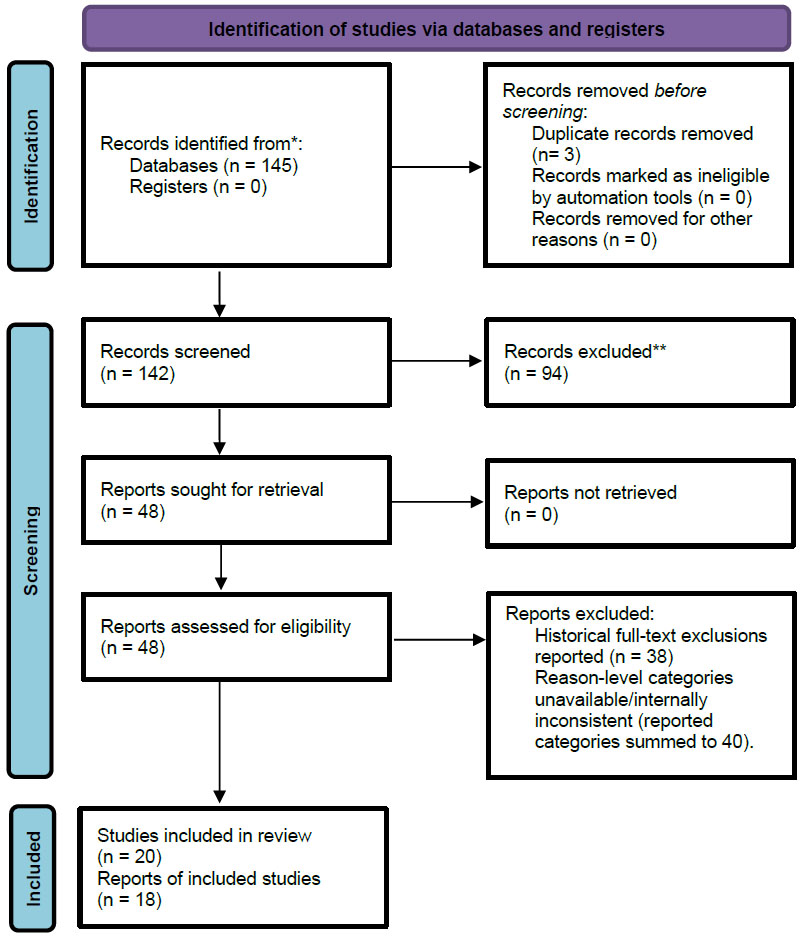
The submitted manuscript reported 145 records identified from electronic databases, three duplicate records removed, 142 records screened, 94 records excluded at title/abstract level, and 48 reports assessed in full text. However, the previously reported full-text exclusion categories were internally inconsistent: the category counts summed to 40 while 38 full-text exclusions were reported. Because the original reason-level full-text exclusion log was unavailable during revision, individual historical exclusion categories were not retrospectively altered, redistributed, or estimated.
During revision, the evidence base was updated through 28 August 2026, and all candidate reports were reassessed at the unique-trial level. Trial-family reconciliation identified 20 unique randomized controlled trials reported in 17 primary publications [11-27]. Three primary publications each reported two independent randomized trials: SINUS-24 and SINUS-52 [15], POLYP 1 and POLYP 2 [16], and ANCHOR-1 and ANCHOR-2 [25]. The Fujieda Japanese SINUS-52 analysis [28] was classified as a companion report and contributed no additional trial or participant count. Asthma trials without separately extractable randomized CRSwNP safety outcomes were removed from the primary synthesis. Apparently eligible excluded reports and their primary exclusion reasons are listed in Supplementary Table S2. The study-selection process and revision-stage evidence reconciliation are summarized in Fig. (1).
3.2. Characteristics of Included Trials
The final evidence set comprised 20 unique randomized trials involving 3,598 randomized participants and eight biologic agents: dupilumab, omalizumab, mepolizumab, benralizumab, stapokibart/CM310, GR1802, tezepelumab, and depemokimab [11-27]. Trial size ranged from 24 participants in small proof-of-concept studies to 448 participants in SINUS-52. Randomized treatment periods ranged from approximately 8 to 52 weeks. Most contemporary studies were multicentre, double-blind, placebo-controlled trials conducted on a background of intranasal corticosteroid treatment. Randomized-enrollment totals were kept distinct from outcome-specific safety denominators; for example, 107 participants were randomized in the 2017 mepolizumab trial, although 105 received study treatment, and 410 participants were randomized in WAYPOINT, while 408 were included in the primary safety/efficacy analysis set. The characteristics and quantitative-synthesis contribution of each trial are summarized in Table 1.
| Trial/Reference | Biologic | Randomized N | Controlled Period | Primary Quantitative Safety Use | Overall RoB 2 |
|---|---|---|---|---|---|
| Gevaert 2011 [11] | Mepolizumab | 30 | 8 wk | Narrative; SAE sensitivity only | Some concerns |
| Gevaert 2013 [12] | Omalizumab | 24 | 16 wk | Narrative | Some concerns |
| Bachert 2016 [13] | Dupilumab | 60 | 16 wk | Any AE, SAE, discontinuation | Low |
| Bachert 2017 [14] | Mepolizumab | 107 (105 treated) | 25 wk | Any AE; sparse SAE/discontinuation narrative | Some concerns |
| SINUS-24 [15] | Dupilumab | 276 | 24 wk | Pooled SINUS safety program | Low |
| SINUS-52 [15] | Dupilumab | 448 | 52 wk | Pooled SINUS safety program | Low |
| POLYP 1 [16] | Omalizumab | 138 | 24 wk | Pooled POLYP safety program | Low |
| POLYP 2 [16] | Omalizumab | 127 | 24 wk | Pooled POLYP safety program | Low |
| SYNAPSE [17] | Mepolizumab | 407 | 52 wk | Any AE, SAE, discontinuation | Low |
| Tversky 2021 [18] | Benralizumab | 24 | 20 wk | Narrative | Some concerns |
| Takabayashi 2021 [19] | Benralizumab | 56 | 12 wk | Narrative | Some concerns |
| OSTRO [20] | Benralizumab | 413 | 40 wk | Narrative/sensitivity only | Low |
| CROWNS-1 [21] | Stapokibart/CM310 | 56 | 16 wk | Any AE and SAE | Low |
| MERIT [22] | Mepolizumab | 169 | 52 wk | Any AE and SAE | Some concerns |
| CROWNS-2 [23] | Stapokibart | 180 | 24 wk | Any AE, SAE, discontinuation | Low |
| WAYPOINT [24] | Tezepelumab | 410 (408 analyzed) | 52 wk | Any AE, SAE, discontinuation | Low |
| ANCHOR-1 [25] | Depemokimab | 276 | 52 wk | Any AE; pooled discontinuation program | Low |
| ANCHOR-2 [25] | Depemokimab | 264 | 52 wk | Any AE; pooled discontinuation program | Low |
| GR1802 phase II [26] | GR1802 | 70 | 16 wk | Narrative | Some concerns |
| Chinese dupilumab 2026 [27] | Dupilumab | 63 | 24 wk | Any AE and SAE; discontinuation double-zero | Low |
3.3. Risk of Bias
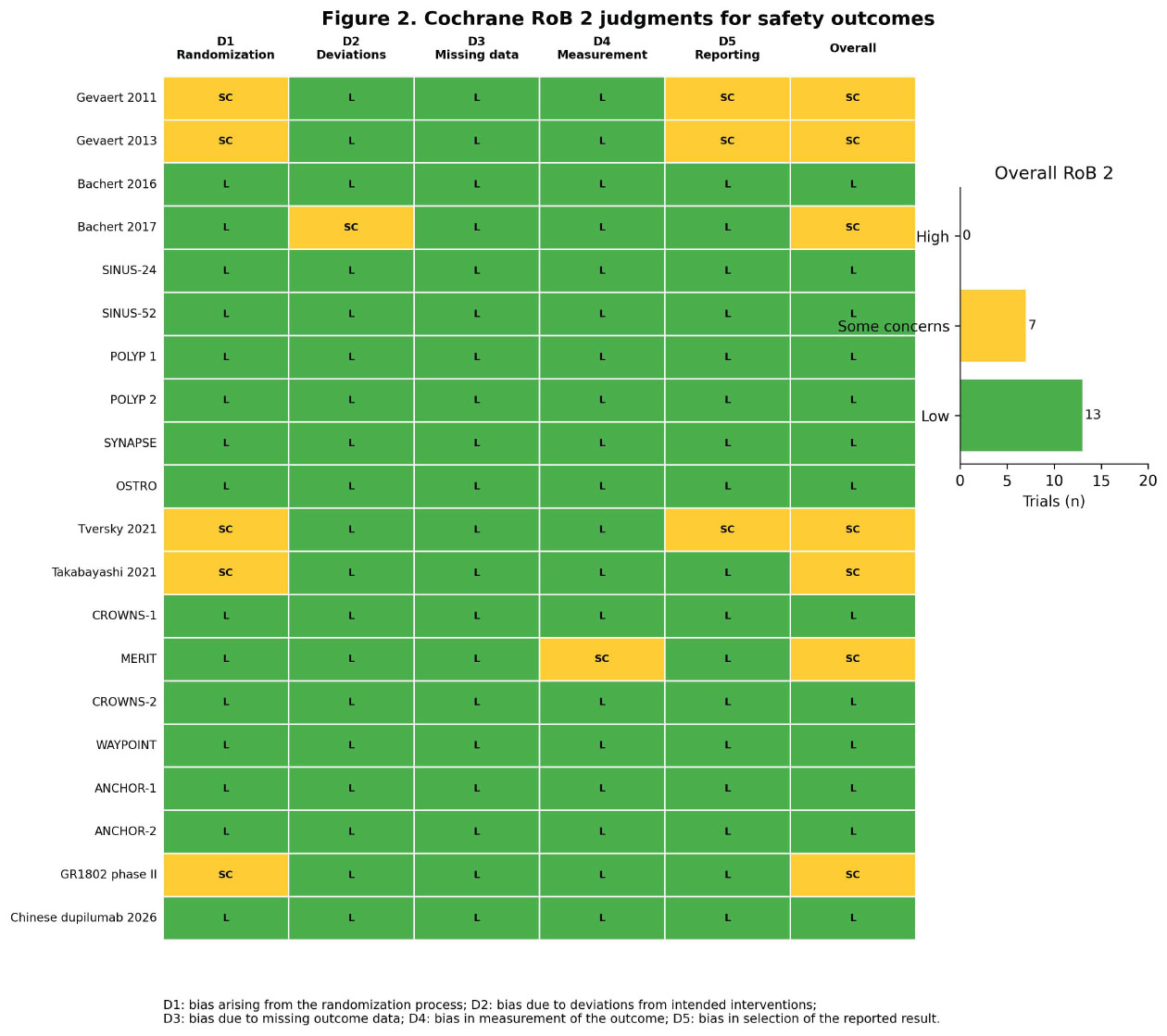
Thirteen of the 20 trials (65%) were judged at low overall risk of bias for the safety outcomes, while seven (35%) raised some concerns; no trial was classified as high risk. The most frequent concern involved incomplete reporting of the randomization process in several early or smaller trials. The 2017 mepolizumab trial raised some concerns for deviations from intended intervention because one randomized participant received the incorrect initial treatment and was handled differently for safety and efficacy analyses. MERIT raised some concerns regarding safety-data integrity because suspected Good Clinical Practice violations affected a small number of participants at two sites. The major contemporary phase 3 programs were generally judged at low risk across all five RoB 2 domains. Overall and domain-level RoB 2 judgments are shown in Fig. (2); detailed justifications are provided in Supplementary Table S3.
3.4. Quantitative Synthesis of Safety Outcomes
3.4.1. Any Adverse Event/Treatment-Emergent Adverse Event
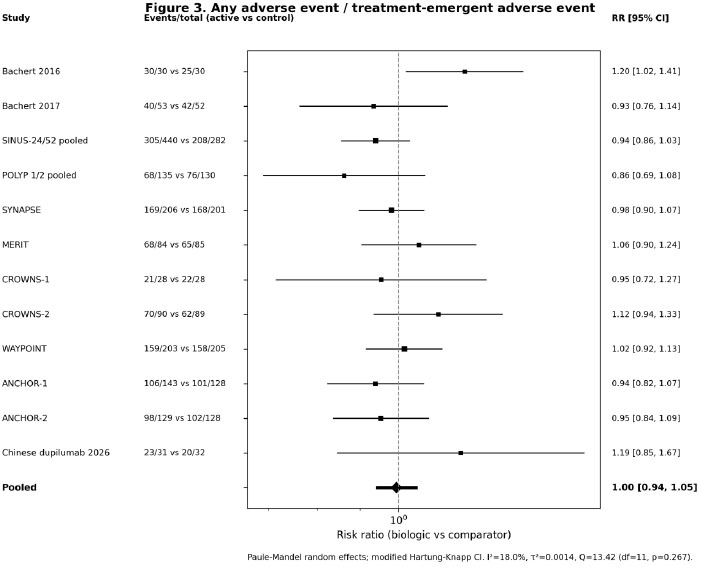
Twelve independent safety-analysis units representing 2,962 participants provided extractable participant-level data for the occurrence of at least one AE/TEAE. Overall, 1,157 of 1,572 biologic-treated participants and 1,049 of 1,390 comparator participants experienced at least one event. The pooled analysis showed little or no difference between biologic and comparator groups (RR 1.00, 95% CI 0.94-1.05; P = 0.845). Statistical heterogeneity was low (Q = 13.42, df = 11, P = 0.267; I2 = 18.0%; tau2 = 0.0014). The participant-level safety extraction dataset underlying the quantitative syntheses is provided in Supplementary Table S4. The pooled comparison is shown in Fig. (3).
3.4.2. Serious Adverse Events
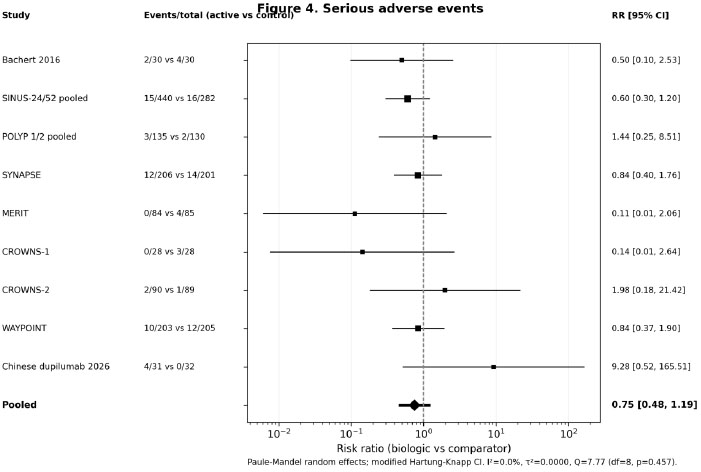
Nine independent analysis units comprising 2,329 participants contributed extractable SAE data. Forty-eight of 1,247 biologic-treated participants and 56 of 1,082 comparator participants experienced at least one SAE. SAEs were numerically less frequent among biologic-treated participants, but the pooled difference was not statistically significant (RR, 0.75; 95% CI, 0.48-1.19; P = 0.186). No measurable statistical heterogeneity was detected (Q = 7.77, df = 8, P = 0.457; I2 = 0%; tau2 = 0). Thus, the randomized evidence did not demonstrate an increased risk of SAEs with biologic therapy, although the confidence interval remained compatible with both a potentially important reduction and a modest increase. The pooled SAE comparison is shown in Fig. (4).
3.4.3. Discontinuation Due to Adverse Events
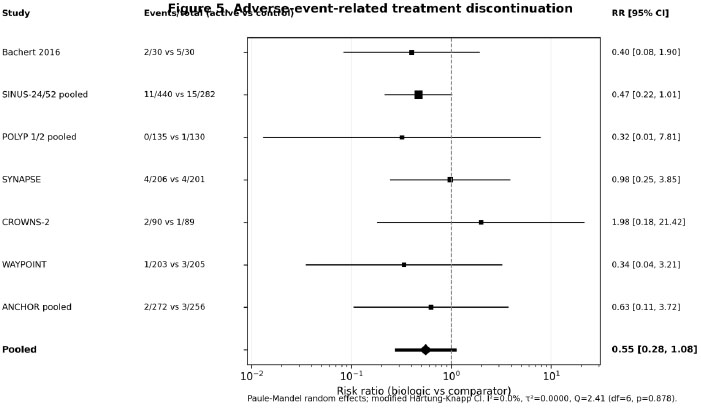
Seven informative analysis units involving 2,569 participants reported extractable data on permanent treatment discontinuation attributable to adverse events. Twenty-two of 1,376 biologic-treated participants and 32 of 1,193 comparator participants discontinued because of an adverse event. The pooled point estimate favored biologic therapy but remained imprecise and did not reach conventional statistical significance under the prespecified conservative random-effects analysis (RR 0.55, 95% CI 0.28-1.08; P = 0.075). Statistical heterogeneity was negligible (Q = 2.41, df = 6, P = 0.878; I2 = 0%; tau2 = 0). The pooled discontinuation comparison is shown in Fig. (5).
3.5. Sensitivity Analyses
Sensitivity analyses supported the robustness of the principal conclusions. For any AE/TEAE, a fixed-effect model produced RR 0.99 (95% CI 0.95-1.03), closely matching the random-effects estimate. Restriction to 10 contributing low-risk-of-bias analysis units yielded an RR of 1.00 (95% CI 0.93-1.06). For SAEs, the fixed-effects estimate was RR 0.75 (95% CI 0.51-1.11), while restricting to low-risk-of-bias studies yielded RR 0.78 (95% CI 0.48-1.25). Excluding trials with a zero-event arm did not materially change the SAE interpretation. For AE-related discontinuation, the fixed-effects model yielded an RR of 0.55 (95% CI 0.32-0.95), whereas the more conservative modified Hartung-Knapp analysis was non-significant. Excluding the single-zero POLYP program or the pooled ANCHOR discontinuation dataset did not materially change the direction of effect. Leave-one-out analyses showed no evidence that a single study determined the overall conclusions. Detailed sensitivity analyses are provided in Supplementary Table S5.
3.6. Risk of Bias Due to Missing Evidence
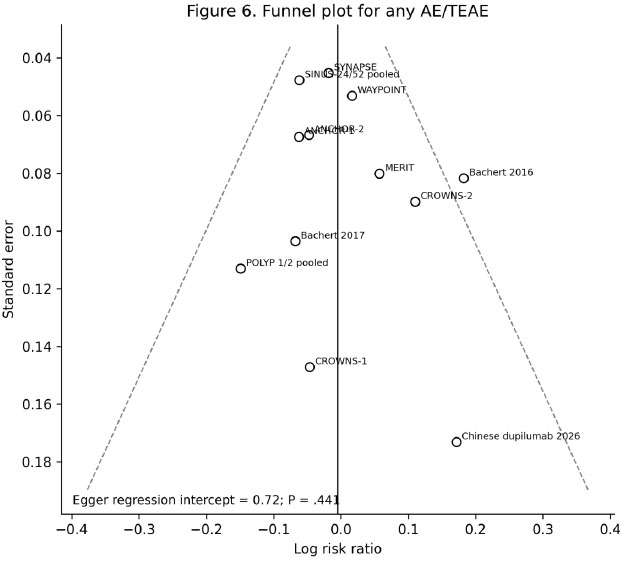
Reporting completeness varied across trials, particularly among earlier and smaller studies that sometimes reported percentages, event episodes, or narrative summaries rather than complete arm-specific participant counts. No consistent pattern suggesting systematic non-reporting of unfavorable safety findings was identified. The any AE/TEAE meta-analysis contained 12 independent analysis units and therefore permitted exploratory small-study assessment. Visual inspection of the funnel plot did not suggest marked directional asymmetry, and the Egger regression intercept was 0.72 (P = 0.441). The fixed-effect and random-effects estimates were also nearly identical. Formal asymmetry testing was not undertaken for SAEs or adverse-event-related discontinuation because only nine and seven analysis units, respectively, contributed to those outcomes; therefore, reporting bias cannot be excluded for these less frequently reported outcomes. The funnel plot for the any AE/TEAE outcome is shown in Fig. (6).
3.7. Certainty of the Evidence
GRADE certainty was high for any AE/TEAE and moderate for both SAEs and AE-related discontinuation. No downgrading was considered necessary for the overall AE/TEAE outcome because the estimate was precise, heterogeneity was low, the evidence directly addressed the review question, low-risk-of-bias sensitivity analysis was concordant, and no clear small-study effect was identified. SAE evidence was downgraded one level for serious imprecision because the confidence interval remained compatible with materially different clinical interpretations. AE-related discontinuation was also downgraded one level for imprecision because few events occurred and the confidence interval ranged from a substantial reduction to little or no difference. The corresponding GRADE summary of findings is presented in Table 2.
| Outcome | Evidence | Pooled RR (95% CI) | Comparator Risk | Absolute Effect with Biologic | Certainty |
|---|---|---|---|---|---|
| Any AE/TEAE | 12 analysis units; 2,962 participants | 1.00 (0.94-1.05) | 755 per 1,000 | 751 per 1,000; 4 fewer per 1,000 (42 fewer to 37 more) | High |
| Serious adverse events | 9 analysis units; 2,329 participants | 0.75 (0.48-1.19) | 52 per 1,000 | 39 per 1,000; 13 fewer per 1,000 (27 fewer to 10 more) | Moderate - imprecision |
| AE-related discontinuation | 7 analysis units; 2,569 participants | 0.55 (0.28-1.08) | 27 per 1,000 | 15 per 1,000; 12 fewer per 1,000 (19 fewer to 2 more) | Moderate - imprecision |
3.8. Patterns of Common and Agent-Specific Adverse Events
Across the randomized trials, commonly reported adverse events included nasopharyngitis, upper respiratory tract infection, headache, epistaxis, injection-site reactions, and other mild respiratory or local reactions. The distribution of individual events varied among agents and trials. CROWNS-2, for example, reported higher frequencies of arthralgia and hyperuricemia with stapokibart than placebo [23], while the overall incidence of TEAEs in the Chinese dupilumab phase 3 trial was similar between groups [27]. The available randomized evidence did not identify a consistent excess of treatment-related anaphylaxis, opportunistic infection, malignancy, or fatal toxicity during the controlled trial periods; however, the rarity of these outcomes means that absence of a trial signal should not be interpreted as proof that such harms do not occur. Broader biologic safety surveillance in other type 2 inflammatory indications similarly emphasizes the importance of agent-specific monitoring and post-marketing pharmacovigilance [29].
4. DISCUSSION
4.1. Principal Findings
This safety-focused systematic review and meta-analysis reconstructs the randomized CRSwNP evidence base at the unique-trial level and incorporates 20 trials involving 3,598 randomized participants. After linking companion reports to their parent trials, separating paired trials reported within single publications, removing non-separable asthma safety populations, and incorporating newer CRSwNP-specific randomized evidence, the review provides a more internally consistent assessment than the submitted manuscript.
The principal finding is that biologic treatment had little or no effect on the overall probability of experiencing an AE/TEAE compared with placebo or standard care. Across 12 independent safety-analysis units involving almost 3,000 participants, the pooled RR was 1.00 with a narrow 95% CI of 0.94-1.05. Heterogeneity was low; the result was essentially unchanged in fixed-effects and low-risk-of-bias sensitivity analyses; and the evidence was rated as high certainty. This supports a relatively strong conclusion that the biologics currently under study do not produce a clinically significant, generalized increase in short- to medium-term AE burden in trial populations.
SAEs require greater caution. The pooled point estimate favored biologic treatment, but the confidence interval was substantially wider and crossed the null. The evidence therefore does not demonstrate that biologics either increase or reduce SAE risk. GRADE certainty was moderate because relatively few serious events occurred and the confidence interval remained compatible with materially different clinical effects. AE-related discontinuation showed a similar pattern: the point estimate suggested fewer discontinuations with biologic therapy, but statistical significance depended on the inferential model and the conservative random-effects CI crossed 1.0. This outcome should therefore be regarded as suggestive rather than confirmatory.
4.2. Interpretation Across Biologic Agents
The included trials evaluated several mechanistically distinct pathways within type 2 inflammation. Despite this diversity, the aggregated randomized evidence did not show an overall increase in AEs or SAEs with biologic treatment. Nevertheless, the present analysis should not be interpreted as demonstrating equivalent safety among individual biologics. Several newer agents are represented by only one or two trials, individual adverse-event definitions vary, and the review was primarily designed to compare biologic therapy with placebo or standard care rather than perform reliable head-to-head safety ranking. Prior syntheses likewise report broadly favorable overall safety while emphasizing that the depth of evidence differs across agents [5-7].
Absence of a pooled increase in overall AEs or SAEs also does not exclude specific treatment-related adverse events. Injection-site reactions, eosinophilia, upper respiratory symptoms, headache, arthralgia, laboratory abnormalities, and other events were reported to varying degrees. Rare outcomes such as anaphylaxis, opportunistic infection, malignancy, severe cardiovascular events, pregnancy-related complications, or treatment-related death could not be robustly quantified. Accordingly, the most defensible interpretation is that no consistent excess was identified during randomized trial follow-up, not that rare harms are absent.
4.3. Robustness of the Findings
Several features strengthen the revised synthesis. Trial-level rather than publication-level accounting prevented duplicate contribution from companion and subgroup reports. Outcome-specific safety denominators were used rather than automatically applying total randomized enrollment. Event episodes were not treated as numbers of affected participants, and rounded percentages were not converted into unreported counts. Pooled safety programs were entered only once for the outcome for which pooled data were reported. The meta-analytic findings were stable across fixed-effect, random-effects, sparse-event, pooled-program, leave-one-out, and low-risk-of-bias sensitivity analyses.
Risk-of-bias assessment was outcome-specific and used RoB 2 rather than transferring generic quality judgments from efficacy outcomes. No included trial was judged at high overall risk for the safety outcomes, and restricting the meta-analysis to low-risk trials did not materially change the principal estimates. Assessment of missing evidence also provided no clear small-study signal for the overall AE/TEAE outcome, although publication and selective reporting bias cannot be excluded for SAEs and discontinuation because fewer studies contributed to those analyses.
4.4. Clinical and Research Implications
For clinicians and patients, the findings provide relatively strong reassurance that currently studied biologics are unlikely to cause a substantial increase in overall short- to medium-term adverse-event burden when used in appropriately selected adults with severe CRSwNP. The results should nevertheless be integrated with agent-specific contraindications, known adverse-event profiles, comorbid conditions, patient preferences, and the substantial costs of biologic treatment. Although repeated systemic corticosteroid exposure and recurrent surgery have important harms [2], this review did not directly compare the cumulative safety of those strategies with biologic therapy and therefore does not establish a net safety advantage over all conventional alternatives.
Future research should prioritize longer controlled and observational follow-up, standardized adverse-event definitions, harmonized participant-level safety reporting, and adequately powered comparative studies. Large pharmacovigilance datasets and prospective registries will remain necessary to characterize very rare, delayed, age-specific, pregnancy-related, immunocompromised, and multimorbidity-related harms that conventional RCTs cannot adequately detect.
5. LIMITATIONS OF THE STUDY
Most eligible RCTs were designed and powered primarily for efficacy rather than uncommon adverse events. Even the combined randomized evidence therefore remains underpowered to exclude rare or delayed harms, and controlled treatment periods were generally no longer than 52 weeks.
Adverse-event reporting was not fully standardized. Definitions, coding systems, reporting thresholds, safety-population definitions, and the level of detail available for individual events varied across trials. Some otherwise eligible studies could contribute only to the narrative synthesis because arm-specific participant-level event counts were unavailable.
The review was restricted to English-language, peer-reviewed, full-text reports, which may introduce language and publication bias. Formal assessment of funnel plot asymmetry was possible only for the overall AE/TEAE outcome, as fewer than 10 independent analysis units contributed to the SAE and discontinuation meta-analyses.
The review was not prospectively registered, and substantial methodological amendments were introduced during revision in response to peer review. These included reconstruction of trial families, removal of non-CRSwNP asthma safety populations, updating the evidence base, RoB 2 assessment, quantitative meta-analysis, reporting bias assessment, and GRADE. These amendments are disclosed rather than presented as prespecified. A structured summary of these revision-stage amendments is provided in Supplementary Table S6.
The original detailed screening log was unavailable during revision, preventing complete retrospective verification of reason-level full-text exclusions. The historically reported categories were internally inconsistent, and we therefore did not invent or redistribute missing counts. This limitation affects reconstruction of the historical record-flow branch but not the trial-level participant accounting or the event counts used in the revised quantitative analyses.
Finally, the pooled analyses evaluate biologic therapy as a broad therapeutic category and should not be interpreted as establishing equivalent safety among individual agents. Several newer biologics remain represented by a limited number of randomized trials.
CONCLUSION
This systematic review and meta-analysis of 20 unique randomized controlled trials involving 3,598 randomized participants indicates that biologic therapies for CRSwNP result in little or no difference in the overall probability of experiencing an adverse event compared with placebo or standard care. This finding was robust across sensitivity analyses and was supported by high-certainty evidence.
Serious adverse events were not demonstrably increased with biologic therapy (RR 0.75, 95% CI 0.48-1.19), although moderate-certainty evidence remains insufficient to exclude clinically important differences. AE-related discontinuation was numerically less frequent with biologic treatment (RR 0.55, 95% CI 0.28-1.08), but this finding also remained uncertain and was supported by moderate-certainty evidence.
Collectively, the randomized evidence supports the short- to medium-term tolerability of biologic therapy in appropriately selected adults with CRSwNP, but it does not establish comparative safety among individual biologics or exclude uncommon, delayed, or agent-specific harms. Continued long-term pharmacovigilance, harmonized safety reporting, and adequately powered comparative studies remain necessary as biologic use expands in routine CRSwNP care.
AUTHORS’ CONTRIBUTIONS
The author confirms sole responsibility for the following: Study conception and design, data collection, analysis and interpretation of results, and manuscript preparation.
AVAILABILITY OF DATA AND MATERIALS
The aggregate event-count datasets used in the meta-analyses and sensitivity analyses are derived from published trial reports or associated public trial/regulatory records. The reconstructed extraction dataset and analysis outputs are included in the revision package; additional reproducible analysis code can be provided with the supplementary material or on reasonable request.
ACKNOWLEDGEMENTS
Declared none.