All published articles of this journal are available on ScienceDirect.

Modeling Analysis of Mental Health Research on Female Survivors of Domestic Violence in China (2000–2024)

Abstract
Introduction
Domestic violence (DV) has been recognized by the World Health Organization as a major global public health issue affecting women’s physical and mental health. In China, DV continues to pose a serious threat to women’s psychological well-being. Although English-language research on this topic has grown in recent years, the overall knowledge structure remains fragmented.
Methods
This study applied latent Dirichlet allocation (LDA) topic modeling to analyze 179 English-language abstracts published between 2000 and 2024, retrieved from four major academic databases. The analysis focused on term frequency distribution, identification and classification of latent topics, and temporal trends in topic prevalence over the 24-year period.
Results
The model identified 25 latent topics, which were categorized into four overarching themes: psychological health consequences, risk and protective factors, intervention and support systems, and research methodology and policy perspectives. A marked thematic shift occurred after 2016, with increased emphasis on empirical evaluation and structural determinants, aligning with the implementation of China’s Anti-Domestic Violence Law.
Discussion
The field has progressed from early descriptive accounts of trauma toward more systematic investigations into risk mechanisms and institutional responses. Nonetheless, important gaps remain, including insufficient attention to perpetrator psychology, the long-term socioeconomic consequences of DV, and the underrepresentation of high-risk or marginalized populations.
Conclusion
This study identified the key thematic structures and temporal trends in research on DV and women’s mental health in China. The findings offer a data-informed foundation for future studies and contribute to the development of culturally responsive public health interventions and evidence-based policy initiatives.
1. INTRODUCTION
Domestic violence (DV) is a pervasive global public health crisis and a serious violation of women's human rights [1-3]. Approximately one in three women worldwide experience physical or sexual violence during their lifetime, mostly by intimate partners [4, 5]. Beyond physical injury, DV imposes profound mental health consequences, including depression, anxiety, PTSD [6-12], diminished self-esteem, somatization, and self-harming behaviors, as well as long-term societal costs, undermining social cohesion, family functioning, and healthcare systems [13-22]. Exposure during childhood or adolescence further elevates risk for PTSD and emotional distress [23-30].
Understanding DV requires a multi-level perspective. Guided by the social-ecological model [31], this study recognizes that violence arises from interacting factors at individual, relational, community, and societal levels [32]. This perspective underscores the need to systematically map existing research to identify thematic patterns, gaps, and underexplored structural levels.
In China, DV is shaped by cultural and institutional factors. Traditional norms of family harmony, privacy, and face-saving render DV a private issue, discouraging disclosure and help-seeking [33-36]. The Anti-Domestic Violence Law (2016) marked a milestone, yet gaps between legislation and practice remain, including low judicial recognition and a preference for mediation over punishment [37-42].
Although English-language research on DV and women's mental health in China has expanded, covering prevalence, risk factors, interventions, and policy, existing reviews remain largely descriptive [41-45]. Narrative reviews often lack systematic mapping of thematic structures, temporal trends, and cross-disciplinary connections, limiting identification of priority areas and research gaps [46-48].
Data-driven approaches, such as latent Dirichlet allocation (LDA), offer scalable, inductive methods to uncover latent thematic structures and track their evolution over time [49-51]. While probabilistic topic extraction requires scholarly interpretation, rigorous multi-stage validation can mitigate subjectivity [50]. LDA is therefore employed not as a replacement for qualitative synthesis, but as a tool to structure and delineate this complex, interdisciplinary field.
To address this gap, the present study poses the following research questions:
RQ1: What are the dominant themes in English-language research on DV and women’s mental health in China?
RQ2: How have these themes evolved in terms of research attention and distribution between 2000 and 2024?
RQ3: What thematic gaps or structural omissions can be identified through topic distribution and temporal analysis?
We focused on English-language publications from major international databases to map the research landscape visible to the global academic community. This allowed evaluation of cross-cultural knowledge transfer, identification of internationally visible topics, and examination of how China's DV issues are framed globally, while acknowledging the partial scope of the analysis.
LDA was applied to a corpus of publications retrieved from PsycInfo, PubMed, Scopus, and Web of Science. Through semantic modeling, topic categorization, and temporal analysis, the study identified dominant research foci and underlying thematic structures, offering a structured knowledge base to inform future research, interventions, and policy, particularly in contexts where international collaboration is critical for advancing DV prevention and mental health services.
2. METHOD
2.1. Data Source and Selection
This study deliberately focused on English-language publications to map the research landscape visible to the global academic and policy community. This scope allowed for an analysis of how China's DV issues are framed in international discourse and enabled a critical evaluation of cross-cultural knowledge transfer.
To construct a comprehensive corpus covering the period from January 1, 2000, to December 31, 2024, a final literature search was conducted in early February 2025 across four major academic databases: PsycInfo, PubMed, Scopus, and Web of Science. The search strategy combined keywords related to DV, mental health, and the Chinese context. The complete search strings for each database are provided in the Supplementary Material.
The initial search yielded 833 records. After removing 344 duplicates, the titles and abstracts of the remaining 489 unique records were screened independently by two reviewers. Studies not directly focused on the intersection of DV, mental health, and the Chinese female population were excluded. Any discrepancies were resolved through discussion, resulting in a final corpus of 179 publications for analysis (Fig. 1).
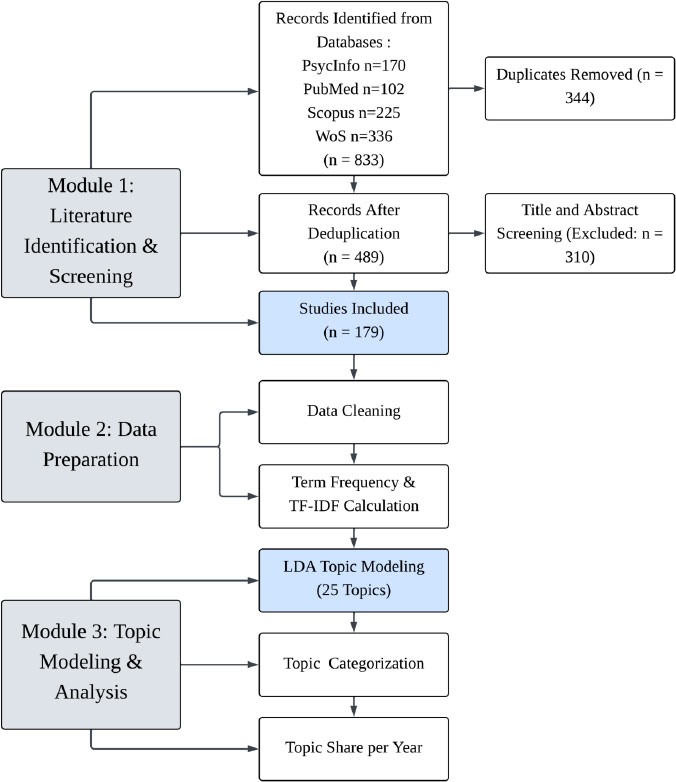
Overview of the research workflow.
2.2. Text Preprocessing
The titles and abstracts of the 179 publications were compiled for analysis. A standardized preprocessing pipeline was implemented in R (v. 4.4.5) using the tm package. The process included converting text to lowercase, removing punctuation and numbers, eliminating standard English stopwords, and applying Porter stemming to consolidate word variants [44-53]. Abstracts were chosen over full texts as a deliberate methodological strategy. The goal of this study was to identify the main thematic trends in the research landscape, a task for which abstracts are particularly well-suited. While full texts offer greater coverage, abstracts provide higher information density, focusing on the core concepts and contributions of a study. Furthermore, this approach avoided introducing numerous “noise terms” (e.g., from detailed methodology sections) that may be present in full texts and potentially reduce the interpretability of the resulting topics. As the literature suggests, if the aim is to map a field's primary topics, abstracts are often sufficient [54].
2.3. Topic Modeling
To identify latent topic structures, we employed latent Dirichlet allocation (LDA), an unsupervised probabilistic model widely used for abstract and news corpus analysis [44-56]. The model was trained on the preprocessed corpus using the topicmodels package in R [55-57].
2.3.1. Model Selection
Evaluation was guided by perplexity and log-likelihood metrics [57, 58], aiming to balance model fit and semantic coherence. The selection of the optimal number of topics (K) involved a multi-criteria approach combining quantitative metrics with qualitative validation to ensure model robustness. Quantitative evaluation of log-likelihood and perplexity for models with K=10 to 40 indicated that model performance stabilized within the K=20–30 range, with diminishing returns thereafter (Fig. 2). Within this candidate range, a qualitative inspection of thematic coherence was performed. K=25 was ultimately selected as it provided the optimal balance between thematic granularity and interpretability, producing distinct, coherent topics without the conceptual conflation seen in models with fewer topics or the redundancy of those with more. Beyond statistical evaluation, the interpretability of topics was qualitatively assessed by examining the coherence of representative keywords and their alignment with existing literature on DV and mental health. This combined quantitative-qualitative validation ensured the robustness and theoretical relevance of the final model.
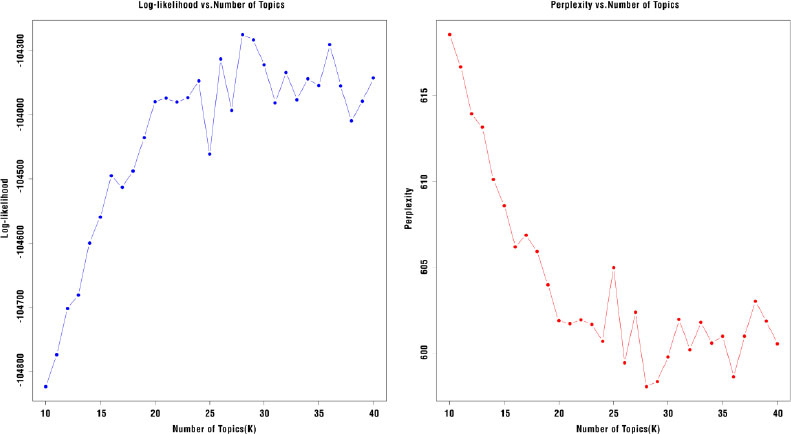
Log-likelihood and perplexity.
2.3.2. Topic Interpretation and Categorization
To ensure the reliability of topic labeling and reduce subjectivity, the two authors systematically reviewed the representative keywords for each of the 25 topics and collaboratively assigned descriptive labels. This process integrated the semantic information of the keyword clusters to form coherent thematic concepts while minimizing conceptual overlap between the topics. The 25 topics were then inductively grouped into four higher-level thematic categories, structuring the presentation of the results and providing a data-driven, high-level map of the research landscape.
2.4. Temporal Trend Analysis
To examine thematic evolution, we tracked the annual prevalence of each topic from 2000 to 2024. For each year, we calculated the number of documents in which a topic was identified as the dominant theme. This count was referred to as the topic's annual 'instances' or prevalence. Annual frequencies were then visualized by category to identify temporal patterns using the ggplot2 package in R.
3. RESULTS
This study applied LDA to analyze 179 English-language abstracts related to DV and mental health among Chinese women. The results are presented in three sections: descriptive statistics of the corpus, identification and classification of latent topics, and topic trends from 2000 to 2024.
3.1. Descriptive Statistics
After text preprocessing, the frequency distribution of key terms was examined. As shown in Fig. (3), the word cloud of the top 50 high-frequency words highlighted dominant terms, such as woman (3.5%), violence (3.24%), partner (1.77%), health (1.63%), and abuse (1.41%). Figure 4 further illustrates the relative frequencies of the top 20 terms, reflecting the field’s lexical emphasis on gender-based violence and its mental health implications.
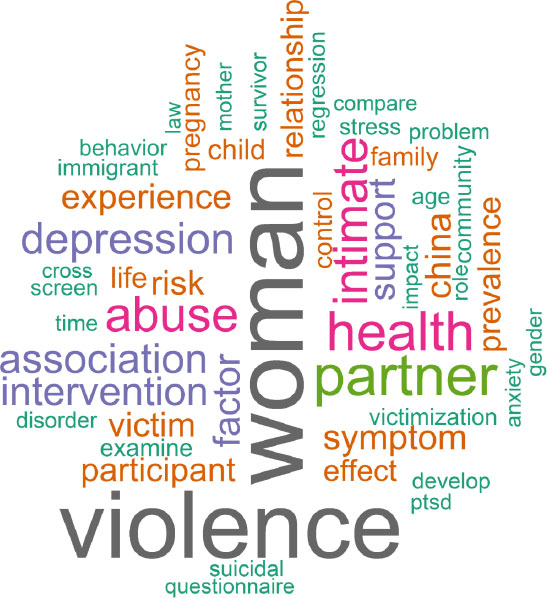
Word cloud of the top 50 high-frequency words.
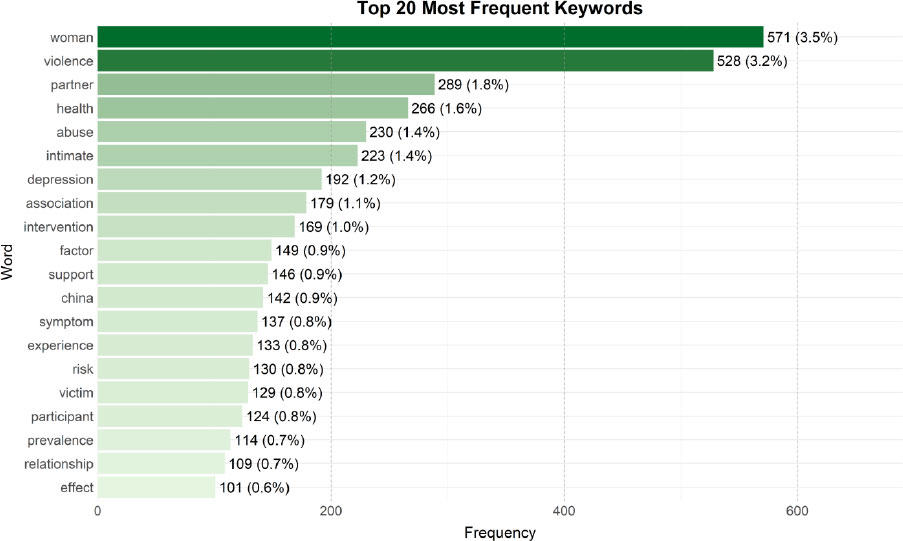
Frequency of the top 20 high-frequency words.
3.2. Topic Identification and Classification
The LDA model (K = 25) identified 25 latent topics, which were semantically grouped into four overarching categories:
• Core Mental Health Consequences
• Risk, Context, and Protective Factors
• Interventions, Treatments, and Support Systems
• Research Methodology and Policy Perspectives
As shown in Fig. (5), the largest share of topics fell under risk, context, and protective factors (32.00%), followed by interventions and support systems (24.00%) and research methodology and policy perspectives (24.00%). Core mental health consequences accounted for 20.00%. This distribution suggested a shift in research focus from mental health symptoms alone to broader structural determinants and systemic responses. Table 1 provides the full list of topic labels, representative keywords, and their category assignments.
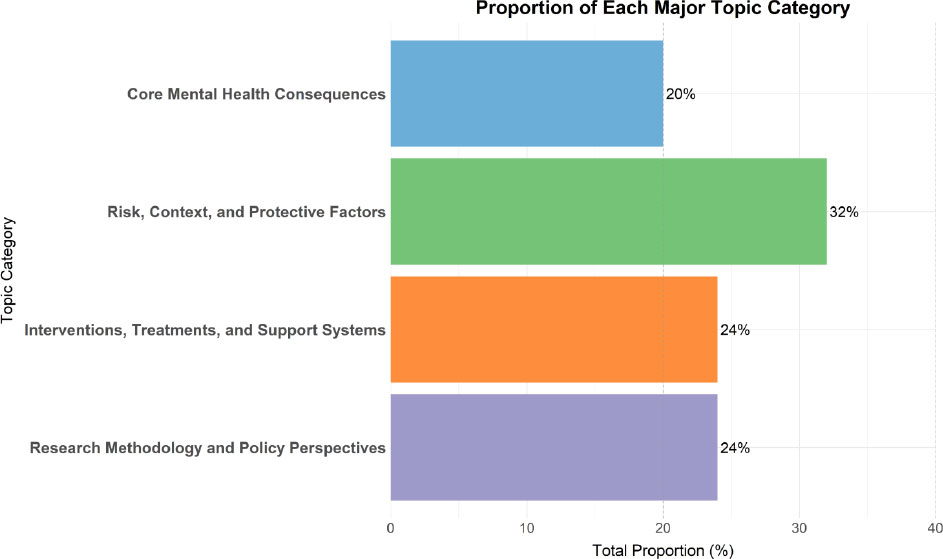
Proportional distribution of 25 topics by category.
| Category | Weight (%) | Topic Name | Representative Keywords |
|---|---|---|---|
| Core Mental Health Consequences | 3.999 | Perinatal Mental Health and Suicide Risk | Pregnancy, depression, score, preced, suicide, individual, wife, wellbe, mediate, followup |
| 4.001 | PTSD and Depression | Victim, associate, ptsd, depression, childhood, influence, severity, program, training, attribute | |
| 4.000 | Postpartum Depression and Suicidal Ideation | Compare, ppd, ideation, injury, form, future, change, search, approach, develop | |
| 4.001 | Marital Abuse and Anxiety Disorders | Abuse, anxiety, disorder, marry, identify, collect, husband, male, prevention, treatment | |
| 3.999 | Correlational Studies of Violent Behaviors | Finding, suffer, type, control, perpetration, follow, correlation, selfharm, increase, bia | |
| Risk, Context, and Protective Factors | 4.000 | Victimization and Adjustment of Vulnerable Groups | Child, survivor, status, victimization, hospital, adjust, develop, emergency, fsw, survey |
| 4.000 | Violence Risks in Migrant/Immigrant Families | Family, suicidal, mother, perceive, worker, migrant, metaanalysis, children, reveal, development | |
| 3.999 | Long-term Effects of ACEs | Intimate, effect, quality, week, ace, nurse, burden, discuss, improve, family | |
| 4.001 | Intimate Partner Relationships in Immigrant Populations | Partner, immigrant, suggest, understand, study, participate, apply, feature, city, part | |
| 4.000 | Risk Pattern Identification of Adverse Events | Participant, risk, examine, year, cop, service, adverse, pain, demonstrate, pattern | |
| 4.001 | Family Relationship Stress and Psychological Distress | Relationship, report, stress, need, interview, association, depression, complete, father, parent | |
| 3.999 | Social Support and Help-Seeking Behaviors | Support, woman, age, history, helpseek, work, characteristic, adults, evidence, confidence | |
| 3.999 | Substance Abuse and Sexual Violence/Satisfaction | Have, conduct, result, impact, satisfaction, sex, alcohol, month, assault, violence | |
| Interventions, Treatments, and Support Systems | 3.999 | Intervention Strategies from a Lifetime Health Perspective | Health, behavior, aim, lifetime, tactic, event, effort, source, item, pubm |
| 3.999 | Community Intervention and Media Advocacy | Cus, community, conflict, indicate, article, focus, men, media, pnd, awareness | |
| 3.999 | Interventions and Screening Tools | Intervention, prevalence, screen, measure, difference, associations, population, marriage, tool, trial | |
| 4.002 | Web-based Health Management and Treatment | Woman, problem, investigate, abuse, models, link, nonabuse, management, treat, web | |
| 4.000 | Group Counseling and Quality of Life | Group, life, reduce, care, find, review, lack, childbirth, style, aor | |
| 3.999 | Symptomatology and Alternative Therapy Exploration | Symptom, include, violence, explore, receive, method, qigong, establish, mean, rs | |
| Research Methodology and Policy Perspectives | 3.999 | Application of Quantitative Analysis and Statistical Models | Regression, levels, model, address, victimization, consider, controller, analyze, estimate, violence |
| 3.999 | Database-driven Evaluation and Substance Abuse | Time, rate, abuse, evaluate, database, class, student, strategy, sample, drug | |
| 4.003 | Assessment Tools and Clinical Practice Guidelines | Violence, help, assessment, practice, review, province, epd, people, inventory, become | |
| 3.999 | Research Design and Experimental Methods | Factor, assess, months, information, literature, variable, randomize, condition, subject, strength | |
| 4.000 | Questionnaire-based Assessment of Resilience | Use, women, show, depression, questionnaire, gender, resilience, center, consequence, number | |
| 3.999 | Policy Implications from the Chinese Experience | China, experience, data, role, aggression, response, make, healthrelate, implication, plan |
Note: Standard abbreviations include: ppd (postpartum depression), epd (Edinburgh Postnatal Depression), aor (adjusted odds ratio), fsw (female sex worker), ace (adverse childhood experience), and pnd (postnatal depression). Recognizable word stems or compound forms resulting from preprocessing include: nonabuse (non-abuse), selfharm (self-harm), metaanalysis (meta-analysis), helpseek (help-seeking), healthrelate (health-related), wellbe (well-being), followup (follow-up), and bia (bias). Terms such as pubm, cus, and rs are likely artifacts generated during the preprocessing stage and do not correspond to meaningful concepts.
3.3. Topic Trends Over Time (2000-2024)
To examine how topic attention evolved over time, the annual frequency of each topic was tracked from 2000 to 2024. These trends are visualized by category in Figs. (6-9). In these figures, the X-axis represents publication year (2000–2024), and the Y-axis represents the number of documents per year in which each topic appeared as the dominant theme.
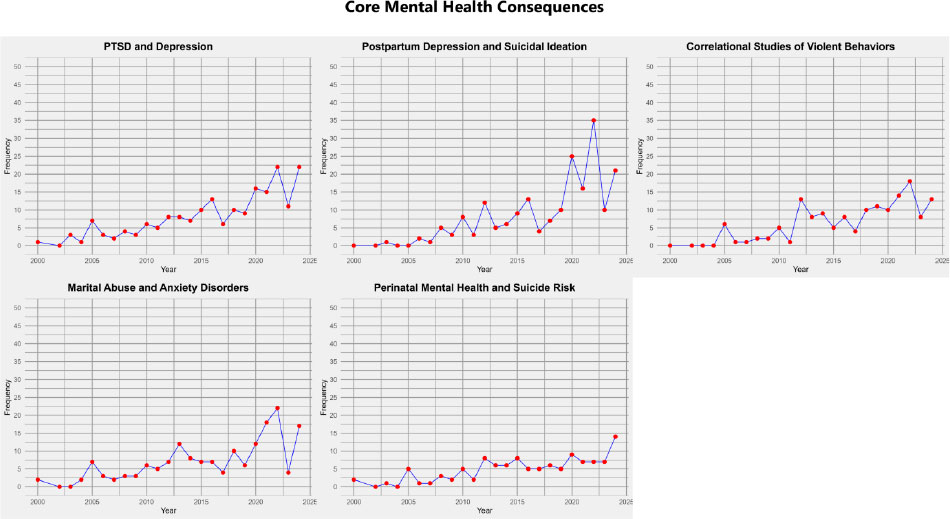
Annual frequency trends (2000–2024) of topics under category a core mental health consequences.
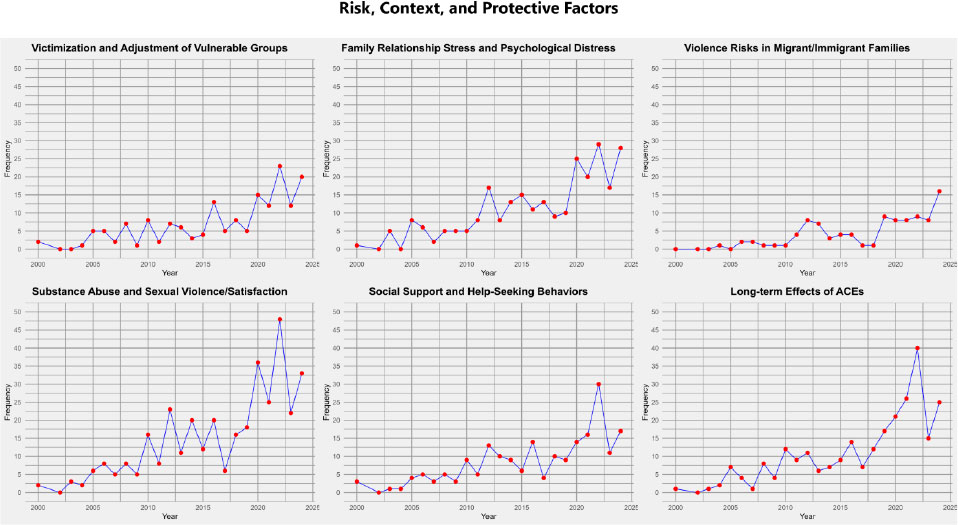
Annual frequency trends (2000–2024) of topics under category B risk, context, and protective factors.
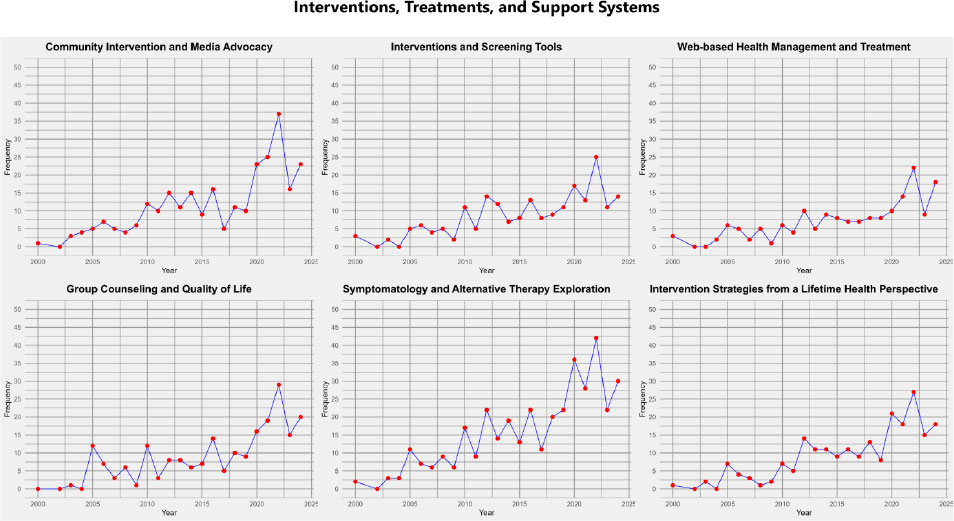
Annual frequency trends (2000–2024) of topics under category C interventions, treatments, and support systems.
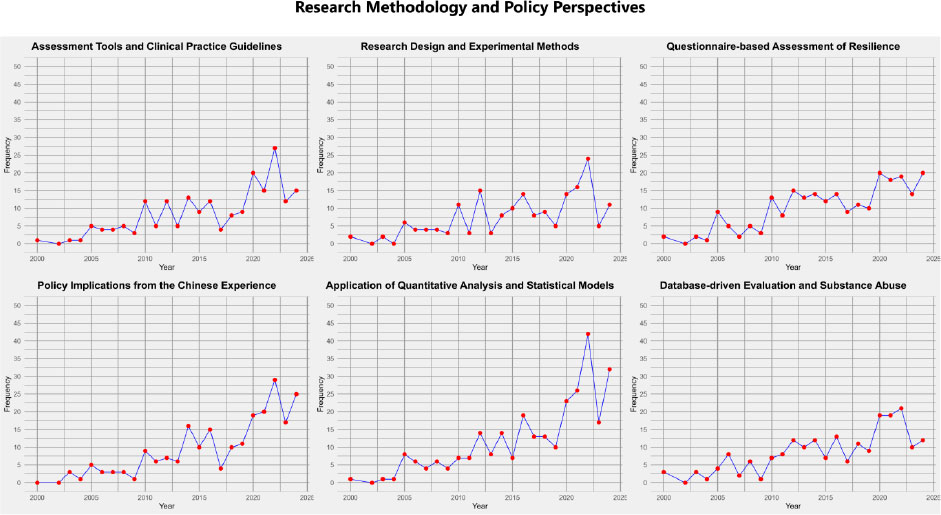
Annual frequency trends (2000–2024) of topics under category D research methodology and policy perspectives.
As shown in Fig. (6), topics under core mental health consequences generally followed a stable or modestly upward trend. Postpartum depression and suicidal ideation rose markedly between 2019 and 2021, peaking at approximately 35 instances. PTSD and depression also increased steadily, reaching around 28 instances in the same year. Other topics, including marital abuse and anxiety disorders and correlational studies of violent behaviors, displayed fluctuating patterns with local peaks around 2021. Perinatal mental health and suicide risk remained less prevalent, peaking at around 10 instances.
In Fig. (7), topics under risk, context, and protective factors showed the most pronounced growth. Substance abuse and sexual violence/satisfaction emerged as the most frequently identified topic in 2021, with approximately 50 instances. Long-term effects of adverse childhood experiences (ACEs) and social support and help-seeking behaviors also saw substantial increases, peaking at about 40 and 35 instances, respectively. Topics related to immigrant populations, family stress, and cumulative vulnerability demonstrated consistent upward movement, particularly after 2015.
Figure 8 displays the trend for interventions, treatments, and support systems. This category reflects growing diversity and an increasing focus on digital and nontraditional approaches. Symptomatology and alternative therapy exploration and web-based health management and treatment experienced significant growth after 2018, peaking at around 40 and 25 instances in 2021. Community intervention and media advocacy reached a local peak in 2019, while interventions and screening tools showed steady gains over the two-decade span.
As shown in Fig. (9), topics under research methodology and policy perspectives followed a pattern aligned with major policy milestones. The application of quantitative analysis and statistical models rose sharply after 2015, peaking at approximately 40 instances in 2021. Policy implications from the Chinese experience saw major surges around 2016 and again in 2021, potentially reflecting the impact of China’s Anti-Domestic Violence Law. Other topics, such as assessment tools and clinical practice guidelines, experimental methods, and questionnaire-based resilience measurement, remained moderately represented, typically ranging between 15 and 25 instances. Database-driven evaluation and substance abuse showed local peaks in 2015 and 2020.
4. DISCUSSION
This study applied LDA to systematically map the English-language research landscape concerning DV and mental health among Chinese women from 2000 to 2024. By integrating topic modeling with temporal analysis, our findings revealed the thematic architecture, dynamic patterns, and structural gaps within this domain. This approach provided an empirical grounding for understanding how knowledge about violence and mental health in a non-Western context is constructed and represented within international academic discourse.
4.1. Thematic Evolution: A Paradigm Shift toward Structural Determinants
To fulfill the promise of a detailed theoretical interpretation, we analyzed the distribution of the 25 identified topics across the four levels of the social-ecological model (Table 2). This analysis revealed a substantive paradigm shift, moving from a primary focus on the individual level toward a more comprehensive, multi-level understanding.
| Ecological Level | Representative Topics from the Corpus | Thematic Focus |
|---|---|---|
| Individual | Perinatal Mental Health and Suicide Risk; PTSD and Depression; Postpartum Depression and Suicidal Ideation; Symptomatology and Alternative Therapy Exploration; Correlational Studies of Violent Behaviors. | Focuses on the direct psychological and behavioral consequences for the survivor. This level received the most consistent attention over the years. |
| Relational | Marital Abuse and Anxiety Disorders; Long-term Effects of ACEs; Intimate Partner Relationships in Immigrant Populations; Family Relationship Stress and Psychological Distress; Social Support and Help-Seeking Behaviors; Substance Abuse and Sexual Violence/Satisfaction; Violence Risks in Migrant/Immigrant Families. | Examines dynamics within intimate partnerships and family environments. This level has seen significant growth, especially in research on childhood experiences (ACEs) and social support networks. |
| Community | Victimization and Adjustment of Vulnerable Groups; Community Intervention and Media Advocacy; Interventions and Screening Tools; Web-based Health Management and Treatment; Group Counseling and Quality of Life; Intervention Strategies from a Lifetime Health Perspective. | Addresses the community-level systems and settings where survivors interact, such as healthcare, social services, and digital platforms. Research in this area, particularly on interventions, has grown post-2016. |
| Societal | Application of Quantitative Analysis and Statistical Models; Database-driven Evaluation and Substance Abuse; Assessment Tools and Clinical Practice Guidelines; Research Design and Experimental Methods; Questionnaire-based Assessment of Resilience; Policy Implications from the Chinese Experience; Risk Pattern Identification. | Pertains to broad societal factors, including laws, policies, cultural norms, and research methodologies that shape the field. This level shows a marked increase in attention following the 2016 Anti-Domestic Violence Law, reflecting a shift toward systemic and evidence-based approaches. |
As Table 2 illustrates, the research landscape has evolved significantly. Early scholarship predominantly documented individual-level psychological sequelae, including depression, anxiety, and PTSD, establishing prevalence but offering limited insight into causal mechanisms. From 2016 onward, however, thematic complexity increased markedly, reflecting a transition toward upstream social determinants aligned with the social-ecological model [31, 32]. The growth in research on relational factors is particularly evident. For instance, increased attention to the long-term effects of adverse childhood experiences (ACEs) [59-62], family relational stress [30, 63], and migration-related vulnerabilities exemplifies a growing recognition that individual-level trauma is embedded within broader structural contexts [64-67].
This acceleration coincides with China's Anti-Domestic Violence Law [35]. While topic modeling cannot establish causation, several mechanisms plausibly explain this pattern: landmark legislation legitimizing DV as a research priority, unlocking funding streams [38], and facilitating institutional access for researchers. Alternative explanations include the global #MeToo movement [68], China's participation in the WHO Global Plan of Action [69], and methodological advancements in trauma research. Disentangling these influences requires citation network analysis and systematic policy document reviews, which are beyond the scope of the present study.
From a social-ecological perspective, this thematic evolution revealed growing attention to relational (marital conflict, family dysfunction) and community-level factors (social support networks, migration stress). While topics at the societal level related to policy and research methodology have accelerated, other crucial structural determinants, such as gender norms, economic inequality, and the detailed functioning of the judicial system, remain analytically underexplored. This international comparison further highlighted a key divergence: the broader international literature allocates substantial attention to perpetrator psychology and batterer intervention programs [70, 71], whereas our corpus detected minimal offender-focused research, reflecting a victim-centric bias consistent with other East Asian contexts [42].
4.2. Critical Research Gaps and Underlying Mechanisms
Three major omissions constrain the field's capacity to inform prevention and intervention.
4.2.1. The Missing Perpetrator
The near-absence of perpetrator-focused research hinders the development of evidence-based batterer intervention programs, which are crucial for breaking cycles of violence beyond symptom treatment in victims. This gap arises from (1) ethical and logistical barriers, including recruiting perpetrators and low voluntary participation; (2) cultural stigma against framing husbands as offenders requiring treatment [29, 42]; and (3) historical victim-advocacy origins of DV research [6].
Addressing this gap requires methodological innovation, such as court-mandated intervention settings, anonymous surveys on aggression norms, and dyadic couple analysis with safety protocols. China's 2016 law mentions offender education but lacks implementation guidelines [38, 40], highlighting a policy vacuum.
4.2.2. The Perinatal Paradox
Despite evidence identifying pregnancy as a high-risk period for DV onset and escalation [59, 72], perinatal topics remain infrequent. DV during pregnancy increases preterm birth, low birth weight, postpartum depression, and maternal suicide [22, 73]. This persistent research gap is particularly striking, given that studies within our own corpus, such as that of Zhang et al. (2012) [22], have already highlighted the significant association between DV and postnatal depression among Chinese women, signaling the urgency of the issue. The gap likely reflects methodological challenges, fragmented healthcare services, and cultural silence regarding marital conflict disclosure during pregnancy [72]. This underrepresentation of perinatal DV contrasts with the extensive body of research on this topic in broader international literature contexts, where it is recognized as a critical public health issue [74].
4.2.3. Socioeconomic Consequences Overlooked
A third omission is inattention to DV's long-term economic outcomes, such as employment disruption, educational attainment, financial independence, and intergenerational poverty transmission [75-78]. While mental health dominates the corpus, DV functions as a structural barrier to economic mobility: chronic PTSD/depression impairs productivity [16]; controlling partners sabotage education/employment [79]; and exposed children face elevated school dropout and poverty risks [77, 78]. This gap reflects disciplinary silos, as mental health and economic research remain largely unintegrated. This omission is particularly noteworthy when compared to the growing body of broader international literature on the economic costs of DV, which highlights its role in perpetuating cycles of poverty and hindering women's economic empowerment [80].
4.3. Translating Evidence into Policy and Practice
The findings highlight three evidence-informed priorities for improving DV responses in China. First, integrating mental health screening into DV service pathways is essential. PTSD, depression, and anxiety collectively accounted for 12% of the research corpus, yet most shelters and legal aid centers still lack trained professionals and standardized screening procedures [81]. Embedding validated mental health assessments at intake and referral points, alongside training staff in trauma-informed communication, could enable early identification and more effective referral for survivors. Second, the lack of perpetrator-focused research mirrors a policy infrastructure void [38-40]. Pilot programs adapted to the Chinese context and systematically evaluated with evidence-based frameworks are necessary to develop national standards for offender intervention. Third, attention should be directed toward high-risk populations, such as migrants, pregnant women, and rural residents. Although research interest in these groups has increased, targeted service models remain limited. Integrating DV screening into prenatal care, deploying community health workers in migrant-dense areas, and establishing elder abuse task forces may address current service disparities.
4.4. Methodological Contributions and Limitations
The methodological contributions of this study include several key strengths. First, the use of LDA enabled scalable analysis of 179 abstracts, providing comprehensive coverage of the literature. Second, the initial extraction process was largely objective, minimizing confirmation bias inherent in manual reviews [82]. Third, LDA allowed precise temporal tracking, revealing patterns, such as thematic shifts, following 2016. Finally, the approach facilitated interdisciplinary synthesis by linking concepts across domains, for example, connecting adverse childhood experiences with adult DV research. Topic modeling in this context complements, rather than replaces, traditional literature reviews, serving as a valuable tool for preliminary scoping before in-depth synthesis.
Despite these strengths, several limitations should be acknowledged. Restricting the analysis to English-language publications may have introduced topical, methodological, and cultural framing biases [35, 83, 84]. Relying solely on abstracts may have limited access to detailed methods, contextual information, and negative findings, prioritizing breadth over depth [50]. Finally, the analysis has been constrained by both technical and interpretive challenges. On a technical level, the preprocessing pipeline, while robust, occasionally yielded source-specific artifacts (e.g., 'pubm', 'cus') stemming from database formatting; their presence highlighted the challenge of balancing computational efficiency with semantic fidelity in natural language processing for social science research [85, 86]. On an interpretive level, topic labeling involves subjective judgment. Both challenges were mitigated through our systematic dual-author review process, where such artifacts were manually excluded, and a consensus on topic labels was reached.
CONCLUSION
This study conducted a quantitative analysis of English-language literature published between 2000 and 2024 on DV and mental health among Chinese women. The findings revealed a marked shift in the research agenda from early descriptive accounts of psychological trauma (e.g., depression, anxiety) toward a structural investigation of the root causes of violence. Increasing attention has been paid to upstream social determinants, such as adverse childhood experiences, dysfunctional family dynamics, and social isolation. This thematic evolution, particularly after the implementation of China’s Anti-Domestic Violence Law in 2016, reflects a broader transition from advocacy-based narratives to evidence-driven evaluation, underscoring a more mature public health understanding of DV.
Despite this progress, our analysis has identified several critical knowledge gaps hindering the effectiveness of intervention strategies. Existing research remains largely victim-focused, with limited examination of perpetrator psychology or behavioral mechanisms, thereby constraining insights into the cycle of violence. High-risk subpopulations, such as perinatal women, rural residents, and older adults, are severely underrepresented. In addition, the long-term socioeconomic consequences of DV, such as employment disruption and intergenerational poverty, are insufficiently integrated into current analytical frameworks. These omissions weaken both the targeting precision of preventive strategies and the continuity of support services.
This study argues for a paradigmatic shift from description to prediction and intervention. Future research must move beyond siloed approaches and aim to construct an integrated framework that connects mental health, social structures, and policy responses. This calls for methodological innovation, especially through interdisciplinary collaboration and longitudinal study designs to trace risk trajectories and evaluate long-term intervention outcomes. Most importantly, efficient knowledge translation pipelines are needed to embed empirical findings into mainstream health and justice systems, transforming research into actionable tools, service pathways, and institutional safeguards. China’s experience not only strengthens local health system development but also provides a vital case for the global adaptation of DV intervention strategies across diverse cultural and institutional contexts.
AUTHORS’ CONTRIBUTIONS
The authors confirm their contribution to the paper as follows: X.L.: Study conception and design; K.S.: Validation. All authors reviewed the results and approved the final version of the manuscript.
LIST OF ABBREVIATIONS
| DV | = Domestic violence |
| IPV | = Intimate partner violence |
| PTSD | = Post-traumatic stress disorder |
| LDA | = Latent Dirichlet allocation |
| ACE/ACEs | = Adverse childhood experience(s) |
| PPD | = Postpartum depression |
| AOR | = Adjusted odds ratio |
| FSW | = Female sex worker |
| PND | = Postnatal depression |
AVAILABILITY OF DATA AND MATERIALS
All data generated or analyzed during this study are included in this published article.
ACKNOWLEDGEMENTS
This research work was supported by the Universiti Sains Malaysia through its academic infrastructure and resources.