All published articles of this journal are available on ScienceDirect.

Identifying and Understanding the Patterns of Handwriting Difficulties among School Students in North Chennai, South India
 Sethuraman Lakshmanan2
Narasimhan Udayakumar3
Aladi Gokul1
Ramachandran Padmanabhan3
Sethuraman Lakshmanan2
Narasimhan Udayakumar3
Aladi Gokul1
Ramachandran Padmanabhan3
Authors Info & Affiliations
Abstract
Background
The skill of handwriting is one of the fundamentals that aid in the early academic success, both cognitive and motor development. Dysgraphia is a neurological condition of children that affects their handwriting, thus they usually perform poorly in school. The developmental learning issues should be identified early so that effective interventions can be undertaken.
Methods
In this cross-sectional study, the researchers evaluated handwriting proficiency in 878 children (6 to 7 years old) with the help of the Screener of Handwriting Proficiency (SHP) tool. The participants were assessed according to their age, gender identity, and for learning environment. The first consequence was that handwriting problems were widespread.
Results
In general, 31.7 percent of children had handwriting problems. The prevalence was high among males (35.9) as compared to females (27.1). It was observed that handwriting problems were a little bit higher among six-year-olds (32%), as compared to seven-year-olds (30.3%). There was a considerable difference among the schools with a range of prevalence of between 16.1% and 64.2%.
Discussion
The results suggest that the handwriting problems are prevalent among the early elementary school students with prominent gender and age variation. The large range of difference in schools implies that the school environment might contribute to development of handwriting. The relevant implications of these findings are the necessity of systematic screening in schools.
Conclusion
Handwriting problems are common during early years and may have adverse effects on the academic developments when not addressed. Frequent evaluations and intensive early interventions are important in helping affected students with the growth of the threat of educational challenges in the long term.
1. INTRODUCTION
Writing is a fundamental skill that children need to succeed in school, particularly in the early stages of learning. Effective writing is a crucial skill that children should develop to effectively communicate information and avoid academic difficulties as they mature [1, 2]. When engaging in creative writing, learners must simultaneously execute multiple physical and cognitive processes, initiating and completing them [3]. The methods that have been discussed include concept mapping, structuring, composition, spelling, punctuation, grammar, metacognition, evaluation, and handwriting integration [4, 5]. The tasks mentioned above are prime examples of why young learners must attain expertise in handwriting.
Dysgraphia is a characteristic learning disorder that impairs the process of writing and prevents the acquisition of written language [6, 7]. This is a problem that poses a lot of challenges within the educational setting, where the clarity and ease of writing are very important. The most common problems that are often mentioned in relation to referring school-age children include learning disabilities and difficulties, and one of the most common problems is handwriting problems [8]. These issues can manifest as problems with letter shape and size, word spacing, and inaccuracies in popular phrases during handwriting, affecting the overall quality of the written work [9].
The effects of challenges associated with handwriting are not limited to the school setting but also affect other aspects in the lives of the learners [10]. This also influences the academic performance of the child as they can hardly write legible work and achieve the learning objectives. A lack of manual writing skills is observed among school-aged children, and studies show that up to 34% of these children are affected [11]. This incidence is particularly high among children with developmental and learning problems. Early insights and prompt intervention regarding this particular group are vital considerations [12].
Handwriting instruction involves numerous necessary preparation skills and principles [13]. Some examples include the use of hands to maintain balance, independent manipulation and placement of objects, and the development of fine motor skills through different activities in early communication contexts [14]. The process of acquiring handwriting skills among children directly depends on the possibility to interact freely, actively, and properly with the surrounding world [15]. Moreover, one must possess a minimum level of knowledge about the alphabet and the rules of writing, as well as the ability to read and process printed text.
Dysgraphia occupational therapy interventions are formulated based on the child's impairments and challenges [16]. The interventions can include the development of fine motor skills and hand-eye coordination, and the inclusion of solutions that are specific to the needs of students with the disease [7]. Intervention style depends on important factors like age of the child, specific issues or learning disability, and overall development [17]. The research problem of this study is to determine the prevalence of handwriting problems among first-grade students in North Chennai. Thus, this study aims to establish the extent of these problems to emphasize the need to intervene and provide support to young students at an early age. If this group encounters significant challenges regarding handwriting, it will guide the development of intervention measures and educational programs that can be used to improve the handwriting of children in this area.
2. METHODOLOGY
2.1. Study Design and Participants
A cross-sectional study was conducted using multi-stage sampling procedures to assess the handwriting difficulties of first-grade students in North Chennai. The study participants were required to meet particular inclusion and exclusion criteria, which were developed to classify them accordingly. The study included children in their early education stages, specifically between the ages of six and seven. The exclusion criteria included a memory subscore of more than 13 mistakes on the SHP analysis and the presence of neurological problems in development, congenital disorders, psychiatric illnesses, or orthopedic disorders affecting the upper limbs and trunk.
2.2. Sampling Procedure
A multi-stage random sampling technique was employed. In the first stage, 4 out of the 10 wards in Perambur, North Chennai, were randomly selected. In the second stage, 3 neighborhoods were randomly selected from each of the 4 chosen wards, yielding a total of 12 neighborhoods. Finally, from a comprehensive list of all schools within these 12 neighborhoods, 9 schools were selected using systematic random sampling for final inclusion in the study. Nine schools were selected using a multistage random sampling procedure. From the identified wards in North Chennai, Tamil Nadu, India, neighborhoods were first randomly selected, followed by the random selection of schools within these neighborhoods. Screening a school involved multiple criteria and required following various processes. The nine schools included in the study were a diverse array of government, private, and government-aided institutions of varying sizes and socioeconomic backgrounds. Schools 1, 3, and 8 were modest private English institutions catering primarily to the middle and upper classes, while schools 2, 5, and 9 were huge government Tamil schools predominantly attended by pupils from disadvantaged backgrounds. Schools 4 and 7 were government-aided schools that employed a multilingual medium of instruction and exhibited a diverse socioeconomic profile. School 6 was a substantial, private institution that offered instruction in English, primarily catering to middle-income families in metropolitan areas. The variety in school types, instructional media, and student backgrounds provided a comprehensive framework for evaluating handwriting difficulties across diverse educational settings. A total of 878 first-grade students at the selected schools were included in the sample.
2.3. Informed Consent
Informed consent involves an individual giving explicit agreement after being provided with the relevant information and understanding the potential risks and benefits involved. As the participants were children, parental agreement was necessary before commencing the study. During this procedure, the parents were informed about the study's purpose, the procedures that would be followed, and the confidentiality of the data collected. Only children whose parents provided consent were included in the study.
2.4. Assessment Tool
The Screener of Handwriting Proficiency (SHP) tool assessed the participant's handwriting skills. The SHP is a comprehensive tool that enables teachers and educators to identify fundamental skills and metrics essential for students to learn handwriting [18]. It also collects formative and summative data on each learner's handwriting skills, identifying areas that may need improvement in relation to the overall curriculum and specific teaching methods.
2.5. Data Collection
The participants were evaluated using the SHP for an overall assessment. To ensure consistency, the evaluation took place within the school premises, specifically among the student population. Research analysts utilizing standardized health protocols ensured that participants were evaluated consistently to reduce discrepancies.
2.6. Data Analysis
The collected data were fed into Microsoft Excel (MICROSOFT 2019) for initial data management. The data were analyzed using the Statistical Package for the Social Sciences (SPSS) version 16, with an advanced Student Statistical License [19]. Before conducting the analysis, descriptive statistics were obtained to gain a comprehensive overview of the data. In inferential statistics, a significance level of 0.05 was considered adequate to establish statistical significance. This implies that the likelihood of the observed results being due to chance was low.
2.7. Ethical Considerations and Constraints
The study adhered to established ethical protocols, including obtaining parental consent from participants and safeguarding the confidentiality of their information. Any research carried out must adhere to the given ethical standards; therefore, the research protocol was submitted to the relevant Institutional Review Board (IRB) for approval. Furthermore, the study's methodology relied solely on the SHP as the assessment tool, potentially overlooking other characteristics of handwriting proficiency. Further research could involve using multiple assessment measures and broadening the selection criteria for participants. Thus, this methodological approach offers a framework that helps recognize handwriting problems among first-grade children in North Chennai. Using the multistage sampling method, backed by the SHP, and employing the right approach to data processing makes it possible to achieve the reliability and validity of the findings.
3. RESULTS
3.1. Prevalence of Handwriting Difficulty
Table 1 provides a description of handwriting ability among 878 first-grade children in North Chennai. These statistics indicate that 31% of the respondents possess poor handwriting. The study was particularly carried out on the basis of a cross-sectional survey of students in schools, where 31.7% of them had problems with handwriting. Nevertheless, the other 600 children, who made up 68%, indicated that disadvantaged students need to be given extra help and resources to address handwriting issues. Approximately 68.3% of the participants claimed that they did not have handwriting problems. These results show that there is an increased level of handwriting challenges among individuals with dysgraphia. It is important to identify children with handwriting problems early, as these problems may be chronic. These problems must be given priority because various aspects of dysgraphia have effects on academic achievement as well as the functioning of the brain as a whole. These findings indicate that at least one in every three children needs special intervention to improve their handwriting skills, suggesting that the teaching system should adopt comprehensive handwriting and occupational therapy strategies. Thus, through a proper recognition and response to the challenges mentioned above, teachers and counselors can enhance the academic success and self-esteem of the children affected by writing dysfunction.
| Handwriting Status | Number of Individuals | Percentage |
|---|---|---|
| Handwriting Difficulty | 278 | 31.70% |
| Without Handwriting Difficulty | 600 | 68.30% |
| Total | 878 | 100% |
3.2. Prevalence of Handwriting Difficulty within Different Genders
Figure 1 illustrates the prevalence of handwriting difficulties among first-grade children of both genders in North Chennai. Out of the total 878 participants, 31.7% (278 individuals) exhibited poor handwriting, while the remaining 68.3% (600 individuals) did not. Among the 278 students with poor handwriting, 164 were male, and 114 were female. Overall, 35.9% of males exhibited poor handwriting, compared to 27.1% of females. Conversely, 293 (64.1%) male students and 307 (72.9%) female students reported that they had never experienced handwriting difficulties.
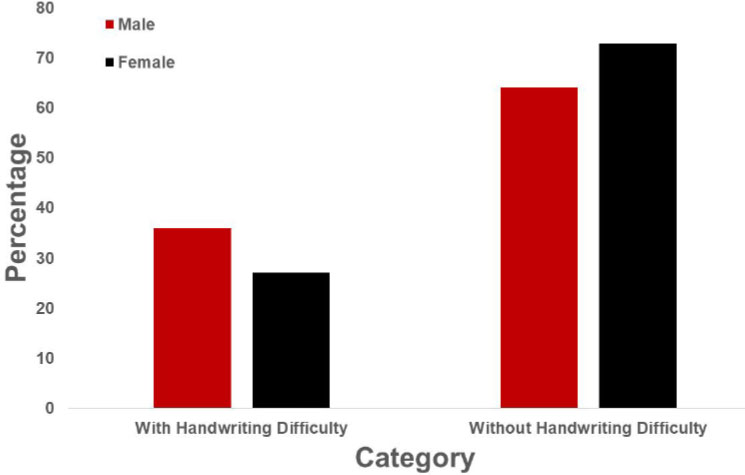
The prevalence of handwriting difficulty among different genders.
This difference indicates that male students are more likely to face handwriting difficulties than female students (p = 0.0063). Based on the results from all participants, it can be concluded that gender differences may influence the development or manifestation of handwriting problems, as a higher proportion of males experience such difficulties. These findings highlight the importance of employing gender-sensitive approaches when investigating and addressing handwriting difficulties in childhood. It is essential to consider targeted interventions for males, who appear to be more susceptible to handwriting difficulties, to improve academic performance and support gender equity in education.
3.3. Prevalence of Handwriting Difficulty among Age Groups
Table 2 summarizes the handwriting problems exhibited by students in North Chennai in the first grade, grouped by age. Out of 694 six-year- old students, 232 (32%) students had handwriting problems, and 494 (68%) did not exhibit the handwriting problems. Of the students aged 7, 46 (30.3%) had handwriting problems, and 106 (69.7%) did not. In general, among all the students (n=877) 278 (31.7%) students were found to have difficulty in handwriting, and the rest (n=600) did not.
According to statistics, about 32% of six-year-olds have handwriting difficulties, which is slightly higher than the rate among seven-year-olds. The age group difference was, however, not statistically significant (p = 0.623). The findings suggest that the students of both age groups have issues with handwriting, and approximately 30% of the students are impacted. This supports the significance of early intervention practice because, as long as handwriting changes are not addressed in time, they may interfere with academic achievement and intellectual growth. The similarity in the number of challenges encountered by both groups of people underscores the need to provide constant support and resources to that group, since the first steps in formal education must be taken to ensure that every child learns to write with a good hand.
| Age | With Handwriting Difficulty | Without Handwriting Difficulty |
|---|---|---|
| 6 | 232 (32%) | 494(68%) |
| 7 | 46(30.3%) | 106(69.7%) |
| Total | (31.7%) 600(68.3%) | |
3.4. Distribution of the Study Based on Various Schools
Table 3 provides a detailed breakdown of the study respondents, who were spread across nine schools in North Chennai. The sample sizes of participants per school and the percentage of the total sample are reported. School 5 had the highest number of participants (253 students, 28.8% of the entire sample), and School 7 had the second highest amount of 163 students (18.6%), and School 6 had 153 students (17.4%). Schools 1 and 8, in turn, were the least represented, with 23 students (2.6% of the overall sample) each. The number of participants in other schools was different, and School 3 provided 93 participants (10.6%), School 2 provided 67 participants (7.6%), School 4 provided 56 participants (6.4%), and School 9 provided 47 participants (5.4%).
| Name of the School | Number of Individuals | Percentage |
|---|---|---|
| School - 1 | 23 | 2.6 |
| School - 2 | 67 | 7.6 |
| School - 3 | 93 | 10.6 |
| School -4 | 56 | 6.4 |
| School - 5 | 253 | 28.8 |
| School -6 | 153 | 17.4 |
| School - 7 | 163 | 18.6 |
| School -8 | 23 | 2.6 |
| School -9 | 47 | 5.4 |
| Total | 878 | 100 |
This distribution shows that there is a variety of student representation across schools; hence, it might provide a holistic picture of the problem of handwriting among this group of students. Nevertheless, differences in the number of participants among the schools may reflect differences in school size or in the rates of willingness to participate. The large number of representatives from some schools, especially School 5, affected the general outcome and should be taken into consideration during interpretation. Knowledge of a school's context and environment could provide additional information on the factors that lead to handwriting difficulties, as well as aid in organizing subsequent interventions.
The data presented in Table 4 provide a detailed analysis of the extent of handwriting difficulties among students from nine schools in North Chennai. The results demonstrate notable disparities in the frequency with which students exhibit substandard penmanship across the participating educational institutions. Among the nine schools, School 2 had the highest proportion of children facing handwriting difficulties (64.2%), with 43 out of 67 students affected. In contrast, School 3 reported the lowest proportion of children with handwriting issues (16.1%).
Additional observations include Schools 4 and 5, where 33.9% (19 out of 56) of students in School 4 and 29.2% (74 out of 253) of students in School 5 experienced handwriting difficulties. According to the data, School 6 reported that 49 out of 153 students (32%) had handwriting difficulties, while School 7 showed a similar trend, with 47 students (28.8%) affected. The prevalence of handwriting issues was also relatively high in Schools 8 and 9, with 34.8% (8 out of 23 students) and 40.4% (19 out of students) affected, respectively.
Upon analyzing the findings, it became evident that School 1 had the lowest number of students with handwriting difficulties, with only 4 out of 23 students affected, accounting for 17.4%.
| Name of the School | Handwriting Difficulty | Without Handwriting Difficulty |
|---|---|---|
| School - 1 | 4(17.4)% | 19(82.6%) |
| School - 2 | 43(64.2%) | 24(35.8%) |
| School - 3 | 15(16.1%) | 78(83.9%) |
| School -4 | 19(33.9%) | 37(66.1%) |
| School - 5 | 74(29.2%) | 179(70.8%) |
| School -6 | 49(32%) | 104(68%) |
| School - 7 | 47(28.8%) | 116(71.2%) |
| School -8 | 8(34.8%) | 15(65.2%) |
| School -9 | 19(40.4%) | 28(59.6%) |
| Total | 278(31.7%) | 600(68.3%) |
The differences in the prevalence of handwriting difficulty across the nine schools are highly significant (p = 8.02 x 10⁻⁸). These differences suggest that certain underlying factors, such as teaching methods, availability of educational resources, or student- related characteristics, may influence the occurrence of handwriting difficulties. The findings indicate that schools with a higher proportion of children experiencing handwriting challenges may benefit from targeted interventions and additional resources to address these issues effectively.
Understanding these distinctions is valuable for developing more appropriate strategies to address and resolve handwriting-related problems across different educational settings.
4. DISCUSSION
The present research shows that there is a great variation in gender in the handwriting difficulty, with more males reporting the problem as compared to females. This observation aligns with Sharma and Khan's (2023) [20] findings, which also showed that male students often experience difficulties with handwriting compared to female students. The factors that could have contributed to this difference might include developmental and cognitive factors, as well as social factors that affect variations in the development of handwriting skill in males and females [21].
In this research, only students in 1st grade participated; this age is critical for the formation and functioning of handwriting patterns. A number of common writing problems were found among the students with poor penmanship. Deficiencies in memory were also common, with illegible letter writing being one such example [22]. The students always made mistakes in formatting as they used uppercase letters instead of lowercase, and they also often forgot the usage of numbers and letters. Such mistakes indicate that these students might need support with the technical aspects of writing, such as letter recognition and memorization. The other area with challenges was orientation, specifically the reversal of letters in upper and lower case. These errors are signs of the weakness of spatial orientation and visual-motor coordination, without which proficient handwriting will not be possible [23]. The factual data showing that these abilities are lacking in a large group of students justifies the need to explore measures to prevent the consequences of such cognitive and motor disorders.
Moreover, a majority of the students showed a preference towards cursive writing over manuscript writing. This is contrary to the recommendation of Morales-Rando et al. (2021) [24], who found that students preferred writing manuscripts. This preference may have different causes, including a constant handwriting style, which may be more convenient or effective for some children. However, the interest in using cursive writing raises concerns about the instructional process and the organization of philosophy. This suggests that it may be necessary to explicitly instruct manuscript writing in order to help children gain the required competencies [25].
Handwriting is greatly affected by the physical aspects of classroom furniture, such as the way the desks are arranged, how the working surface is organized, and the positioning of pupils when they are writing. Studies on replacing chairs with stability balls in classrooms clearly indicate that ergonomics is a significant issue [26]. Unfortunately, the current study did not have the opportunity to examine the factors that can have a substantial influence on students' writing ability. Ergonomic conditions may lead to the minimization of physical tension and the achievement of a positive writing posture, which is among the necessary skills that young students should learn.
Chu (1997) defines occupational therapy assessment as including the setting, components, and areas of performance [27]. When designing program objectives, evaluation statistics are paramount for accurately estimating the program's value in relation to its goals and timeframes. A child with poor handwriting can use the help of an occupational therapist. It could be beneficial to follow the specialist's guidance and apply a specific handwriting improvement treatment to a child based on their needs [17]. Teachers and other school staff can offer invaluable assistance to occupational therapists in tackling writing problems by involving students in fine-motor coordination activities, providing activities that encourage maximum alertness during writing, and setting up classroom conditions that support the optimal writing position [28]. Unlike traditional practices that mostly emphasize fixing illegible handwriting, these interventions aim to increase students' self-confidence, general academic performance, and handwriting skills.
The high range of variance in individual school incidence (16.1%- 64.2%) suggests that contextual and environmental variables may be important in the development of handwriting. Possible causes include differences in pedagogical strategies, access to educational materials, classroom ergonomics, and socioeconomic inequalities between student groups. Although these attributes were not tested in the current study, future studies should critically test these attributes to help better understand their role in handwriting problems and to guide specific interventions.
The outcomes of the present research also confirmthe necessity of identifying and remedying the problems of students with poor penmanship as soon as possible. Through these problems, instructors and therapists can avert the negative effects of poor handwriting on learners' learning performance and overall thinking. Therefore, there is an urgent need to introduce handwriting assessment into the educational system and to implement the necessary support programs that will help children develop effective handwriting skills that correspond to their academic needs.
CONCLUSION
Writing is an important field in occupational therapy. The necessity of well-coordinated evaluations and interventions to fix the handwriting of students and improve their performance and confidence cannot be overestimated. Occupational therapists must use accurate, correct, and efficient methods to rectify the handwriting problems of students. The present study highlights the need to identify handwriting problems in educational systems early and deliver specific support and interventions to address the needs of learners. With the adoption of reciprocal teaching, ergonomic principles, and targeted instruction, issues related to handwriting would be reduced, and all children would be able to master the skills that would help them achieve academic success and further development. In short, the solution to handwriting problems in primary education can be considered part of a larger program aimed at the overall development of children and the improvement of their writing skills.
Nonetheless, this research has some limitations that should be acknowledged. It was conducted in a small region of North Chennai, which could limit the generalizability of the results to other groups with different cultural, linguistic, or educational backgrounds. The cross-sectional design limits the ability to draw causal conclusions about the relationship between demographic or environmental factors and handwriting problems. Also, handwriting skills were only measured with the help of the Screener of Handwriting Proficiency (SHP) device; a single tool might not reflect the entire range of handwriting difficulties. Lastly, possible confounding factors (such as ergonomic factors, classroom environment, furnishings, and posture) and teacher influences were not systematically evaluated, even though they might have contributed to the outcome (handwriting performance). Future research can be enhanced by using longitudinal measures, validated tools, and other contextual variables to create a more integrated picture of the problem of handwriting.
AUTHORS' CONTRIBUTIONS
The authors confirm their contributions to the paper as follows: P.R.: Study conception and design; P.R., S.L., and N.U.: Data collection; P.R., A.G., and R.P.: Analysis and interpretation of results; draft manuscript: PR. All authors reviewed the results and approved the final version of the manuscript.
LIST OF ABBREVIATIONS
| IRB | = Institutional Review Board |
| SHP | = Screener of Handwriting Proficiency |
| SPSS | = Statistical Package for the Social Sciences |
ETHICS APPROVAL AND CONSENT TO PARTICIPATE
This study was approved by the ethics committee of Sri Ramachandra Institute of Higher Education and Research, India [CSP/22/NOV/118/578].
HUMAN AND ANIMAL RIGHTS
All procedures performed in studies involving human participants were in accordance with the ethical standards of institutional and/or research committee and with the 1975 Declaration of Helsinki, as revised in 2013.
AVAILABILITY OF DATA AND MATERIALS
The data are available from the corresponding author [P.R] upon reasonable request, provided the approval is obtained from the institutional review board of the university.
ACKNOWLEDGEMENTS
Declare none.