All published articles of this journal are available on ScienceDirect.

Prevalence and Predictors of Cigarette Smoking Stages among Male High School Students in Shahroud, Iran: A Latent Class Analysis
 iD
iD
Authors Info & Affiliations
Abstract
Introduction
The aim of this study was to determine the prevalence of cigarette smoking stages and their predictors among male students using the Latent Class Analysis (LCA).
Methods
In this cross-sectional study, a questionnaire was administered to 1,100 adolescent male high school students in Shahroud, northeastern Iran. This study assessed their smoking behavior, attitudes, normative beliefs, and socio-demographic data. Smoking stages were classified based on a validated adolescent smoking behavior algorithm encompassing four smoking behavior indicators, and LCA was then used to identify distinct smoking behavior classes.
Results
The three-class model was the one with the best fit (AIC3 = 1511.53). This model indicated an adequate fit and provided the most parsimonious and interpretable classification of smoking behaviors. The classes were named: non-smokers (prevalence: 75.4%, 95% CI: 72.7 –77.9%), experimental smokers (18.0%, 95% CI: 15.8-20.4%), and regular smokers (6.6%, 95% CI: 5.2-8.3%). These classes reflect a behavioral continuum ranging from no smoking experience to experimentation and regular cigarette use. A higher grade point average (GPA) was associated with lower odds of being an experimental smoker (adjusted OR = 0.78, 95% CI: 0.65–0.94). More positive attitudes toward smoking (adjusted OR = 1.90, 95% CI: 1.63–2.22), (Adjusted OR=1.68, 95% CI:1.46-1.94) and more permissive norms regarding cigarette use (adjusted OR = 1.48, 95% CI: 1.10–1.98), (adjusted OR = 1.46, 95% CI: 1.11–1.92) were associated with increased odds of membership in higher-risk smoking classes (exprimental and regular smoker, respectively). Living with parents was also associated with smoking class membership.
Discussion
The LCA distinguished three different classes regarding the smoking behavior of males during adolescence. Regular smoking was less common than the figures mentioned for some adolescent populations around the world. Attitudinal and normative aspects were the main determinants of the classification into smoking classes.
Conclusion
The study highlights that smoking-related attitudes and norms should be addressed in adolescent smoking prevention programs for male students, especially for students with lower academic performance or non-traditional living arrangements.
1. INTRODUCTION
Cigarette smoking is a major health risk factor. Global studies indicate that while the prevalence of cigarette smoking has declined from 1990 to 2019, the absolute number of smokers has increased due to population growth [1].
For instance, in the Eastern Mediterranean region, the prevalence of smoking among individuals aged 15 to 24 decreased slightly during this period, yet the total number of smokers increased. In 2019, an estimated 155 million individuals aged 15–24 were smokers globally, with regional variations in prevalence. The Eastern Mediterranean region has shown the least significant decline in cigarette smoking prevalence compared to other regions during this period [1]. Nonetheless, it has to be stated that the direct prevalence comparisons of smoking among diverse studies are usually constrained by factors like age, sex, measurement methods, and culture, which need to be taken into account while interpreting the global figures. Research findings indicate that quitting smoking, especially before the age of 40, can have beneficial effects on preventing and reducing the risk of disease [2].
Adolescence is a critical period of behavioral and psychosocial development, during which individuals experience significant changes in personal traits and are more likely to initiate risky behaviors, including cigarette smoking [3]. Most smokers begin using cigarettes during this stage: approximately 83% of individuals who smoke between ages 14 and 24 start smoking during adolescence, and about 18.5% of them become regular smokers by age [4].
Understanding smoking trends and identifying influential factors during this period are essential for developing effective prevention strategies, as early initiation strongly predicts future dependence and smoking-related health consequences [5]. Smoking behavior classified into three stages: non-smoker (an adolescent who has never smoked), experimenter (an adolescent who has tried smoking at least once but has smoked fewer than 100 cigarettes), and regular smoker (an adolescent who has smoked more than 100 cigarettes in their lifetime) [6].
This research is based on a conceptual framework that asserts that a range of interacting factors influences smoking behavior. Personal traits (like smoking-related views and school grades) are combined with social environmental factors (such as family arrangements and acceptance of smoking among friends) to determine the smoke patterns. Latent Class Analysis (LCA) is a statistical method used for classifying a population into distinct, mutually exclusive groups based on both continuous and categorical variables [7]. This method was used in a study to identify the stages of cigarette consumption among male high school students as a latent variable, utilizing a well-known algorithm [8]. Initially, LCA was applied to determine the prevalence and classification of cigarette consumption stages, along with their predictors, within the high school student sample.
Therefore, this study aimed to identify latent stages of cigarette smoking and their predictors among male high school students in Shahroud, Iran, using Latent Class Analysis (LCA).
2. MATERIALS AND METHODS
In this cross-sectional study, a total of 1,100 male high school students in Shahroud city (northeast of Iran) during the academic year 2017–2018 were examined (response rate 905/1100= 82.3%). The age of participants ranged from 14 to 19 years. Sample size was determined based on the smoking prevalence (7%) reported in a previous study in this group [9]. The target population was all male students in public high schools enrolled during the 2017-2018 academic year. All eligible students present on the day of data collection were invited to complete the questionnaire after the goals of the study were explained. Inclusion criteria were being male, being present on the data collection day, and a written informed consent. Students who were absent on the data collection day or refused to participate were not included in the study. Data collection was conducted through a self-administered questionnaire, completed by students after receiving a formal introduction letter from the county’s Education Department and an explanation of the study objectives. The study protocol was reviewed and approved by the Ethics Council of Shahroud University of Medical Sciences, Iran (Code No. IR.SHMU.REC.1399.112).
A validated adolescent smoking algorithm based on the state of smoking consumption, number and duration of cigarette smoking, and intention to smoke was used to assess the stages of cigarette smoking [8]. The prevalence of smoking stages was determined based on this algorithm. In this algorithm, students select one of six options related to smoking status. These options include: never smoked, smoked one to two cigarettes, smoked more than two but fewer than 100 cigarettes, occasional smoking, smoking at least once a month, smoking every day or most days of the week, and previously smoked but currently quit. Following this, they complete a second section indicating their intention to smoke or maintain their current pattern over the next six months.
In addition to assessing smoking status, this study examined several variables, including age, socioeconomic status, residential arrangement with parents, presence of a smoker in the family, general risk-taking behavior, self-esteem, attitudes toward smoking, cigarette consumption norms, and positive attitudes toward smoking.
2.1. General Risk-Taking Behavior
This variable was measured based on the criteria outlined by Kaplan et al. [10], which involved asking individuals about their enjoyment of risk-taking behavior.
2.2. Self-Esteem
It was measured using Rosenberg's 10-item questionnaire [11]. Each item of Rosenberg's questionnaire was scored from 1 (“strongly agree”) to 4 (“strongly disagree”), with half of the items positively phrased and half negatively phrased. The negatively stated items were reverse-scored so that higher total scores (range 10–40) consistently reflect higher self-esteem, making it easy for readers to interpret.
2.3. Attitude toward Smoking
Student attitudes were measured using six questions similar to Hill et al. [12]. Each item was scored on a scale from +2 (most favorable attitude) to −2 (least favorable attitude), resulting in an overall attitude score ranging from +12 to −12 for each student. Thus, a higher total score indicates a more positive attitude toward smoking.
2.4. Cigarette Consumption Norms
This variable was assessed using five questions that evaluated the reactions of close relatives, including fathers, mothers, siblings, and best friends, to the student's cigarette consumption [10].
2.5. Positive Attitudes toward Smoking
This variable was measured using five items addressing perceived positive effects of smoking, including increased focus, reduced irritability, decreased sadness and grief, and perceived signs of maturity and independence. Responses ranged from “strongly agree” to “strongly disagree,” scored from 5 to 1, respectively. The total score ranged from 5 to 25, with higher scores indicating a more favorable attitude toward smoking [13].
2.6. Socioeconomic Status
This variable was assessed through questions regarding parental education levels, family income, and household assets and possessions. Based on these indicators, socioeconomic status was categorized into five levels: very high, high, moderate, low, and very low. The categorization was derived using Principal Component Analysis (PCA) [14]. To make the presentation of results clearer and their interpretation more consistent, a table has been created that summarizes the main study variables, including the measurement sources, the ranges of their scores, and the ways they are interpreted. This table is labeled as Table 1.
| Construct (Variable) | Source / Scale | Number of Items / Format | Score Range | Interpretation (Higher Score =) |
|---|---|---|---|---|
| Attitude toward smoking | Hill et al. [12] | 6 items, Likert-type | -12 to +12 | More positive attitude toward smoking |
| Positive attitudes toward smoking | Kaplan et al. [10] | 5 items, Likert-type | 5 to 25 | More perceived benefits of smoking |
| Self-esteem | Rosenberg | 10 items, Likert-type | 10 to 40 | Lower score = Higher self-esteem |
| Cigarette consumption reaction of relatives | Questioning [13] | 5 items | 5-25 | More permissive norms |
| General risk-taking | Kaplan et al. [10] | 1 item, binary | 0/1 or Yes/No | Tendency for risk-taking |
| Grade point average (GPA) | School records | Continuous | 0-20 | Higher academic performance |
| Socioeconomic status (SES) | Assets and social characteristics | Categorical (5 levels) | 1-5 | Higher SES |
The reliability of the multi-item scales used in this study has been supported by previous research. Specifically, the Rosenberg Self-Esteem Scale and the smoking-related attitude and normative measures have shown acceptable internal consistency in earlier Iranian validation studies (Cronbach’s alpha > 0.70) [13, 15].
2.7. Statistical Analysis
To investigate the prevalence of smoking stages in adolescents, LCA was utilized. This method estimates a latent variable using two or more observed indicators; by analyzing responses to these indicators, LCA classifies individuals into homogeneous subgroups based on shared patterns [8]. Through multiple iterations, the optimal number of latent classes is identified by comparing the frequency of observed response patterns with expected patterns. The G2 statistic is used to evaluate model fit. A significant G2 value indicates a discrepancy between observed and expected frequencies, suggesting that the model does not adequately represent the data. In other words, it implies that the selected number of latent classes may not be appropriate for the observed response patterns [16]. The model selection process considered various criteria, including statistical measures (AIC, BIC, AIC3), interpretability of the classes, adequacy of class sizes (each class accounted for> 5% of the sample), and theoretical alignment with established smoking stage models [8]. The model with the lowest value on these indices is typically considered the most appropriate. The AIC3 criterion was particularly favored, as it has been proven to be much more effective in selecting latent class regression models [17]. The local independence assumption (i.e., the observed variables within each latent class are independent) was tested by analyzing bivariate residuals. A three-class solution was the best one in terms of meeting all the criteria.
For conducting LCA, four indicator variables were used: smoking status (five levels), future smoking intentions (five levels), smoking in the past month (two levels), and smoking in the past week (two levels). This study selected these four indicators to reflect both adolescents’ current smoking behavior and their short-term intentions. Evidence from previous studies also suggests that these measures reliably differentiate between various stages of smoking [8, 18].
The missing data for the four LCA indicator variables ranged from 2.9% to 5.6%. The data were collected using 844 respondents who had data for all LCA indicators, accounting for 76.7% of the study population. The missing-data rates for the four LCA indicators were as follows: smoking status = 2.9%; smoking intention = 0.2%; consumption in the past month = 5.6%; and consumption in the past week = 5.5%. Participants for whom data were missing in the LCA indicators were dropped in the latent class analysis (n = 844 with complete LCA data). We highlighted the importance of the classes having substantive meaning. For each analysis, participants with missing data on any variable were excluded (listwise deletion), meaning that only complete cases were included in the models. This helps maintain consistency across analyses and clearly shows how missing data were handled.
For each class, we hypothesized the existence of a meaningful subgroup characterized by a set of behaviorally differentiated profiles. The three-class model met these criteria in that it fit well with theoretical stages of smoking (non-smoker, experimenter, and regular smoker) (Table 2).
| Number of Classes | Log-Likelihood | AIC | BIC | AIC3 | G2 | df |
|---|---|---|---|---|---|---|
| 1 | -1675.89 | 3361.78 | 3386.74 | 3371.78 | - | - |
| 2 | -1231.48 | 2488.96 | 2558.87 | 2518.96 | - | - |
| 3* | -1222.07 | 2556.13 | 2825.38 | 1511.53 | 110.93 | 43 |
| 4 | -1230.81 | 2585.62 | 2899.83 | 2635.62 | - | - |
| 5 | -1222.06** | 2582.12 | 2941.28 | 2642.12 | - | - |
Note: * The 3-class model (which is bolded) was chosen because it had the lowest AIC3, it was easy to understand, the size of the classes was adequate, and it was theoretically coherent.
The G2 value is presented only for the selected three-class model used in subsequent analyses.
** Value that is not exact.
In latent class regression, it is assumed that covariates (e.g., attitudes, norms, and GPA) are conditionally independent of latent class membership, meaning that each smoking class has a covariate-class membership relationship that is not confounded by other unmodeled covariates within that class.
Data analysis was performed using R software and the poLCA statistical package. To examine the relationship between various factors and the latent classes of cigarette consumption, a latent class regression model was applied. In this model, the significance of each effect indicates whether an independent variable contributes meaningfully to distinguishing between the identified classes and the baseline class (non-smoking). A p-value less than 0.05 is considered statistically significant, suggesting that the corresponding variable has a notable impact on differences in cigarette consumption prevalence. Several tests were performed to assess the relationships between covariates and latent class membership. No formal correction for multiple testing was applied because the number of comparisons was small and the analyses were exploratory. Readers are advised to interpret p-values in this context.
3. RESULTS
This study was conducted on 1,100 male high school students aged between 14 and 19 years. The mean age of the participants was 16.9 years (SD=0.1), and their mean GPA was 16.6 (SD=2.4). Over 90% of the students lived with their parents, 5.7% lived with their mother, approximately 1.5% lived with their father, and 1.8% lived with neither parent. Only about 25% of the students showed a tendency toward general risk-taking behavior, while the remaining respondents did not report a tendency towards smoking. In more than 23.4% of the students' families, at least one member was a smoker (Table 3). Some percentages in Table 3 are based on missing data.
| Variable | Frequency | Percent |
|---|---|---|
| Residential arrangement with parents | ||
| Both parents | 908 | 82.6 |
| Father | 17 | 1.5 |
| Mother | 63 | 5.7 |
| Neither parents | 20 | 1.8 |
| No response (missing) | 92 | 8.4 |
| General risk-taking behavior | ||
| Yes | 271 | 24.6 |
| No | 791 | 71.9 |
| No response (missing) | 38 | 3.5 |
| Smoker in the family | ||
| No | 738 | 67.1 |
| Yes | 258 | 23.4 |
| No response (missing) | 104 | 9.5 |
| Smoking status | ||
| Never smoked | 848 | 77.2 |
| Smoked one to two cigarettes | 93 | 8.4 |
| Less than 100 cigarettes | 52 | 4.7 |
| Occasional smoking | 29 | 2.6 |
| Smoking every day | 29 | 2.6 |
| Previously smoked but currently quit | 17 | 1.6 |
| No response (missing) | 32 | 2.9 |
| Intention to smoke for non-smoker group (n=848) | ||
| Never | 751 | 88.6 |
| No intention to smoke in the next five years | 53 | 6.2 |
| Intention to smoke in the next five years | 20 | 2.4 |
| Intention to smoke in the next six months | 5 | 0.6 |
| Intention to smoke in the next one month | 17 | 2.0 |
| No response (missing) | 2 | 0.2 |
| Consumption during the last month | ||
| No | 898 | 81.7 |
| Yes | 140 | 12.7 |
| No response (missing) | 62 | 5.6 |
| Consumption during the last week | ||
| No | 947 | 86.1 |
| Yes | 92 | 8.4 |
| No response (missing) | 61 | 5.5 |
The item-response probabilities depend on the conditions and adjustments proposed for the three-class solution, as shown in Table 4.
| Indicators | Classes | ||
|---|---|---|---|
| Non-smokers (75.4%) | Experimenters (18.0%) | Regular Smokers (6.6%) | |
| Smoking status | |||
| Never smoked | 0.92 | 0.53 | 0.23 |
| Smoked one to two cigarettes | 0.06 | 0.21 | 0.01 |
| Less than 100 cigarettes | 0.01 | 0.16 | 0.18 |
| Occasional smoking | 0 | 0.07 | 0.22 |
| Smoking every day | 0 | 0.005 | 0.36 |
| Intention to smoke | |||
| Never | 0.96 | 0.58 | 0.53 |
| No intention to smoke in the next five years | 0.03 | 0.20 | 0.23 |
| Intention to smoke in the next five years | 0 | 0.12 | 0 |
| Intention to smoke in the next six months | 0 | 0.02 | 0 |
| Intention to smoke in the next one month | 0 | 0.06 | 0.23 |
| Consumption during the last month | |||
| No | 0.99 | 0.71 | 0 |
| Yes | 0.003 | 0.28 | 1.0 |
| Consumption during the last week | |||
| No | 0.99 | 0.92 | 0 |
| Yes | 0.005 | 0.08 | 1.0 |
The response patterns gave rise to the following class labels: (1) Non-smokers (which constituted 75.4% of the sample), (2) Experimental smokers (18.0%), and (3) Regular smokers (6.6%). Overall, the three latent classes represent distinct and interpretable stages of smoking behavior. The non-smoker class is characterized by a very low probability of past or recent smoking and minimal intention to smoke, indicating a stable non-smoking group. The experimental smoker class reflects a heterogeneous and transitional group, combining a high probability of never smoking with meaningful probabilities of experimentation and recent use, suggesting early exposure or susceptibility rather than established behavior. In contrast, the regular smoker class shows consistently high probabilities of recent and frequent smoking, indicating a well-established smoking pattern.
As depicted in Figure 1 (and explained in Table 4), the three classes exhibit distinct behavior patterns. The first class (Non-smokers) was clearly characterized by a 0.92 probability of having never smoked, a 0.96 probability of having no intention to smoke in the future, and a 0.99 probability of not having smoked in either the past month or the past week.. In this class, approximately 3% intended to smoke in the next 5 years. The experimental smokers group exhibited a mixed profile: 53% had never smoked, 21% had tried 1-2 cigarettes, 16% had smoked 3-100 cigarettes, and 28% had smoked within the past month. This group appears to be a transitional one with varied smoking experiences. In contrast, the group of regular smokers exhibited clear smoking behavior: 36% were daily smokers, and all had smoked in the past month and week.
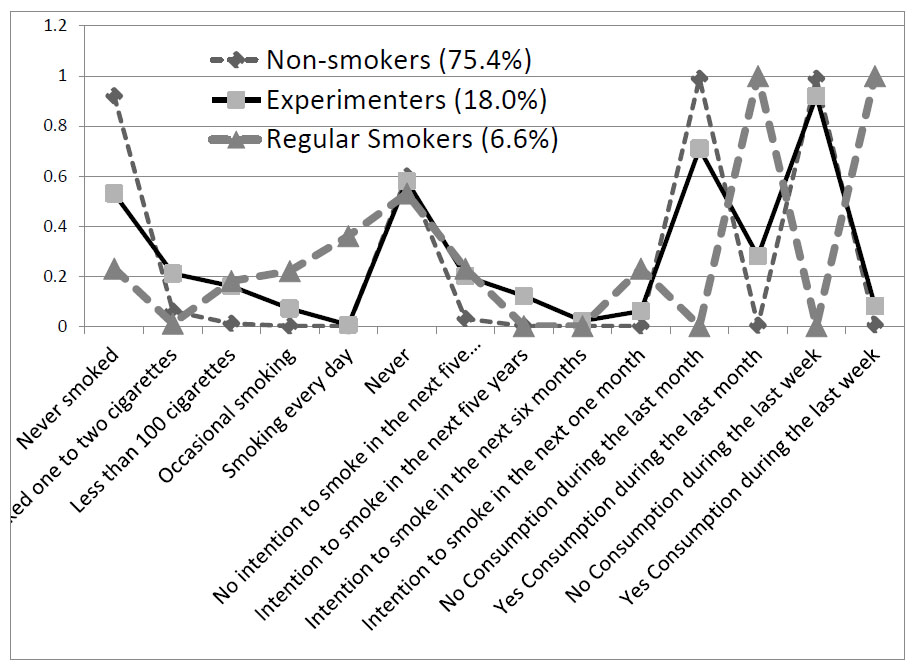
Profile plot of conditional item-response probabilities for the three latent classes of male students’ smoking behavior.
The associations between the predictor variables and their respective latent class memberships were explored through a latent class regression model, taking non-smokers as the reference category. The findings are presented as adjusted Odds Ratios (AORs) with 95% Confidence Intervals (Table 5).
| Predictor | Experimental Smoker V.S Non-smoker | Regular Smoker V.S Non-smoker | ||
|---|---|---|---|---|
| AOR (95% CI) | p-value | AOR (95% CI) | p-value | |
| Continuous Variables (per unit increase) | ||||
| Age (year) | 1.12 (0.62-2.04) | 0.703 | 0.85 (0.54-1.33) | 0.477 |
| Grade Point Average (GPA) | 0.78 (0.65-0.94) | 0.017 | 0.87 (0.73-1.04) | 0.136 |
| Self-esteem | 0.99 (0.91-1.08) | 0.809 | 1.03 (0.95-1.12) | 0.444 |
| Attitude Toward Smoking | 1.90 (1.63-2.22) | <0.001 | 1.68 (1.46-1.94) | <0.001 |
| Positive Thinking | 0.94 (0.84-1.06) | 0.323 | 0.97 (0.88-1.07) | 0.551 |
| Categorical Variables | ||||
| Socioeconomic Status (Middle vs. Low) | 1.21 (0.83-1.77) | 0.316 | 1.00 (0.74-1.35) | 0.994 |
| Cigarette Consumption Norms | 1.48 (1.10-1.98) | 0.010 | 1.46 (1.11-1.92) | 0.007 |
| Residential Arrangement | ||||
| • Father only (vs. Both parents) | † | - | 2.60 (0.15-45.2) | 0.518 |
| • Mother only (vs. Both parents) | 0.66 (0.10-4.23) | 0.696 | 0.32 (0.05-2.08) | 0.239 |
| • Neither parent (vs. Both parents) | 0.02 (0.00-0.57) | 0.029 | 0.02 (0.00-0.30) | 0.005 |
| Smoker in family (Yes vs. No) | 0.97 (0.31-3.01) | 0.951 | 1.01 (0.38-2.69) | 0.984 |
| General risk-taking (Yes vs. No) | 1.59 (0.47-5.40) | 0.462 | 1.40 (0.53-3.72) | 0.501 |
Note: †: unstable estimate.
The major predictors related to the experimental smoker class as opposed to non-smokers, are as follows: GPA (AOR=0.78, 95%CI: 0.65-0.94), more favorable attitudes toward smoking (AOR=1.90, 95%CI: 1.63-2.22), more permissive cigarette consumption norms (AOR=1.48, 95% CI: 1.10-1.98), and living with neither parent (AOR=0.02, 95% CI: 0.00-0.57). For regular smokers, in contrast with non-smokers, significant predictors are favorable attitudes toward smoking (AOR=1.68, 95%CI: 1.46-1.94), permissive cigarette consumption norms (AOR=1.46, 95%CI: 1.11-1.92), and living with neither parent (AOR=0.02, 95%CI: 0.00-0.30).
Some regression estimates, especially for residential arrangement variables, have shown wide confidence intervals, probably due to limited numbers in certain subgroups. Accordingly, these findings should be interpreted cautiously.
4. DISCUSSION
The current research used Latent Class Analysis to differentiate between the different smoking behaviors of male adolescents in Iran. The three classes identified by our LCA, although they generally correspond to the theoretical stages of smoking, indicate significant heterogeneity, with the 'experimental' group being particularly affected. This thus implies that the classes derived from empirical data may be those of transitional or at-risk individuals whose characteristics differ from those of discrete, theoretical trajectories. The three classes, Non-smokers (75.4%), Experimental smokers (18.0%), and Regular smokers (6.6%), were a statistical classification based on data that mirrored the patterns and attitudes of this youth group. A significant fraction of the students without smoking history (53%) formed part of the Experimental smoker class, which suggests that this class corresponds to a varied risk group and not a clear-cut behavioral category. This discovery shows that LCA-derived “stages” may differ from theoretical smoking trajectories, yet reveal shared response patterns across both behavioral and attitudinal aspects.
The proportion of Regular smokers in our sample (6.6%) was considerably lower than that of some other international adolescent populations. For instance, in Eastern European countries, rates of up to 44% have been reported in some studies [1]. However, such comparisons should be interpreted with caution, as many international reports include broader or mixed adolescent age ranges rather than strictly school-based populations, and also differ in measurement methods, cultural context, and study period. When comparisons are restricted to studies focusing specifically on high school students in Iran [16, 18-23], our prevalence estimates fall within the reported national range of 1-13%, indicating reasonable consistency within comparable age groups. The lower prevalence in our study as compared to some international reports may be due to cultural and religious factors or government policies that have a direct impact on the smoking habits of Iranian teenagers.
Our research study has shown that being a part of the experimental smoker (Adjusted OR=1.90) and regular smoker (Adjusted OR=1.68) classes was strongly linked to having more positive attitudes toward smoking when compared to non-smokers (Table 5). This result is consistent with previous literature that highlighted the importance of attitudes in adolescent smoking behavior [16, 24, 25]. The strong influence of this factor among different smoking groups indicates that attitudinal factors might play a significant role in smoking behavior across different smoking classes.
Smoking habits among close contacts were reported as no more than the minimum. Those norms of cigarette consumption among co-actors were thus considered to be the cause for the higher chances of being in both smoking classes (Experimental: Adjusted OR=1.48; Regular: Adjusted OR=1.46). The positive relationship between the norms perception and smoking behavior has been noticed in many cultures of the world [26, 27]. The results of our study underscore the significance of social environment factors during adolescence, when peer and family influences are strongest.
Of all the demographic variables that were analyzed, the residential arrangement of participants (living status with parents) portrayed some relationship with smoking classes. However, one should be very careful while interpreting these relationships because the actual number of samples in the ‘Father only’ and ‘Neither parent’ categories is very low. These values are statistically unreliable, as indicated by the very large confidence intervals shown in Table 5. Thus, while the results are significant but unreliable, they still point to a tendency and do not permit any concrete inferences regarding the impact of such residential situations on smoking. Jalilian et al., in their study on the socio-demographic characteristics related to smoking, drug abuse, and alcohol consumption among male students at Iran University of Medical Sciences, observed the impact of parental separation on the initiation of smoking in adolescents [28]. Two other studies [29, 30] also noted the relationship between living with parents and smoking behavior.
The students' GPA variable was found to be significantly associated with membership in the Experimental Smoker class (Adjusted OR=0.78). This finding aligns with previous research on the relationship between academic achievement and smoking [31] and with an investigation into the impact of academic achievement on the onset of smoking during adolescence carried out by Alexandre J. S. and his colleagues [32]. These and other studies have emphasized the links among average grades, academic progress, and smoking behavior- consistent with the findings of the present study. This trend implies that academic factors could be more crucial at the time of initial smoking experimentation rather than during the regular smoking period.
In contrast to some earlier investigations [16, 33], a smoker in the family did not have a noticeable influence on the membership of the smoking classes in our study, which is similar to a previous study in Iran [25]. This lack of association might be due to differences in family dynamics, students' dependence on their families, differences in measurement methods, or the relatively small proportion of regular smokers in our sample.
In other similar studies, no significant relationship has been observed between socioeconomic status and the probability of being placed in any of the three smoking classes [10, 16, 34]. However, contrary to these findings, a study by Tyas et al. reported a significant relationship between socioeconomic status and smoking consumption [35]. In another study, high level group was a causal factor for the initiation of smoking in adolescents [25]. Regarding the relationship between self-esteem and smoking consumption and its impact on classifying individuals into smoking groups, no significant relationship was observed in our study. Although this relationship has been confirmed in a few studies [35, 36], it is insignificant in the initial stages of consumption [37].
5. STRENGTHS AND LIMITATIONS
The study presents several major strengths, including the application of a validated algorithm alongside LCA to identify behavioral profiles, indicating more than just simple prevalence. Nevertheless, several limitations should be taken into account. First, the cross-sectional nature of the study provides only a snapshot at a specific time, so it is not possible to make causal inferences or, most importantly, to model transitions between smoking classes over time. Second, the data collected were all through self-reports and could thus reflect social desirability bias, especially in the case of sensitive activities like smoking among the teenage population. Third, the study yielded a male-only sample from one city in Iran, leading to the conclusion that generalization to female adolescents, other areas, and different cultures is limited (cultural context specificity). Fourth, despite being careful in choosing the model, the process of classification in Latent Class Analysis is inherently uncertain, and individuals may be misclassified into the wrong classes. We did not formally account for classification error, which may influence the estimates of class membership and associations with predictors. Additionally, LCA results are sensitive to the choice of indicator variables; selecting different combinations of smoking-related indicators could lead to different latent class solutions, potentially affecting prevalence and predictor identification. Future studies should explore alternative indicator sets and consider sensitivity analyses to assess the robustness of the class structure. Lastly, as already highlighted, the relatively small sample sizes for some subgroups might affect the accuracy of estimates for those categories (sparse-data bias). As this is a cross-sectional study, causal inferences cannot be drawn, and longitudinal research is required to clarify the temporal sequence of smoking behavior development.
Finally, our analysis was based on traditional latent class analysis. Further studies might benefit from Bayesian Latent Class Regression, thereby enabling rigorous quantification of classification uncertainty and providing more reliable estimates of model parameters from small groups.
CONCLUSION
This research, utilizing LCA, has distinguished three different smoking behavior classes among the male adolescent students in Iran: Non-smoker, Experimental smoker, and Regular smoker. The prevalence of regular smoking was reported to be 6.6%. Through our cross-sectional analysis, it has been established that being part of the smoking classes is associated with having more favorable attitudes about smoking, being more permissive in normative beliefs, lower academic grades (particularly for the Experimental smoker class), and living in specific arrangements.
These results pose significant hypotheses for prevention and public health practice. They imply that prevention programs targeted at male adolescents would gain more effectiveness if they focus on risk factors, for instance, attitudes towards smoking and perceived norms, as these factors were highly associated with both experimental and regular smoking patterns in our sample. Also, providing academic support for students with low performance is necessary, as it was linked to experimental smoking.
Due to the cross-sectional design, causal inferences cannot be made. Longitudinal studies are necessary to determine if smoking intervention tactics based on these risk profiles can indeed bring about changes in smoking behavior. Moreover, studies should also incorporate female adolescents and other demographic categories to develop a more comprehensive understanding of smoking trends.
AUTHORS’ CONTRIBUTIONS
The authors confirm their contribution to the paper as follows: A.K.: Study conception and design; M.H.: Data collection; A.K, M.K.: Analysis and interpretation of results; M.K., N.A.: Draft manuscript. All authors reviewed the results and approved the final version of the manuscript.
LIST OF ABBREVIATIONS
| LCA | = Latent Class Analysis |
| PCA | = Principal Component Analysis |
| BIC | = Bayesian Information Criteria |
| AIC | = Akaike Information Criteria |
| SD | = Standard Deviation |
| GPA | = Grade Point Average |
ETHICS APPROVAL AND CONSENT TO PARTICIPATE
This study received ethical approval from the Institutional Review Board of Shahroud University of Medical Sciences, Iran (Ethics Committee approval number: IR.SHMU.REC.1399.112).
HUMAN AND ANIMAL RIGHTS
All procedures performed in this study involving human participants were conducted in accordance with the ethical standards of the institutional research committee and the 1964 Declaration of Helsinki and its later amendments or comparable ethical standards.
AVAILABILITY OF DATA AND MATERIALS
The data supporting the findings of the article will be available from the corresponding author [A.K] upon reasonable request.
ACKNOWLEDGEMENTS
The authors express their sincere gratitude to all students who participated in this study. Special appreciation is extended to the Research Deputy of Shahroud University of Medical Sciences, Iran for their support and facilitation of this research. This article is extracted from an epidemiology master's thesis.