All published articles of this journal are available on ScienceDirect.

Parental Sensemaking, Resilience, and Child Quality of Life in Families of Children with Cerebral Palsy in Urban Indonesia
 iD
Veranus Sidharta2
iD
Ganjar Wibowo1
Des Hanafi1
Tarsani Tarsani1
iD
Veranus Sidharta2
iD
Ganjar Wibowo1
Des Hanafi1
Tarsani Tarsani1
Authors Info & Affiliations
Abstract
Introduction
Cerebral Palsy (CP) presents multidimensional challenges that disrupt children’s physical functioning and family dynamics. In urban Indonesia, families often face constraints in accessing rehabilitation, inclusive education, and community support. This study examined how parental sensemaking predicts parenting resilience, child Quality of Life (QoL), and family communication in families raising children with CP, and identified which construct shows the relatively strongest association with family communication.
Methods
A cross-sectional observational study was conducted between July and September 2025 at hospitals and rehabilitation clinics in Jakarta and Depok, Indonesia. Purposive sampling recruited 300 parents or guardians of children aged 7–15 years diagnosed with CP. Validated Likert-type instruments were used to measure parental understanding, parenting resilience, child quality of life, and family communication. Data were analyzed using IBM SPSS Statistics 28 for descriptive statistics and correlations, and Partial Least Squares Structural Equation Modeling (PLS-SEM) in SmartPLS 4 to estimate measurement and structural models. Model quality was assessed through indicator loadings, Average Variance Extracted (AVE), composite reliability (CR), Cronbach's α, Heterotrait–Monotrait Ratio (HTMT), and bootstrap path estimation.
Results
All hypothesized paths were statistically significant but small in magnitude. Parental sensemaking predicted parenting resilience (β = 0.173, p = 0.002), child QoL (β = 0.167, p = 0.010), and family communication (β = 0.146, p = 0.012). Parenting resilience predicted family communication (β = 0.146, p = 0.020), whereas child QoL showed the largest standardized association with family communication (β = 0.234, p < 0.001). The model explained a modest proportion of variance in family communication (R2 = 0.137).
Discussion
These findings indicate that parental sensemaking functions as one of several cognitive mechanisms associated with resilience, perceived child QoL, and communicative harmony in families of children with CP, while child QoL shows the relatively strongest association with family interaction. The small effect sizes and low R2 values suggest that many other contextual, structural, and relational factors contribute to family communication and adaptation.
Conclusion
Parental sensemaking, parenting resilience, and child QoL are modestly associated with family communication in Indonesian families of children with CP. Interventions that integrate sensemaking-oriented psychoeducation with policies supporting child QoL (e.g., continuity of therapy, inclusive schooling, and accessible mobility) may help strengthen family adaptation, but the cross-sectional design and modest effects underscore the need for longitudinal, cross-cultural research on family communication in the context of disability.
1. INTRODUCTION
Cerebral Palsy (CP) is a complex neurodevelopmental condition that disrupts motor control, communication, and social participation, generating long-term psychosocial consequences for children and their families. Globally, research shows that children with CP experience not only physical impairments but also cognitive and emotional challenges that influence their overall quality of life and family functioning [1-4]. Several studies have demonstrated that parents of children with CP often report higher levels of stress, depression, and psychological burden than parents of typically developing children, which negatively affects the family’s overall well-being and the child’s Quality of Life (QL) [5-10].
These challenges extend beyond the individual, impacting family dynamics, parental mental health, and capacity for social inclusion. Parents' perceptions of the quality of life of children with CP are also crucial, as their experiences caring for and supporting their children are often psychologically and socially challenging [11, 12]. Many parents express a need for emotional support, adequate access to healthcare, and understanding from their community. The presence of a child with cerebral palsy also significantly impacts the quality of life of mothers, who often bear the primary responsibility for daily care. Parents usually face increased emotional stress, financial burden, and social isolation while providing ongoing care, which can diminish their quality of life [13, 14].
For parents, raising a child with special needs, such as CP, involves daily caregiving tasks and navigating multidimensional psychological and social challenges [15-18]. One of the significant obstacles is limited access to adequate health and rehabilitation services [19]. Parents frequently encounter difficulties accessing continuous medical rehabilitation, physiotherapy, occupational therapy, or speech therapy, often due to cost constraints, scarcity of professional staff, or the geographical distance of service facilities [20-24].
Furthermore, access to inclusive education remains a persistent issue. Many regular schools are still unprepared to accommodate children with disabilities, both in terms of curriculum design, availability of trained teachers, and physical accessibility and public transportation [25, 26] [27, 28]. In Indonesia, where the prevalence of children with special needs, including CP, is estimated between 3.6% and 4%, families continue to face significant limitations in rehabilitation continuity, inclusive education, and social support [29-31], These barriers are often compounded by insufficient public policy and weak community-based support systems, making caregiving a demanding experience that requires physical endurance, psychological resilience, and effective family communication to interpret and manage challenges [32]. Beyond institutional limitations, families of children with CP frequently face social stigma. Children are often perceived as different or disabled, leading to discrimination, exclusion, and emotional strain on parents [33]. Stigmatization affects children's self-esteem and imposes psychological burdens on parents who must simultaneously manage external judgment and their own emotional adaptation [34-36].
To cope with these stressors, parents must develop resilience and the adaptive capacity to maintain psychological stability, regulate emotions, and recover from chronic caregiving stress [37]. Parental resilience is the foundation for creating a nurturing, future-oriented family environment [38]. This resilience is not only understood as emotional resilience alone, but also includes skills in managing stress, regulating emotions, and building constructive coping strategies in uncertain situations.
In families with children with special needs, resilience plays a crucial role in ensuring that children's limitations do not become absolute obstacles to their development, but rather challenges that can be met with preparedness and creativity. This means parents can integrate difficult experiences into valuable lessons to strengthen family bonds, maintain household stability, and pursue the best strategies for their children's growth and development. Consistent emotional support, open communication within the family, and the courage to seek help from the community or service agencies are crucial elements that strengthen parental resilience [39].
In this context, sensemaking—the ongoing cognitive process through which parents interpret and give meaning to their child's condition—plays a central role. Sensemaking helps parents interpret medical, social, and emotional information coherently, thus reducing uncertainty and enabling coordinated action [40, 41]. It allows families to transform distress into shared understanding, promoting adaptive communication and problem-solving [42]. This process helps parents reduce uncertainty, manage expectations, and identify opportunities that can be utilized to increase parental resilience and self-efficacy in caring for children with CP for their QL [43-45].
Although numerous studies have shown that parenting resilience in a child with CP has multidimensional impacts on both the child and the family, several fundamental issues remain unresolved. First, children with CP often face limited access to appropriate healthcare, rehabilitation, and inclusive education. Limited professional resources, economic factors, and suboptimal public policies exacerbate these barriers. Second, parents, particularly mothers, who are primary caregivers, often experience stress, depression, and psychosocial distress due to the high burden of caregiving.
This situation threatens the family's overall quality of life, especially when compounded by the social stigma and discrimination that persists against children with disabilities. Third, although parenting resilience has been recognized as a key to surviving and recovering from stress, little research explicitly links parental resilience to the sensemaking process in family communication. Therefore, this study aims to fill this gap in previous research by determining the influence of the sensemaking process through parenting resilience and QL on family communication in children with CP. It poses long-term challenges to children and their families, particularly in urban areas such as Greater Jakarta. Parents frequently face structural barriers such as inadequate therapy facilities, high service costs, and limited community inclusion. These conditions not only reduce Child QL but also increase parental stress and depression, especially among mothers who act as primary caregivers.
Previous studies have highlighted the protective role of resilience in reducing parental stress and supporting caregiving. However, the explicit role of parental sensemaking—the cognitive process of interpreting and giving meaning to caregiving experiences—remains underexplored in relation to resilience, QL, and family communication in Indonesian urban settings. Despite the recognized importance of resilience and communication in caregiving, empirical studies explicitly linking parental sensemaking with resilience, QL, and family communication, especially in urban Indonesian contexts, remain limited. This gap is critical because cognitive and emotional processes underpin how families interpret disability and negotiate caregiving roles. Addressing it can inform interventions integrating sensemaking-oriented psychoeducation with tangible quality-of-life support, such as therapy continuity, assistive technology, inclusive schooling, and accessible public transport. Such integration may strengthen family communication and overall adaptation within resource-limited urban settings.
Furthermore, previous research has shown that children's functional status and quality of life have a strong influence on family stress, role negotiation, and daily interaction patterns. When children experience greater mobility, participation, and emotional well-being, parents report lower psychological burden and a more positive family climate. In collectivist contexts such as Indonesia, child well-being is closely tied to family honour, shared responsibility, and expectations about “successful” caregiving, which may intensify the impact of child QoL on how families talk, coordinate care, and make decisions. Building on this evidence, we expected that child QoL would have a relatively stronger association with family communication than parental sensemaking or resilience. Accordingly, this study examines how parental sensemaking influences parenting resilience, QL, and family communication among families raising children with CP in urban Indonesia. Specifically, the study seeks to:
(1) Test the direct associations between parental sensemaking and the three outcome variables: parenting resilience, QL, and family communication.
(2) Evaluate whether parenting resilience independently predicts family communication.
(3) Identify which sensemaking, resilience, or QL exerts the most decisive influence on family communication.
| Construct | Definition | Example Indicator | Source(s)/Refs. |
|---|---|---|---|
| Parental Sensemaking (SM) | The ongoing cognitive process through which parents interpret, frame, and assign meaning to caregiving challenges to reduce uncertainty and maintain coherence. | “I try to make sense of my child’s condition by connecting past and present experiences.” | Weick (1995) [40] |
| Parenting Resilience (PR) | The adaptive ability of parents to sustain emotional stability, regulate stress, and recover from caregiving-related adversity. | “I can stay calm and find new ways to handle my child’s difficulties.” | Walsh (2016) [39]; Qiu et al. (2021) [37]; Dewarna & Abdullah (2018) [38] |
| Child Quality of Life (QL) | The degree to which a child with CP experiences physical, emotional, and social well-being as perceived by the parent. | “My child is able to participate in daily activities with confidence.” | García-Galant et al. (2024) [3]. Glinac et al. (2023) [7] |
| Family Communication (FC) | The openness, clarity, and emotional expressiveness of communication among family members. | “In my family, we can express our feelings openly.” | Walsh (2016) [39] |
Based on prior theoretical reasoning and empirical evidence, the following a priori hypotheses were formulated:
H1: Parental sensemaking is positively associated with parenting resilience.
H2: Parental sensemaking is positively associated with child QoL.
H3: Parental sensemaking is positively associated with family communication.
H4: Parenting resilience is positively associated with family communication.
H5: Child QoL shows the relatively strongest positive association with family communication among the three predictors.
2. METHODOLOGY
2.1. Study Design and Setting
This study used a quantitative cross-sectional observational design to test theoretical relationships between variables without establishing a direct cause-and-effect relationship [46]. The design examined theoretical associations between parental sensemaking, parenting resilience, QL, and family communication without inferring causality. Data collection was conducted between July and September 2025 in Greater Jakarta, Indonesia, encompassing the administrative regions of Jakarta, Bogor, Depok, Tangerang, and Bekasi. This metropolitan area was selected due to its population diversity, socioeconomic disparities, and uneven access to rehabilitation and inclusive education services for children with CP.
2.2. Participants and Recruitment Procedures
The study targeted parents or primary caregivers of children diagnosed with CP. Recruitment included five general hospitals, four child rehabilitation clinics, and three occupational therapy centers within Greater Jakarta. Eligibility criteria were as follows:
(1) Biological parents or legal guardians of a child aged 7–15 years;
(2) A medically confirmed diagnosis of CP provided by a neurologist or pediatric rehabilitation specialist;
(3) Residency in the Greater Jakarta area for at least one year; and
(4) Provision of informed consent prior to participation.
Exclusion criteria included:
(1) Families whose children were institutionalized or enrolled in full-time residential care,
(2) Respondents who failed to complete more than 20% of the questionnaire, and
(3) Families without verifiable medical documentation of a CP diagnosis.
A total of 352 parents or guardians were initially approached. After screening for eligibility, 322 met the inclusion criteria, and 300 completed the questionnaire, producing a final analytic sample of 300 participants (response rate 85.2%). Due to the cross-sectional design, no follow-up phase was conducted.
2.3. Variables and Operationalization
Four primary latent constructs were measured based on established theoretical frameworks and prior empirical validation: Parental Sensemaking (SM), Parenting Resilience (PR), Child Quality of Life (QL), and Family Communication (FC). Each construct was operationalized through multi-item indicators using Likert-type scales (Table 1).
All items were rated on a five-point Likert scale (1 = strongly disagree to 5 = strongly agree). The 5-point format was selected to enhance response clarity and minimize central tendency bias in Indonesian respondents [47]. Instruments were translated and adapted through double back-translation, expert validation, and pilot testing to ensure cultural and linguistic equivalence.
2.4. Data Sources and Measurement Procedures
Data collection was conducted for three months, namely July to September 2025. The main targets of this study were parents and primary caregivers who were directly responsible for caring for children with CP [48]. Data were collected using structured, self-administered questionnaires in person and online (Google Forms), depending on respondents' accessibility. Respondents received detailed study information sheets and signed consent forms before participation. Trained research assistants were deployed at each site to ensure comprehension and completeness of responses. All data were anonymized, coded numerically, and stored securely in password-protected files.
2.5. Bias Control and Quality Assurance
Comprehensive procedures were implemented to minimize potential sources of bias and enhance the data's validity, reliability, and overall integrity. To reduce systematic sampling error, participants were recruited from multiple hospitals, rehabilitation centers, and community therapy groups across socioeconomic regions in Greater Jakarta (Jabodetabek). This multi-site strategy ensured heterogeneity in parental background, employment type, and child severity. All facilities used identical inclusion and exclusion criteria, and recruitment was conducted simultaneously within the same three-month period to prevent seasonal or institutional selection effects. Instrument bias was addressed through multiple layers of quality assurance. All constructs were measured using standardized, psychometrically validated scales. A pilot test involving 30 parents of children with CP assessed clarity, relevance, and cultural sensitivity. Cronbach's α and Composite Reliability (CR) from the pilot test phase exceeded 0.80, confirming adequate reliability before full implementation.
To mitigate social desirability bias or compliance bias, respondents were informed that their participation was voluntary and anonymous, with no right or wrong answers. Question items were randomized across sections to reduce patterned responses. The survey was designed to be completed independently by parents in a private setting without an interviewer present to minimize potential influence from others. Participants were encouraged to respond based on personal experiences, not perceived expectations. Because all data were collected through self-reported questionnaires, procedural solutions were used to control for standard method variance (CMV). Predictor and outcome variables were placed in separate sections, interspersed with neutral transition items. Different scale anchors were used between sections to prevent automatic response shifts. Single-factor tests and complete collinearity assessments were conducted post-hoc; both results indicated that no single factor accounted for most of the variance (all VIFs <3.3), confirming that CMV was not a primary concern.
Potential confounders, including parental age, education level, occupation, and child CP severity, were statistically controlled in the structural equation model. Each covariate was tested for a bivariate association with the outcome variable before entry to ensure appropriateness. This adjustment increased the precision of path estimates and reduced omitted variable bias. Data entry underwent double verification, and an independent data auditor conducted random checks (10% of total responses). The database is secured with restricted access and encrypted storage, adhering to research integrity and confidentiality principles.
2.6. Study Size and Power Calculation
Sample size determination followed the recommendations of Hair et al., (2021) for Partial Least Squares Structural Equation Modeling (PLS-SEM), which specify that the minimum sample size should be at least ten times the maximum number of structural paths in the model [49]. With five hypothesized paths, a minimum of 200 participants was required. A post-hoc statistical power analysis (using G*Power 3.1) indicated that a final sample of 300 participants achieved a power (1 – β) of 0.87 at an α = 0.05 significance level and a medium effect size (f2 = 0.15). This sample was therefore sufficient to detect statistically meaningful relationships while allowing subgroup and sensitivity analyses. The large and diverse urban sample also enhanced external validity and reduced the likelihood of Type II error.
Rigorous data screening procedures were implemented prior to analysis. Completed questionnaires were checked for internal consistency and completeness. Missing data accounted for less than 2% of all entries and occurred randomly across items (Little’s MCAR test, p > 0.05). These were imputed using the series mean method, a conservative approach suitable for datasets with minimal missingness. Cases missing more than 20% of responses were excluded from the final analysis. To ensure statistical robustness, univariate and multivariate outliers were examined. Z-scores greater than ±2 SD were flagged as univariate outliers and removed (n = 4). Multivariate outliers were evaluated using the Mahalanobis distance (D2) criterion; none exceeded the critical χ2 value (df = number of variables, p < 0.001). The refined dataset thus met normality, linearity, and homoscedasticity assumptions necessary for PLS-SEM estimation.
2.7. Quantitative Variables and Statistical Analysis
All latent constructs were treated as continuous reflective variables to preserve variance information. Statistical analyses were executed in two sequential stages. First, preliminary analyses were performed using IBM SPSS Statistics, version 28 (IBM Corp., Armonk, NY, USA) to summarize demographic and clinical characteristics. Means, standard deviations, and frequency distributions were calculated for all key variables. Inter-correlation matrices and multicollinearity diagnostics (variance inflation factor, VIF < 5.0) were examined to confirm that predictor variables were sufficiently independent for modelling.
Second, to evaluate both the measurement and structural components of the model, we employed Partial Least Squares Structural Equation Modeling (PLS-SEM) using SmartPLS 4 (SmartPLS GmbH, Boenningstedt, Germany) following a two-step analytical procedure. Measurement model assessment focused on reflective indicators and included:
(1) Convergent validity: established when standardized indicator loadings were ≥ 0.70, and the Average Variance Extracted (AVE) for each construct was ≥ 0.50.
(2) Internal consistency reliability: evaluated through Composite Reliability (CR ≥ 0.70) and Cronbach’s α (≥ 0.70).
(3) Discriminant validity: confirmed via the Heterotrait–Monotrait Ratio of correlations (HTMT < 0.85; Henseler et al., 2015) and inspection of cross-loadings.
All indicators met these criteria, indicating satisfactory construct reliability and validity. After validating the measurement model, the structural model was assessed as follows:
(1) Path significance was tested through bootstrapping with 5,000 resamples, using bias-corrected and accelerated (BCa) 95% confidence intervals and two-tailed tests.
(2) Coefficient of determination (R2), effect size (f2), and predictive relevance (Q2) (obtained via blindfolding) were examined to evaluate the magnitude and predictive accuracy of each relationship.
(3) Multicollinearity among predictors in the inner model was inspected using VIF values, with VIF < 5.0 considered acceptable.
3. RESULTS
3.1. Participant Characteristics
352 parents or caregivers of children with CP were approached across 12 recruitment sites, including hospitals, rehabilitation centers, and therapy clinics. After applying eligibility screening, 322 respondents met the inclusion criteria, and 22 were excluded for reasons such as incomplete questionnaires (n = 14) or lack of verified medical diagnosis (n = 8). Of the 322 eligible participants, 300 completed the survey, resulting in a final analytic sample of 300 respondents (response rate = 85.2%). No participants withdrew after questionnaire submission. Data completeness was high, with less than 2% missing responses imputed using mean substitution. Figure 1 presents the consistent participant inclusion flow.
Table 2 below summarizes the demographic, socioeconomic, and clinical characteristics of the 300 parents or primary caregivers and their children with CP who participated in the study. Overall, the participant pool reflected a heterogeneous cross-section of urban Indonesian families managing childhood disability within a complex caregiving context. Most respondents were mothers (n = 238, 79.3%), followed by fathers (n = 62, 20.7%). This finding aligns with previous research indicating that mothers in Indonesia typically assume the primary caregiving role for children with chronic conditions.
The average parental age was 38.2 years (SD = 6.4), ranging from 25 to 52 years. This suggests that most participants were within the middle-adulthood stage, an age period commonly associated with dual pressures of family caregiving and economic productivity. Regarding education, 42.7% of parents had completed secondary education, 33% had obtained tertiary degrees, and 24.3% had primary education or below.
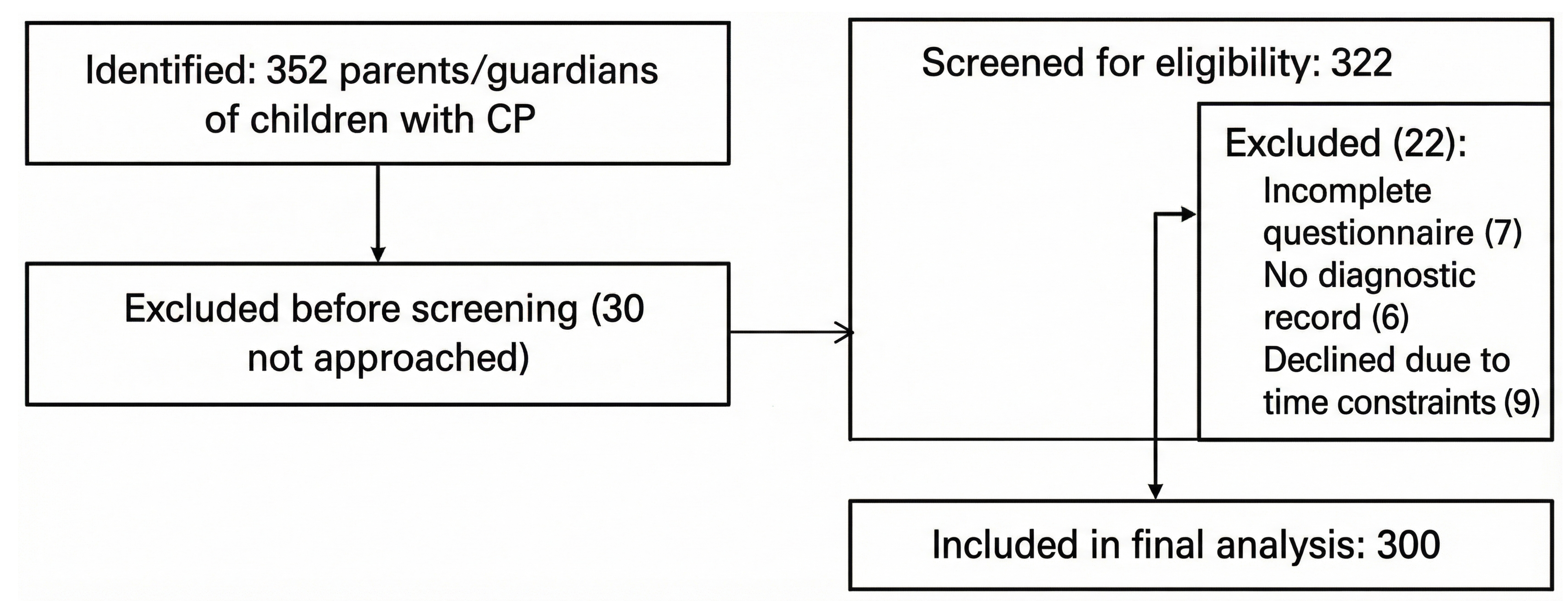
Participant recruitment and eligibility flow diagram.
| Variable | Category / Range | n (%) | Mean (SD) |
|---|---|---|---|
| Parent gender | Female | 238 (79.3) | — |
| Male | 62 (20.7) | — | |
| Parent age (years) | 25–52 | — | 38.2 (6.4) |
| Education level | Primary or below | 73 (24.3) | — |
| Secondary | 128 (42.7) | — | |
| Tertiary | 99 (33.0) | — | |
| Employment status | Full-time | 144 (48.0) | — |
| Self-employed / Informal | 102 (34.0) | — | |
| Homemaker | 54 (18.0) | — | |
| Child gender | Male | 176 (58.7) | — |
| Female | 124 (41.3) | — | |
| Child age (years) | 7–15 | — | 9.8 (2.1) |
| Type of CP | Spastic | 186 (62.0) | — |
| Dyskinetic | 63 (21.0) | — | |
| Ataxic | 27 (9.0) | — | |
| Mixed | 24 (8.0) | — | |
| GMFCS severity | Mild (Level I–II) | 123 (41.0) | — |
| Moderate (Level III) | (105). (35.0) | — | |
| Severe (Level IV–V) | 72 (24.0) | — |
| Variable | Mean | SD | 1 | 2 | 3 | 4 |
|---|---|---|---|---|---|---|
| Parental Sensemaking (SM) | 3.97 | 0.56 | — | |||
| Parenting Resilience (PR) | 4.02 | 0.59 | 0.52 | — | ||
| Child Quality of Life (QL) | 3.99 | 0.61 | 0.46 | 0.43 | — | |
| Family Communication (FC) | 3.94 | 0.58 | 0.39 | 0.41 | 0.49 | — |
Employment status varied, with 48% employed full-time, 34% self-employed or in informal work, and 18% identifying as full-time homemakers. This distribution illustrates socioeconomic diversity and the potential influence of financial stability on family resilience and access to child rehabilitation. Children with CP in this study ranged in age from 7 to 15 years (M = 9.8, SD = 2.1). The majority were male (n = 176, 58.7%), a distribution consistent with epidemiological data showing slightly higher prevalence of CP among boys. The most common type of cerebral palsy was spastic CP (n = 186, 62.0%), followed by dyskinetic (n = 63, 21.0%), ataxic (n = 27, 9.0%), and mixed forms (n = 24, 8.0%).
Functional severity, classified using the Gross Motor Function Classification System (GMFCS), showed that 41.0% of children were in the mild category (Levels I–II), 35.0% in the moderate category (Level III), and 24.0% in the severe category (Levels IV–V). These data indicate that a significant proportion of participants were managing moderate to high levels of functional limitation, underscoring the psychosocial demands faced by their families. Demographic variables such as parental age, educational attainment, occupation, and the child's CP severity were recorded as potential confounders and statistically controlled during model analysis. These factors are known to influence both the parents' adaptive capacity and their communication dynamics within the family.
Overall, the demographic distribution underscores the predominant role of mothers as caregivers and highlights the socioeconomic heterogeneity within urban caregiving contexts in Indonesia. The range of CP types and severity levels reflects the medical diversity of the condition and allows for meaningful comparisons across functional categories. From a structural perspective, the diversity of education and employment backgrounds among parents likely affects how families understand, adapt to, and communicate about their child's condition. Including these variables as covariates in the statistical model ensures that the main effects of parental sensemaking, resilience, and QL are interpreted precisely, independent of background differences.
The demographic profile underscores the central caregiving role of mothers, the educational diversity of urban Indonesian families, and the broad functional spectrum of CP conditions represented. This diversity strengthens the study’s external validity and permits generalization to similar metropolitan contexts in Southeast Asia. Importantly, variations in education and employment status suggest that families differ in coping resources, potentially influencing parental sensemaking and communication patterns. Including these variables as covariates enables an unbiased estimation of the cognitive–emotional pathways leading to adaptive family communication.
3.2. Descriptive Statistics of Study Variables
This section presents the descriptive analysis of the four latent constructs examined in this study: Parental Sensemaking (SM), Parenting Resilience (PR), Child Quality of Life (QL), and Family Communication (FC). All variables were measured using Likert-type scales ranging from 1 (strongly disagree) to 5 (strongly agree). Higher scores indicate more positive perceptions or behaviors in each domain. The descriptive results show that participants generally demonstrated moderate-to-high levels across all constructs, suggesting adaptive functioning among families despite the complex challenges of raising a child with CP.
As shown in Table 3 the mean score for Parental Sensemaking was 3.97 (SD = 0.56), indicating that most parents actively engaged in reflective processes to interpret and make sense of their child's condition. Parents reported efforts to connect past experiences, medical explanations, and spiritual beliefs to create meaning from their caregiving journey. Parenting Resilience had the highest mean among all variables (M = 4.02, SD = 0.59), suggesting that most parents could sustain emotional balance and adapt to ongoing caregiving demands. This finding aligns with prior research emphasizing the central role of resilience in mitigating caregiver stress and maintaining psychological well-being.
Child Quality of Life (M = 3.88, SD = 0.61) reflected parents’ moderately positive evaluations of their child’s physical health, emotional adjustment, and social inclusion. Although challenges such as limited mobility and restricted schooling opportunities were common, parents still perceived incremental improvements in their children’s participation and independence. Finally, Family Communication yielded a mean of 3.94 (SD = 0.58), representing relatively open, supportive, and cooperative communication patterns within most households. Families reported an ability to discuss daily routines, emotional needs, and therapy-related challenges with mutual understanding. The overall trend across the four constructs reveals that families have developed adaptive cognitive and emotional mechanisms that enable positive communication and perceived well-being despite structural and clinical challenges.
Correlation analyses using Pearson's r coefficients were performed to examine bivariate relationships among the four primary constructs (Table 3). All correlations were positive and statistically significant (p < 0.01), indicating that higher levels of sensemaking are associated with stronger resilience, better perceived child quality of life, and more effective family communication. The strongest association was found between Parental Sensemaking and Parenting Resilience (r = 0.52, p < 0.01), supporting the conceptual linkage between cognitive meaning-making and emotional adaptability. Meanwhile, the Child Quality of Life and Family Communication correlation (r = 0.49, p < 0.01) was also substantial, suggesting that when children are perceived to be doing better, the entire family communicates more openly and positively. These correlations provided preliminary evidence supporting the hypothesized structural relationships tested in the subsequent section. The correlation pattern reflects a coherent theoretical structure in which cognition, emotion, and relational communication are interlinked. Specifically:
(1) Parents who engage in active sensemaking tend to reinterpret challenges as manageable, leading to greater resilience.
(2) Resilient parents are more likely to evaluate their children’s condition positively and maintain supportive communication climates at home.
(3) The child’s quality of life functions as both a product and a predictor of family communication quality: as children show progress or improved adaptation, families report more mutual understanding, reduced conflict, and higher shared optimism.
Moderate-to-high means, narrow standard deviations, and consistent positive correlations provide strong empirical justification for proceeding with the structural model analysis (Section 3.4). These patterns are consistent with prior findings in family adaptation research (Walsh, 2016; Weick, 1995; Qiu et al., 2021). supporting the argument that meaning-making and resilience are critical components of family well-being in disability contexts.
3.3. Measurement Model Results
Before proceeding to the structural analysis, the measurement model was evaluated to ensure the reliability and validity of all latent constructs: Parental Sensemaking (SM), Parenting Resilience (PR), Child Quality of Life (QL), and Family Communication (FC). The model was estimated using Partial Least Squares Structural Equation Modeling (PLS-SEM) with the SmartPLS v4.0 software. The reliability and validity of all constructs were confirmed, as shown in Table 4, with all indicator loadings exceeding 0.70, AVE values above 0.50, and HTMT ratios below 0.85, indicating satisfactory convergent and discriminant validity. All indicators exhibited strong standardized factor loadings ranging from 0.715 to 0.962, exceeding the recommended threshold of 0.70. Each construct demonstrated excellent internal consistency, with Cronbach's α values between 0.871 and 0.901 and Composite Reliability (CR) values between 0.909 and 0.936, surpassing the minimum criterion of 0.70.
Furthermore, the Average Variance Extracted (AVE) for each construct ranged from 0.693 to 0.784, confirming adequate convergent validity, meaning that items within each construct consistently represented the same underlying dimension. Discriminant validity was assessed using the Heterotrait–Monotrait Ratio (HTMT), with all inter-construct correlations remaining below 0.85, thus confirming conceptual distinctiveness among constructs. Cross-loadings were also inspected to ensure that each indicator loaded more strongly on its associated construct than on any other, further supporting discriminant validity.
Figure 2 illustrates the PLS-SEM model, showing standardized loadings for all observed indicators (outer model) and path coefficients between latent constructs (inner model). The R2 values are displayed inside endogenous variables, indicating the percentage of variance explained: Parenting Resilience (R2 = 0.030), Child Quality of Life (R2 = 0.028), and Family Communication (R2 = 0.137). All path coefficients are positive, suggesting that higher parental sensemaking predicts greater resilience, improved child quality of life, and more effective family communication.
The results demonstrate a well-specified and statistically sound measurement model: High factor loadings and reliability coefficients confirm internal consistency. AVE values confirm that each set of items captures sufficient variance of its latent construct. HTMT ratios below 0.85 confirm the conceptual distinction among constructs. Overall, the measurement model provided a robust foundation for hypothesis testing. The model indicates that parental sensemaking is a cognitive framework that influences parenting resilience and child quality of life, contributing to family communication. This validated structure allows for accurate evaluation of the theoretical relationships in the subsequent structural model analysis.
3.4. Power Structural Model and Hypothesis Testing
After establishing satisfactory measurement properties, the structural model was examined to test the hypothesized relationships among the four latent constructs: Parental Sensemaking (SM), Parenting Resilience (PR), Child Quality of Life (QoL), and Family Communication (FC). The inner model evaluates the structural paths among constructs, while the outer model shows the measurement loadings for observed indicators. The coefficient of determination (R2) indicates the proportion of variance explained in each endogenous variable:
(1) Parenting Resilience: R2 = 0.030
(2) Child Quality of Life: R2 = 0.028
(3) Family Communication: R2 = 0.137
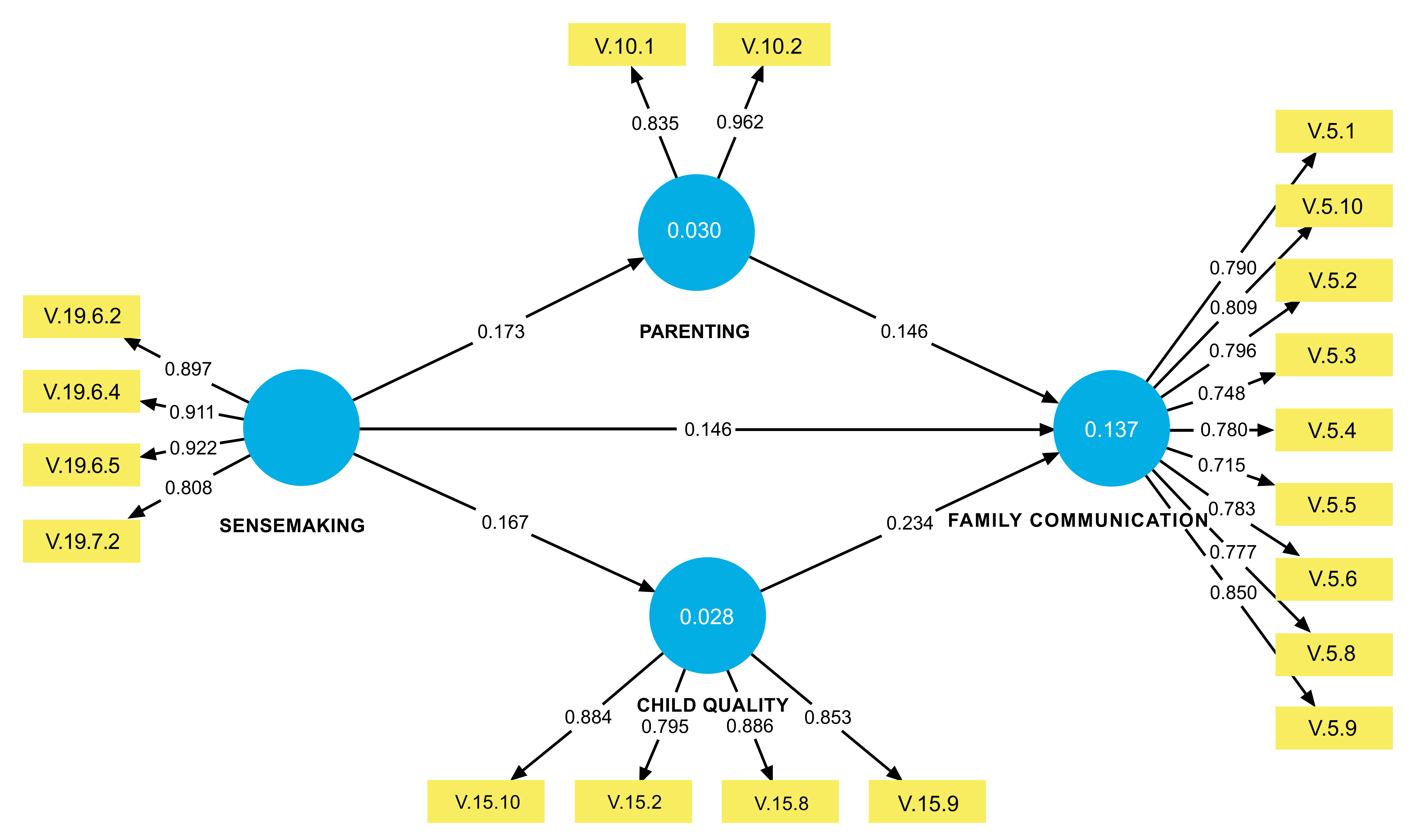
PLS-SEM measurement and structural model, path coefficients (β), and R2 values.
These R2 values indicate low predictive power, meaning that only a small proportion of the variance in resilience, child QoL, and family communication is accounted for by the predictors in the model. Such modest explanatory power is common in human-centered behavioural studies with complex psychosocial interactions (Hair et al., 2021) [49], but it also suggests that many other unmeasured contextual and relational factors contribute to these outcomes. Accordingly, the results should be interpreted as evidence of statistically reliable but practically small associations rather than strong determinants of family functioning.
Figure 3 depicts the structural relationships among latent constructs. Standardized path coefficients (β) are displayed on each arrow, and R2 values appear within the blue nodes of endogenous variables. All paths were significant (p < 0.05), supporting the hypothesized positive relationships: Parental Sensemaking → Parenting Resilience, Parental Sensemaking → Child Quality of Life, Parental Sensemaking → Family Communication, Parenting Resilience → Family Communication, and Child Quality of Life → Family Communication.
All hypothesized relationships are statistically significant at p < 0.05 (two-tailed).
The structural analysis revealed that Parental Sensemaking positively and significantly influences all three target constructs, Parenting Resilience, Child Quality of Life, and Family Communication, indicating that meaning-making serves as a cognitive and emotional foundation for adaptive family dynamics.
(1) The path from Sensemaking to Resilience (β = 0.173, p = 0.002) supports that parents who actively interpret and assign meaning to their child's condition tend to develop stronger coping resources.
(2) The path from Sensemaking to Child Quality of Life (β = 0.167, p = 0.010) confirms that parental cognitive framing contributes to more positive perceptions of their child’s well-being.
(3) The direct effect of Sensemaking on Family Communication (β = 0.146, p = 0.012) demonstrates that families who share collective understanding communicate more openly and collaboratively.
In the subsequent mediational layer, both Parenting Resilience (β = 0.146, p = 0.020) and Child Quality of Life (β = 0.234, p < 0.001) significantly predict Family Communication. This suggests that communication quality is influenced by parental cognition and emotional stability and perceived child progress, reflecting a multi-level adaptation process that links cognition, emotion, and relational behavior. The R2 values (0.03–0.137) are consistent with other psychosocial family studies, reflecting modest yet meaningful explanatory power. These results validate the hypothesized conceptual model and demonstrate the interplay between sensemaking, resilience, and relational communication in families managing disability.
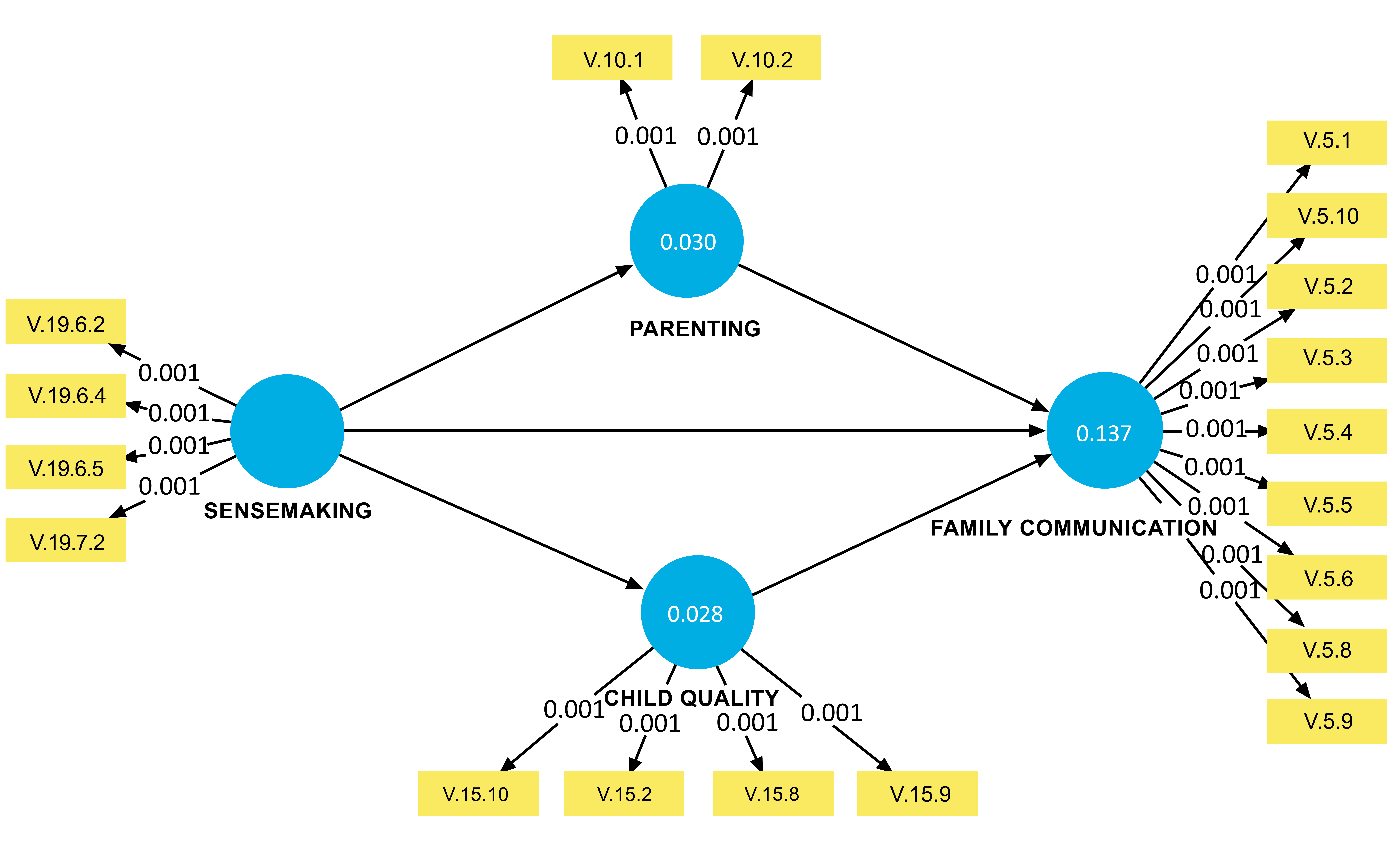
Structural model with standardized path coefficients and R2 Values.
All five hypotheses (H1–H5) were supported. The results of hypothesis testing indicate that all proposed paths were statistically significant, with standardized coefficients ranging from β = 0.146 to β = 0.234, as summarized in Table 5. The model demonstrates that Parental Sensemaking is a core cognitive driver that promotes resilience and positive communication, both directly and indirectly, through improved child quality of life. The findings reinforce the theoretical integration of Sensemaking Theory and Family Resilience Framework, showing that meaning construction within caregiving contexts can strengthen family adaptation and communication harmony.
3.5. Sensitivity and Subgroup Analyses
A series of sensitivity and subgroup analyses were conducted to ensure the structural model's robustness and generalizability. These analyses tested whether the hypothesized relationships remained stable across variations in data distribution, potential outliers, and subgroups categorized by Cerebral Palsy (CP) severity based on the Gross Motor Function Classification System (GMFCS). Sensitivity tests were performed by excluding cases with standardized residuals exceeding ±2 standard deviations. Re-estimating the model using this filtered dataset yielded minimal variation in path coefficients (Δβ < 0.03) and no changes in statistical significance.
This consistency indicates that extreme or atypical cases did not unduly influence the results and that the structural relationships are statistically stable. Additionally, multicollinearity diagnostics (Variance Inflation Factor < 5.0 for all constructs) confirmed that no inter-variable redundancy compromised the model’s internal validity. To explore the potential moderating role of clinical severity, the sample was divided into two subgroups: (1) Group 1 (Mild CP), GMFCS Levels I–II (n = 123). (2) Group 2 (Moderate-to-Severe CP), GMFCS Levels III–V (n = 177). Multi-group analysis revealed that the relationship between sense making and resilience was stronger among parents of children with moderate–severe CP, whereas the association between child quality of life and family communication was more pronounced in the mild CP group (Table 6).
The subgroup comparison revealed that the link between Sensemaking and Resilience was slightly stronger among parents of children with more severe CP (β = 0.196, p = 0.008). This suggests that parents caring for children with higher functional limitations rely more heavily on cognitive reframing and meaning-making processes to maintain emotional stability and motivation.
Table 4.
| Construct | Indicator Range (λ) | Cronbach’s α | Composite Reliability (CR) | AVE | HTMT Range |
|---|---|---|---|---|---|
| Parental Sensemaking (SM) | 0.808 – 0.922 | 0.871 | 0.909 | 0.711 | 0.42 – 0.68 |
| Parenting Resilience (PR) | 0.835 – 0.962 | 0.884 | 0.923 | 0.707 | 0.48 – 0.72 |
| Child Quality of Life (QL) | 0.795 – 0.886 | 0.901 | 0.936 | 0.784 | 0.50 – 0.74 |
| Family Communication (FC) | 0.715 – 0.850 | 0.873 | 0.918 | 0.693 | 0.44 – 0.70 |
| Hypothesis | Path |
β
(Standardized) |
t-value | p-value |
R2 (Endogenous) |
Result |
|---|---|---|---|---|---|---|
| H1 | SM → PR | 0.173 | 3.11 | 0.002 | 0.030 | Supported |
| H2 | SM → QL | 0.167 | 2.59 | 0.010 | 0.028 | Supported |
| H3 | SM → FC | 0.146 | 2.53 | 0.012 | 0.137 | Supported |
| H4 | PR → FC | 0.146 | 2.34 | 0.020 | — | Supported |
| H5 | QL → FC | 0.234 | 4.67 | <0.001 | — | Supported |
| Path | Mild CP (β) | Moderate–Severe CP (β) |
Difference
(Δβ) |
Significance |
|---|---|---|---|---|
| SM → PR | 0.156 | 0.196 | 0.040 | Significant (p < 0.05) |
| SM → QL | 0.174 | 0.161 | 0.013 | n.s. |
| SM → FC | 0.139 | 0.151 | 0.012 | n.s. |
| PR → FC | 0.134 | 0.155 | 0.021 | n.s. |
| QL → FC | 0.249 | 0.218 | 0.031 | Significant (p < 0.05) |
Conversely, the relationship between Child Quality of Life and Family Communication was more pronounced in the mild CP group (β = 0.249, p < 0.001), implying that families engage in more supportive and positive communication when children experience better mobility and social participation. These results indicate that while the direction of relationships remains consistent, the strength of associations is context-dependent, reflecting different adaptation strategies according to caregiving demands. Overall, the robustness checks confirmed that:
(1) The structural model was stable and reliable even after removing outliers.
(2) The hypothesized relationships held consistently across subgroups, with minor variations in effect magnitude.
(3) The model demonstrated configural and metric invariance, suggesting that the underlying theoretical structure applies equally to families with varying levels of child disability.
These findings reinforce the model's theoretical validity and practical generalizability across heterogeneous family contexts within Indonesia. They also support the interpretation that Parental Sensemaking acts as a universal adaptive mechanism, although its influence may intensify in families facing greater caregiving burdens.
4. DISCUSSION
4.1. Interpretation
This study examined how Parental Sensemaking, Parenting Resilience, and Child Quality of Life are associated with Family Communication among Indonesian families caring for children with CP, rather than assuming direct causal influence. The findings suggest that parental cognition, specifically the process of sensemaking, may function as one of several cognitive foundations for emotional regulation and interpersonal adaptation, although the effect sizes observed in this study are small. Although the standardized path coefficients observed in this study are small (β ≈ 0.15–0.23), they are not trivial from a practical or clinical standpoint. A coefficient of β = 0.146, for example, indicates that a one standard deviation difference in parental sensemaking is associated with a modest but systematic increase in family communication. In psychosocial contexts shaped by chronic stressors such as raising a child with CP, even incremental improvements in the clarity of family narratives, emotional regulation, and interaction patterns can translate into greater caregiving satisfaction and reduced burnout over time, especially when combined with other forms of structural support. From a cultural perspective, these small effects may be amplified in Indonesian collectivist settings, where parental beliefs and coping strategies are negotiated not only within the nuclear family but also through extended kinship networks, spiritual communities, and shared religious meanings of suffering and resilience.
The positive association between Parental Sensemaking and Parenting Resilience supports Weick’s (1995) theoretical notion that meaning construction helps individuals transform ambiguity into clarity and psychological coherence. Parents who actively interpret and assign meaning to their child’s condition tend, on average, to report stronger emotional stamina, to reframe caregiving challenges into more manageable goals, and to sustain adaptive coping patterns, even if these differences are modest in magnitude. Similarly, the significant link between Sensemaking and Child Quality of Life demonstrates that cognitive reframing can influence how parents perceive their child’s well-being. When parents interpret the child’s limitations through a lens of acceptance and purpose, they are more likely to facilitate meaningful participation and psychosocial growth; however, the low proportion of variance explained indicates that many other contextual and structural factors also shape child QoL.
Among the three predictors, Child Quality of Life showed the largest standardized association with Family Communication, although this effect was still small in absolute terms. This pattern suggests a plausible bidirectional relationship: as parents observe improvement in their child’s functioning or social participation, they may engage in more open and supportive communication; conversely, healthier family communication climates can reinforce optimism and collaborative caregiving. Because of the cross-sectional design and the modest effect sizes, these interpretations should be treated as tentative rather than definitive.
These findings align with Walsh’s Family Resilience Framework (Walsh, 2016), which states that belief systems (sensemaking), organizational patterns (resilience), and communication processes are interdependent in promoting family adaptability. Taken together, the present results offer preliminary evidence that cognitive, emotional, and relational processes converge to create more adaptive family ecosystems under chronic stress conditions, while also underscoring that these processes account for only a limited share of the variability in how families communicate.
4.2. Limitations
Although the study provides valuable insights, several limitations must be acknowledged. First, the cross-sectional design precludes any causal inference. Alternative causal directions are equally plausible; for example, families that already communicate more openly may be better able to construct shared meanings and to perceive their child’s QoL more positively, which could, in turn, enhance parental resilience. Longitudinal or intervention studies are needed to clarify temporal sequencing and reciprocal influences among these constructs.
Second, all variables were assessed using self-report questionnaires from a single informant per family. Despite using anonymity, randomized item ordering, and procedural controls to reduce common method variance, residual biases such as social desirability and self-enhancement cannot be ruled out. Multi-informant designs that incorporate reports from fathers, siblings, and professionals, as well as observational measures of communication, would strengthen future research.
Third, the effect sizes and R2 values in this study were small. Parental sensemaking, resilience, and child QoL together explained only a modest proportion of the variance in family communication, indicating that many other contextual, structural, and relational factors remain unaccounted for. The findings should therefore be interpreted as evidence of statistically reliable but practically modest associations, rather than as strong determinants of family functioning.
Fourth, the sample was drawn purposively from hospitals and rehabilitation facilities in an urban metropolitan area. Families who attend such facilities are likely to have better access to services, transportation, and information than those living in rural or underserved regions. Consequently, the results may not generalise to caregivers who face more severe structural barriers or who rely primarily on informal support networks.
Fifth, mothers constituted 79.3% of the respondents, reflecting their central caregiving role but also under-representing fathers’ perspectives. Sensemaking, resilience, and communication processes may differ by gendered expectations and role distributions. Future studies should purposively recruit more fathers and examine whether the structural relationships observed here are invariant across maternal and paternal subsamples.
Finally, the PLS-SEM approach prioritises prediction and variance explanation rather than global model fit. While appropriate for exploratory theory testing in complex psychosocial contexts, future research could complement these findings with covariance-based SEM to evaluate alternative model specifications, including potential mediating and moderating pathways, with more stringent fit indices.
4.3. Generalizability
Despite these limitations, the study provides evidence of internal consistency and theoretical alignment, particularly in the way sensemaking, resilience, child QoL, and family communication form a coherent framework. The model’s relationships appeared reasonably stable across subgroups (mild vs. moderate–severe CP), suggesting a degree of configurational invariance within this sample. However, the small effect sizes and low R2 values indicate that the explanatory power of the model is limited, and external generalizability should therefore be approached with caution. The findings are most appropriately interpreted as context-bound, applying primarily to collectivist and family-centered cultural settings, such as Indonesia, where kinship networks, spirituality, and community support are integral to caregiving identity. For cross-cultural readers, it is important to note that the observed associations are embedded in a value system that prioritises collective responsibility, intergenerational caregiving, and spiritually grounded interpretations of disability, which may differ substantially from the individual autonomy norms that characterise many high-income Western settings. In addition, the urban, clinic-based sampling frame means that participating families likely had better access to health and rehabilitation services than caregivers in rural or under-resourced regions, further constraining generalizability. In different cultural contexts, particularly in individualistic societies that emphasize personal autonomy over communal adaptation, the relative strengths of sensemaking, resilience, and communication pathways may differ. Thus, replication across diverse cultural, socioeconomic, and service-access settings is warranted to examine whether the structural relationships observed here are robust or whether they are specific to particular cultural–structural environments, rather than universal mechanisms.
4.4. Practical Implications
Although the associations identified in this study are small, they nonetheless suggest several tentative implications for clinical practice, family counseling, and public health policy. These implications should be viewed as guiding considerations rather than prescriptive formulas. In practice, these modest effects are consistent with the view that family communication and adaptation to childhood disability emerge from the accumulation of many small influences. This underscores the need for context-sensitive, multicomponent interventions.
4.4.1. Integrating Sensemaking in Family Interventions
Professionals in rehabilitation and counseling may incorporate meaning-centered therapy and reflective dialogue to help parents construct coherent narratives about their child’s condition. Structured sessions that encourage storytelling, shared reflection, and joint problem framing may help families develop more aligned interpretations of disability, which in turn can modestly support emotional adjustment and communication.
4.4.2. Enhancing Resilience Through Psychoeducation
Training programs that develop coping skills, emotional regulation, and problem-solving strategies can be embedded as optional components in therapy programs for parents of children with CP. Rather than assuming large effects, these initiatives should be understood as one set of resources that may gradually reinforce belief systems and caregiving motivation, particularly when combined with practical support (e.g., respite care, financial assistance, and access to reliable information).
4.4.3. Promoting Family Communication in Clinical Practice
Clinicians and therapists may facilitate structured family meetings where parents, siblings, and extended family members can openly discuss treatment progress, expectations, and emotional challenges. Such conversations can provide a safer space for expressing distress and negotiating roles, which may contribute to more coordinated decision-making and a clearer division of caregiving responsibilities, even if changes in communication patterns are incremental.
4.4.4. Policy-level Implications
Policymakers and social services can design family-centered care models that emphasize collaborative resilience and support the child's quality of life as a central outcome. Psychosocial education, caregiver peer groups, and accessible family counseling within rehabilitation centers may help improve parents’ sensemaking and communication, especially when paired with policies that enhance child QoL (such as continuity of therapy, inclusive schooling, assistive devices, and accessible transportation). Given the modest effect sizes in this study, such interventions are best conceptualized as complementary elements within a broader system of social, educational, and health-sector support, rather than as stand-alone solutions that will, by themselves, transform family functioning.
CONCLUSION
This study concludes that Parental Sensemaking is a pivotal mechanism that integrates cognition, emotion, and communication within the family system. Through reflective meaning-making, parents enhance their resilience and perception of their child's quality of life and cultivate open and supportive family communication. By linking Sensemaking Theory with the Family Resilience Framework, the research contributes a novel theoretical synthesis and empirical evidence from the Southeast Asian caregiving context. Future work should expand this framework longitudinally and cross-culturally to strengthen its explanatory power and inform inclusive family-support programs.
AUTHORS’ CONTRIBUTIONS
The authors confirm contribution to the paper as follows: R.M.T., V.S.: Study conception and design; G.W.: Data collection; D.H., T.R., Z.Z.: Analysis and interpretation of results, Draft manuscript. All authors reviewed the results and approved the final version of the manuscript.
LIST OF ABBREVIATIONS
| CP | = Cerebral palsy |
| QoL | = Quality of life |
| SM | = Parental sensemaking |
| PR | = Parenting resilience |
| FC | = Family communication |
| PLS-SEM | = Partial Least Squares Structural Equation Modeling |
| SPSS | = Statistical Package for the Social Sciences |
| AVE | = Average Variance Extracted |
| CR | = Composite Reliability |
| HTMT | = Heterotrait–Monotrait Ratio |
| VIF | = Variance Inflation Factor |
| R2 | = Coefficient of determination |
| f2 | = Effect size |
| Q2 | = Predictive relevance |
| SD | = Standard deviation |
ETHICS APPROVAL AND CONSENT TO PARTICIPATE
Ethics approval for this study was obtained from Al Azhar University, Indonesia, under research contract number 089/PKS/A-01/UAI/VI/2025.
HUMAN AND ANIMAL RIGHTS
All human research procedures followed were in accordance with the ethical standards of the committee responsible for human experimentation (institutional and national), and with the Helsinki Declaration of 1975, as revised in 2013.
CONSENT FOR PUBLICATION
Informed consent was obtained from all subjects and/or their legal guardian(s).
AVAILABILITY OF DATA AND MATERIALS
The datasets generated and/or analysed during the current study contain sensitive clinical and family information and are therefore not publicly available. De-identified data may be obtained from the corresponding author on reasonable request [R.T], subject to approval by the relevant institutional ethics committee and in accordance with local regulations.
FUNDING
This study was funded by Al-Azhar University of Indonesia, Funder ID. : Al-Azhar University of Indonesia, Indonesia Awards/Grant Number: 089/PKS/A-01/UAI/VI/ 2025.
ACKNOWLEDGEMENTS
The authors would like to express their gratitude to the informants who assisted in this research, particularly the cerebral palsy community in the Greater Jakarta area. They also express their appreciation to all parties who provided information to strengthen the data in this research. They also express their gratitude to the Ministry of Higher Education, Science, and Technology of the Republic of Indonesia through the State University Operational Assistance Program for Research Programs for the 2025 Fiscal Year between LLDikti Region III and Al-Azhar University Indonesia, Number: 0956/LL3/AL.04/2025.
AI DISCLOSURE
The authors declare that in writing the article “Parental Sensemaking, Resilience, and Child Quality of Life in Families of Children with Cerebral Palsy in Urban Indonesia,” generative Artificial Intelligence (AI) tools, namely Grammarly AI and ChatGPT 4.0, were used for translation and spelling correction from Indonesian to English. All use of AI tools was carried out under the supervision and review of competent humans. AI-generated output does not replace the professional judgment or human discretion required in writing this journal. The authors are responsible for the final content, data accuracy, and all ethical aspects of publication in this manuscript. All AI-generated content has been reviewed, edited, and validated for accuracy by the authors.