All published articles of this journal are available on ScienceDirect.

Exploring Affiliation as a Capability Towards Strengthening Social Cohesion in Rural South African Communities
 iD
Nicolette Vanessa Roman1
iD
Stephné Mijlof1
Chante Johannes2
iD
Catherina Schenck1
iD
Nicolette Vanessa Roman1
iD
Stephné Mijlof1
Chante Johannes2
iD
Catherina Schenck1
Authors Info & Affiliations
Abstract
Introduction/Objectives
In many developing countries, communities face adversity and limited resources, creating a pressing need for innovative strategies to foster social cohesion. Positive and trusting relationships enable individuals and communities to build stronger networks and more cohesive social environments. In South Africa, families have been identified as central to strengthening social cohesion; however, the mechanisms through which this occurs require further exploration. This study aimed to examine the factors contributing to social cohesion within rural communities and to assess the relevance of the human capability of affiliation in fostering cohesion.
Methods
A descriptive qualitative design was employed, using semi-structured interviews with 19 participants from two rural South African towns, Lambert’s Bay and Philippolis. Interviews were recorded, transcribed, and thematically analysed to identify common patterns and key insights.
Results
Two major themes emerged. The first, perceptions of social cohesion, included three sub-themes: community support and relations, community participation, and collective efficacy. The second, affiliation as a social capability, comprised three sub-themes: mutual sense of belonging, social network resources, and transference of values.
Discussion
The findings indicate that affiliation and social cohesion in rural communities are strongly shaped by the quality of social interactions and relationships among community members. Furthermore, Nussbaum’s Human Capabilities Approach, particularly the capability of affiliation, provides a useful framework for understanding and enhancing cohesion in the South African context.
Conclusion
These findings highlight the importance of social policies and intervention programmes that strengthen social networks and promote affiliation as a key capability. Future policy development should prioritise initiatives that cultivate positive relationships, mutual support, and community participation, thereby enhancing social cohesion and improving the well-being of rural communities.
1. INTRODUCTION
1.1. The Capabilities Approach
Mabaso et al. note that South Africa’s national policy frameworks emphasise the need to build and enhance people’s capabilities to improve social and economic outcomes [1]. The capabilities approach adopts a ‘basic needs’ perspective, arguing that individuals should possess the capacity and opportunity to meet fundamental needs to achieve well-being [2]. This approach recognises shared human characteristics that are central to living a life of dignity, morality, and freedom from deprivation [3]. Brooks draws on Nussbaum’s work [4-6], which identifies ten central human capabilities required for a flourishing life: (1) life; (2) bodily health; (3) bodily integrity; (4) senses, imagination and thought; (5) emotions; (6) practical reason; (7) affiliation; (8) other species; (9) play; and, finally, (10) control over one’s environment. These capabilities provide a framework for addressing and overcoming social challenges. This study, which is concerned with strengthening social cohesion, focuses on Nussbaum’s seventh capability: affiliation.
1.2. The Capability of Affiliation
Nussbaum [6] defines ‘affiliation’ as the capacity to engage in social relationships, to experience compassion, and to recognise how one’s actions affect the well-being of others. Demonstrating concern involves acknowledging one’s impact on others, feeling a sense of relatedness to those in need, and possessing the means to offer support [7]. This capacity is shaped, in part, by the capabilities of ‘friendship’ - the ability to participate in social networks - and ‘justice’ - being treated with self-respect and without humiliation [4, 5]. Kersten et al. [8] found that affiliation can strengthen the relationship between everyday social contact and well-being. For example, individuals with higher levels of affiliation reported lower levels of loneliness when they engaged in frequent social contact and interactions with others. Affiliation is therefore subject to one’s ability to interact socially, as well as the quality of those interactions, as this determines an individual’s relationships with others [4].
The findings by Brooks et al. [4] and Kersten et al. [ 8] further indicate that meaningful relationships with partners, close family, or friends foster stronger affiliation capabilities. However, people are motivated to connect not only for affiliation but also for appreciation and acknowledgment [4, 7]. This demonstrates the importance of all individuals being recognised as contributing members of their networks and the wider community [9]. Research also shows that individuals with strong social ties and a sense of affiliation tend to experience improved mental and physical health outcomes, as well as enhanced functioning [10]. The ability to sustain social relationships that promote well-being - both for oneself and for others - reflects a valuable social capability. Investigating this capacity in relation to strengthening social cohesion within communities is therefore essential.
Key dimensions of social cohesion - such as a sense of belonging, attachment to place, shared values, and social relations - are closely linked to affiliation [11, 12]. A sense of belonging encompasses feelings of inclusion, acceptance, and social support across diverse social contexts [7, 8]. The cultivation of both inter-group and intra-group relations is fundamental to robust social capabilities. In contrast, Hommerich et al. [13] conceptualise social affiliation as a society-level aspect of social capital, reflecting whether individuals perceive themselves as part of the broader social whole and feel needed within society. Their findings reveal that higher levels of social affiliation correspond with reduced concerns about exclusion, and that feeling needed and included is positively correlated with well-being, serving as a key social-capital predictor of interdependent happiness. Such evidence suggests that a broader sense of societal belonging is integral to relational forms of happiness. Accordingly, the capability of affiliation is crucial for social integration into wider society [4-6].
Shared values further enhance affiliation capabilities [14], with trust and cohesion strengthening interpersonal relationships and mitigating conflict [15]. The ‘justice’ dimension of affiliation capability accentuates equality, non-discrimination, and the safeguarding of institutions that facilitate affiliation, such as freedom of association [4, 6]. Institutional, behavioural, and attitudinal elements are fundamental for fostering meaningful social cohesion. Such dimensions maintain relationships that underpin collective flourishing. Experiences of social acceptance within groups and a sense of belonging shape motivation to sustain relationships, particularly under challenging circumstances [14, 15].
Contrastingly, Petek et al. [16] contend that affiliation constitutes a multilayered capability encompassing close relationships, associations, and a broader sense of societal belonging. Their findings indicate that, for vulnerable groups, affiliation is less centred on identity and more oriented towards solidarity, with daily participation significantly influencing feelings of inclusion. Petek et al. [16] further maintain that institutions can safeguard and promote affiliation among vulnerable groups, such as those experiencing poverty, by upholding dignity, non-discrimination, and freedom of association. Additionally, supportive social environments and personal virtues - such as kindness and sociability - reinforce lived experiences of belonging. These dimensions are particularly significant in African and global South contexts, where well-being and survival are frequently mediated through vulnerable groups and informal economies [16, 17].
1.3. Social Capabilities
Social capabilities refer to individuals’ involvement in collective action or their sense of affiliation with a social group [17]. Moleka [17] further conceptualises social capabilities as intrinsic capacities that strengthen societal resilience and the ability to function under conditions of uncertainty and socio-ecological stress. In African contexts, these capabilities are expressed through relational settings and are co-produced via community solidarity, trust, kinship, and care networks, as well as culturally grounded ethical frameworks such as Ubuntu - “a person is a person through other persons” [18, p. 2]. These capabilities shape family and community agency, participation, and resilience in the pursuit of well-being and cohesive societies. They encompass relationships and social awareness, extending to collective participation. Social interactions are therefore central to social cohesion, with their quality and quantity determining social capabilities, which are developed through the freedoms and opportunities available within one’s social environment [4, 17, 18].
1.4. Social Cohesion as a Capability
The need for belonging is deeply rooted in social psychology [19, 20]. González et al. [21] conducted a study framed by the social capabilities approach, demonstrating that capabilities are closely linked to belonging and inclusion. In addition, supportive social ties and feelings of recognition and respect are strongly associated with personal well-being and social integration. The study further highlights the non-linear nature of social relationships, showing that movement from deprivation to a basic threshold in key capabilities can, in some cases, negatively affect social well-being. Social capabilities thus move beyond individual attributes; they are shaped by the relational and institutional conditions that enable participation, mutual support, and collective functioning. Consequently, when societies strengthen these enabling conditions - such as dignity, security, opportunities, and institutional trust - they enhance social cohesion within communities and increase the collective capability to act together [21-23].
Conversely, Fonseca et al. [23] note that although social cohesion is a vital concept for inclusive societies, it lacks a universal definition and standardised measurement, owing to differences in political structures, economic contexts, and historical trajectories. Within this complexity, the capability of affiliation - the capacity to experience belonging, respect, and inclusion - emerges as a critical factor for human development and cohesive communities [23]. Strengthening individuals’ ability to relate meaningfully to others underpins the development of cohesive communities [22, 23]. Consequently, stronger social cohesion fosters affiliation and social capabilities, creating space for greater freedom and expanded opportunities.
In this sense, social capabilities can be understood as common bridges between the capability of affiliation and social cohesion. Figure 1 illustrates how Nussbaum’s capability of affiliation (friendship and justice) connects to social cohesion through lived social capabilities. Affiliation is expressed as a set of co-produced social processes operating within relationships with others, associations, and institutions. Social cohesion, in turn, is linked to social capabilities through shared foundations of belonging, social network resources, and the transmission of values. In contexts of adversity and limited resources, the figure demonstrates how positive conditions - such as supportive relationships, equal opportunities, and trustworthy public institutions - enable affiliation and social capabilities to strengthen community cohesion and well-being.
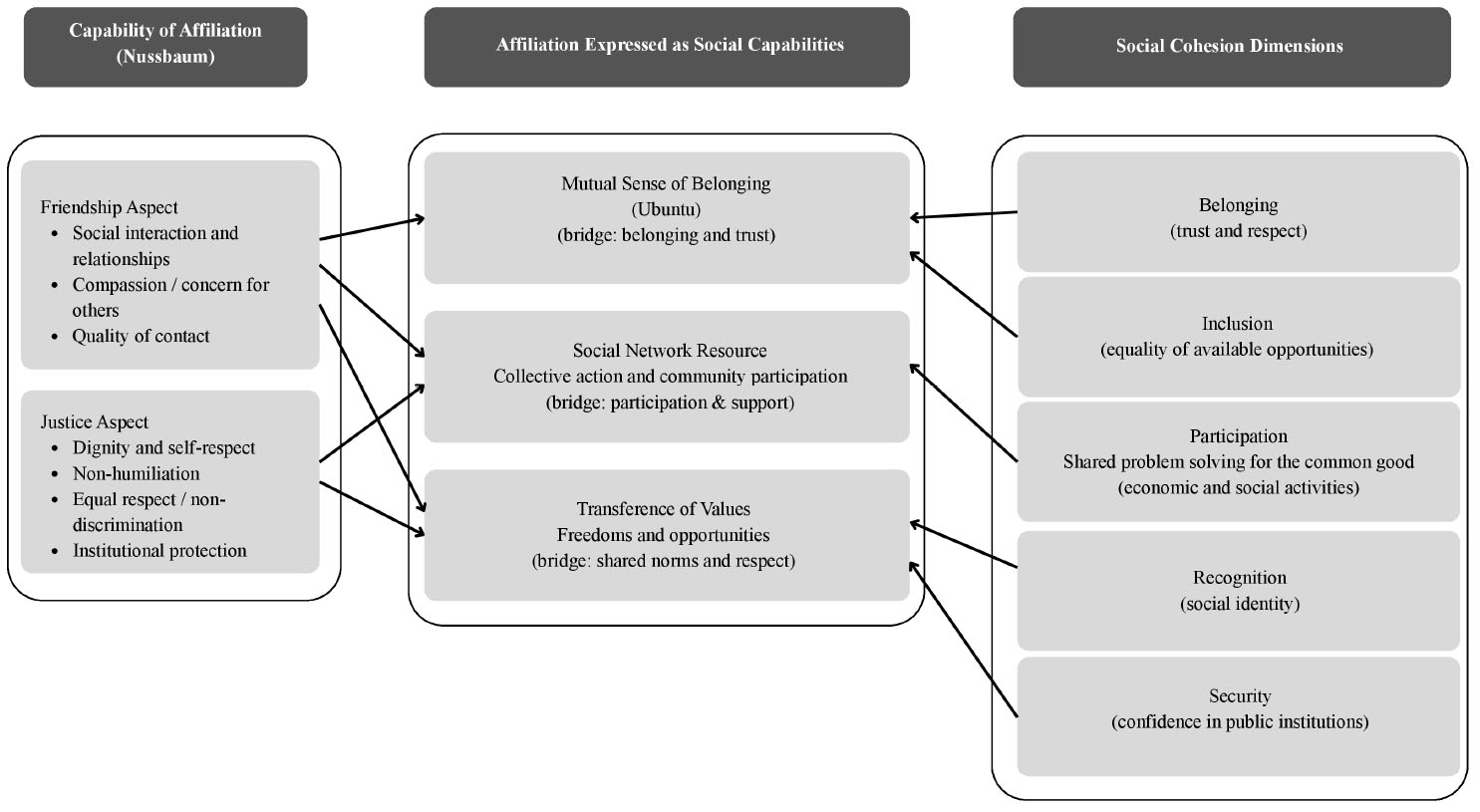
Social capabilities as bridges between the capability of affiliation and social cohesion.
1.5. Dimensions of Social Cohesion
Social cohesion is a characteristic of the quality of life, contributing to shared solidarity and loyalty [17]. It comprises (1) quality social relations; (2) identification with the overarching social entity; and (3) orientation towards the common good [23]. Moustakas [24] contends that social cohesion is a multi-dimensional concept centred on social relations, a sense of belonging and identification, and an orientation towards the common good. These dimensions have been further developed to include shared values, participation, mobility, and equality. Additional factors contributing to social cohesion encompass a sense of belonging (trust and respect), participation (economic and social activities), inclusion (fair access to opportunities), recognition (protection of identity), and legitimacy (confidence in public institutions) [24, 25]. Moustakas [24] also maintains that inequality weakens cohesion, with detrimental effects closely connected to segregation and deprivation.
In a similar vein, Seyoum [25] examined how state fragility influences human development outcomes across 180 countries. Their research explored both the direct impact of social cohesion on human development and the extent to which this relationship is mediated by state legitimacy. The findings reveal a link between greater fragility and diminished cohesion and human development outcomes. Enhancing social cohesion through policy discourse was identified as important for improving human development. Nevertheless, it should be acknowledged that both studies note state fragility manifests in diverse ways across countries, and that the dimensions of social cohesion ought to be broadened to reflect different cultural contexts [24-27].
Studies indicate that social cohesion fosters greater social participation and positively influences well-being through shared services [28-31]. Shared identity and connectedness cultivate a sense of belonging and affiliation within a group. In contrast, a lack of social cohesion may result in disorganisation, violence, human rights violations, and heightened social tension [32-35]. In South Africa, social cohesion is undermined by exclusion, poverty, and limited resources. Consequently, the South African National Development Plan (NDP) emphasises the need for an inclusive society and economy, as well as the pursuit of peace and security. It also calls for the development of an inclusive economy to enhance capabilities and strengthen the state [34, 36]. A cohesive society addresses disparities, inequalities, discrimination, and exclusion by reinforcing social relations and promoting inclusion [35].
Furthermore, when community members foster social cohesion, they are more likely to develop trust, respect, and positive attitudes towards others [24-30]. The establishment of participatory institutions and shared social networks is fundamental to strengthening cohesion. Government regulations also play a pivotal role in creating environments where citizens can cultivate a sense of citizenship, appreciation of differences, strong community ties, increased social unity, and the development of new identities [36]. In addition, family functioning can significantly influence the development of a stronger sense of cohesion.
1.6. Family and Social Cohesion
Research indicates that families play a central role in forming social ties, providing security, and sharing common ideas and values [35]. Building and maintaining relationships is therefore essential for well-being. Barnhart et al. [37] further argue that neighbourhood social cohesion can indirectly influence family well-being and resilience, with close ties offering both social and emotional support. Conversely, the family and community strengths that contribute to the development of resilience vary across societies; however, these are consistently linked to social networks, shared values, and people-place relationships [37-38]. Furthermore, Callan [39] contends that strong and stable families that provide members with support, care, and a shared sense of personal and collective identity enhance individuals’ feelings of belonging and connectedness within society.
Similarly, Lamanna et al. [40] found that well-functioning families thrive in environments that support child development. In South Africa, family functioning is shaped by social, political, and economic factors [35]. However, the conventional nuclear family is not the dominant family structure, with many children being raised by single parents or extended relatives [41, 42]. Early parent-child relationships are crucial for a child’s ability to relate to others, and families play a central role in establishing the capability of affiliation [4, 8, 43]. Social capabilities significantly influence individuals, families, and communities [17]. Consequently, families affected by a range of social challenges may experience constraints in achieving the capability of affiliation. As such, a gap exists in the literature regarding the interplay between social cohesion and human capabilities, particularly within the South African context. This study therefore, aims to explore the contributing aspects of social cohesion in a rural community and to examine the relevance of the human capability of affiliation in strengthening social cohesion in South Africa.
2. MATERIALS AND METHOD
2.1. Study Design
This study adopted a descriptive qualitative design to investigate in depth the experiences and understandings related to social cohesion and the capability of affiliation in a rural South African context. Grounded in an interpretivist paradigm, this approach prioritises the exploration of subjective meanings and individual perspectives within their socio-cultural settings [44, 45]. The study was guided by descriptive phenomenology, which seeks to reveal the essence of lived experiences by examining the “what” and “how” of those experiences, providing a detailed and objective account of phenomena from participants’ viewpoints [46].
2.2. Location and Setting
The qualitative study was conducted in two rural South African towns: Lambert’s Bay and Philippolis. Lambert’s Bay is situated along the West Coast, approximately 280 km north of Cape Town, and is classified as a rural coastal town with low socio-economic status linked to the fishing industry and harbour activities [47]. The total population of Lambert’s Bay is 6,120, with the majority of residents identified as Coloured (74%), followed by White (15%) and Black (8%), and Afrikaans is the predominant first language for approximately 90% of the population [48]. Philippolis is similarly characterised as a low-income and impoverished town. It is a small, remote settlement in the Free State province of South Africa, located between Bloemfontein (174 km) and Colesberg (65,4 km) [49]. The town has a total population of approximately 3,640, with a demographically diverse composition of around 70% Black, 25% Coloured, and 5% White residents. Afrikaans and Sesotho are the most commonly spoken languages in the community [49]. Both rural towns face significant social challenges, including poverty, inequality, unemployment, limited access to resources (such as land, water, education, skills, and government services), and substance abuse [50, 51].
2.3. Participants and Sampling
All participants were recruited using a purposive sampling technique, which was deemed appropriate given that families and stakeholders are recognised as key social agents of change within the social environment [52]. The inclusion criteria specified parents with children, as their experiences were directly relevant to the study’s focus. Individuals without children were therefore excluded from participation.
Table 1 summarises the demographic profiles of the participants in this study. Nineteen individuals took part in the interviews. The number of interviews was determined by the qualitative nature and exploratory aims of the research. At both study sites, all interviews were audio-recorded and transcribed verbatim to ensure the accuracy and depth of the qualitative data. Recruitment was facilitated through local non-governmental organisations (NGOs) operating in both towns, as well as a door-to-door approach within each community, which enabled direct interaction with residents. The study comprised 8 stakeholders and 11 parents. Of the participants, 12 were female and 7 male, with ages ranging from 21 to 67 years. The sample is diverse in population group and native language, varying from no formal schooling to postgraduate level. A fuller demographic description of this participant group has been reported in [53]; in the present article, participant characteristics are only included to contextualise the analysis.
| Category | Grouping | n | % |
|---|---|---|---|
| Town of Residence | Philippolis | 11 | 57,8 |
| Lambert’s Bay | 8 | 42,1 | |
| Gender | Female | 12 | 63 |
| Male | 7 | 36,8 | |
| Age | 18-67 | 19 | 99,8 |
| Population Group | Coloured | 7 | 36,8 |
| White | 6 | 31,5 | |
| Black | 5 | 26,3 | |
| Other | 1 | 5,2 | |
| Native Language | Afrikaans | 9 | 47,3 |
| English | 4 | 21 | |
| Xhosa | 3 | 15,7 | |
| Zulu | 2 | 10,5 | |
| Other | 1 | 5,2 |
2.4. Data Collection Instrument
To collect data, the study employed semi-structured interviews. This approach offered a flexible framework, enabling participants to express their experiences in detail and in their own words [45]. The interview schedule addressed themes related to social cohesion, such as community support, interpersonal relationships, sense of belonging, and participation. Informed consent was obtained before the interviews began, each lasting between 30 and 60 minutes.
2.5. Data Collection Procedure
Participants were recruited through local NGOs in both Philippolis and Lambert’s Bay, employing purposive sampling to identify families most pertinent to the study's objectives. The NGOs contacted potential participants telephonically to explain the study's purpose and invite voluntary participation. Interested individuals received information sheets and provided informed consent. The interviews that guided the study were focused on two aspects affiliations and social cohesion these questions were as follows: affiliation (“what are your feelings towards family and friends and the community”, “How do you show concern to others”) and social cohesion (“How do you teach children to show concern to others”, “Do you trust your family, friends, neighbours, governmental institutions”, “What values and traditions do you follow”, “Where and who do you spend the most time”). To maintain consistency, all interviews were conducted by the same researchers at NGO facilities within the same year until data saturation was met. Semi-structured interviews facilitated an in-depth exploration of participants' experiences. With participants' permission, all interviews were audio-recorded and subsequently transcribed verbatim. Transcripts were anonymised to protect confidentiality, and these procedures were upheld throughout the analysis to ensure adherence to ethical standards in qualitative research.
2.6. Data Analysis
The study adopted the six-step thematic analysis framework proposed by Braun and Clarke [54], which entailed: (1) familiarisation with the data to identify key details; (2) generating initial codes relevant to the study’s focus; (3) organising related codes into preliminary themes; (4) reviewing and refining themes to ensure consistency and depth; (5) defining and naming themes according to their distinct contributions; and (6) producing the final report, supported by illustrative quotes and analytical interpretation grounded in participants’ lived experiences [54]. Two researchers, K.R.O. and S.M., manually coded and provided themes for the data following the six thematic analysis steps and discussed and reanalysed the data until consensus was reached.
2.7. Trustworthiness and Reflexivity
Trustworthiness in qualitative research may be established through three key criteria, namely credibility, transferability, and confirmability [55, 56]. In the present study, credibility was ensured through the use of triangulation (employing multiple interview sources to corroborate the findings) and member checking (whereby participants provided feedback to validate their transcriptions) [45]. Transferability was addressed through the provision of thick description, in which detailed contextual information was presented to enable the findings to be relevant and applicable to similar study populations [55]. Confirmability refers to the extent to which the findings are shaped by the participants rather than by researcher bias [55]. In this study, confirmability was enhanced through researcher transparency regarding perspectives and potential biases, as well as the maintenance of audit notes in which key decisions were systematically documented. In addition, the research team comprised all female researchers with postgraduate qualifications in psychology, social work, and sports sciences. Interviews were conducted by K.R.O and S.M., ensuring that participant rapport was built before interviewing. Reflexivity included documenting the researcher’s transparency perspectives and potential biases, and the maintenance of audit notes documenting key analytical decisions.
2.8. Ethical Considerations
Permission for the research was granted by the Senate Research and Ethics Committee at the University of the Western Cape with ethics number HS24/10/29. Participants were invited to take part in the study voluntarily, with those consenting signing an informed consent document. Before the commencement of each interview, participants were reminded of their right to participate voluntarily and informed that they could withdraw or discontinue at any point during the interview without penalty. The primary researcher also clarified that participants were not obliged to answer any questions they found uncomfortable. Adherence to the principle of non-maleficence was maintained, ensuring that no harm befell participants throughout the interview process. To safeguard participant identity and uphold confidentiality and anonymity, any names mentioned during the interviews were removed and replaced with pseudonyms [56].
3. RESULTS AND DISCUSSION
The data collected examined parents’ and stakeholders’ experiences and perceptions of social cohesion, as well as the contribution of affiliation capabilities within their community. Analysis of the data from both rural communities revealed two principal themes, each comprising several sub-themes, which are presented in Table 2. The first theme addresses dimensions of social cohesion within the community, encompassing community support and relations, community participation, and collective efficacy. The second theme concerns parents’ and stakeholders’ affiliation as a social capability, further defined by their shared sense of belonging, the social network resources available, and how these attributes are transmitted to their children.
| 3.1 Perceptions of Social Cohesion | 2.1 Affiliation as a Social Capability |
|---|---|
| 3.1.1 Community support and relations | 2.1.1 Mutual sense of belonging |
| 3.1.2 Community participation | 2.1.2 Social network resource |
| 3.1.3 Collective efficacy | 2.1.3 Transference of values |
The analysis demonstrates a reciprocal relationship between social cohesion and affiliation capability, wherein a sense of belonging arises from engagement and networking with others. Strong social relations result from the interplay between cohesion and affiliation capability.
3.1. Theme 1: Perceptions of Social Cohesion
The first theme, 'Perceptions of Social Cohesion', explored participants' interpretations of social cohesion. Analysis of the data revealed three sub-themes: ‘community support and relations’, ‘community participation’, and ‘collective efficacy’.
3.1.1. Community Support and Relations
Parents and stakeholders from both communities were invited to share their perceptions regarding mutual support among community members. Participants from Lambert’s Bay and Philippolis indicated that support is primarily demonstrated through group affiliations based on social or cultural backgrounds. Respondents in both areas also conveyed a sense of comfort when interacting with community members who share the same racial or religious identities. The following participants reported these perspectives:
“Yes, our people are very helpful, we go out of our way to help people … I'm specifically talking about coloured people, we go out of our way to help other people is probably our Christianity” (Lambert’s Bay, Parent, Participant 7).
A participant in Philippolis similarly noted that their sense of community is divided according to the various groups with which individuals are affiliated within the community. This was expressed as follows:
“There are a few groups that are implemented here in Philippolis… for sure growing up in a community everyone has their own groups where they feel comfortable in… They rather stick to their own groups… Yes, I do think they are more comfortable because they feel at ease in their group section. There are sometimes clashes between the groups. In general, if it comes heart on heart, the whole community stands together” (Philippolis, Stakeholder, Participant 3).
These findings are consistent with the literature indicating that group affiliation, grounded in shared values and identity, is fundamental to social cohesion [9, 13, 57]. Social identity theory suggests that individuals exhibit a preference for their in-groups, accounting for the pronounced intra-group support reported in the study [57-59]. Harwood [60] argues that positive group relations help individuals achieve their desired identity [61-64]. Such dynamics correspond with the conceptual framework of social cohesion, wherein a collective sense of belonging facilitates coordinated action [60, 65, 66]. The findings therefore demonstrate that both communities reported a strong sense of cohesion between groups. Additionally, a second sub-theme emerged concerning the state of cohesion within the two rural communities.
3.1.2. Community Participation
The state of cohesion was examined in both communities, revealing divergent perspectives between the two areas. Participants from Lambert’s Bay noted that community members tend to be supportive when they are able to assist during times of need. In contrast, participants in Philippolis indicated a desire for greater cohesion within their community. The following responses illustrate these viewpoints:
“Our neighbourhood is basically our congregation, um [laughs] you see that makes it difficult because people we are involved with and we will go do a home visit, not as a social worker but to go see how we can help, because we will take the resources within the church to go and help people, or sometimes personally, if we can. Especially if it's not from our congregation, we will help personally if we can, money-wise, food-wise, look out for a job, or look out for accommodation. And there I might say that I'm not very hospitable, so I won't let anyone into my house…so I will seek accommodation for other people” (Lambert’s Bay, Stakeholder, Participant 5).
Participants in Philippolis indicated that, although cohesion is advancing, the process remains gradual. Several individuals also articulated a desire for greater unity within their community. Social integration and interactions within groups appear less dynamic than those occurring between different groups. The following participants expressed these perspectives:
“If you had this interview 20 years ago. It would’ve been a very different story. But there is also a very slow integration that is taking place. When I got here about 20 years ago, the people didn’t even get into one another’s communities; they didn’t talk to one another. If you were cross-culturally, you were frowned upon, so the teachers were outsiders. I was an outsider because I was also culturally. But today that has shifted … no, I think we are far from it. I think we are taking steps, baby steps. The thing you must remember is that racism was a big part of this community, and we still have our hard-minded racists, not only in the white community, make no mistake, you have it in the other communities as well” (Philippolis, Stakeholder, Participant 7).
“We need to get back to standing together and helping each other and being in community…” (Philippolis, Stakeholder, Participant 3).
These findings indicate that inter-group cohesion, facilitated by social integration, is essential for fostering broader social cohesion. This aligns with the South African context, where, despite increased social connection since the end of apartheid, many individuals continue to primarily interact within their own racial groups [66]. This is in line with social identity framework studies on group bias and positive self-identity. South African social and structural strain has been shown to impact these preferences, especially amongst social status groups [64-67]. In the South African context, strong in-group cohesion may sometimes result in exclusion or reduced tolerance for difference, potentially impeding wider societal cohesion [61, 64, 66]. Although cohesion between groups was enhanced, evidence of social cohesion also emerged during times of crisis. The third sub-theme examined the manifestation of cohesion during periods of crisis.
3.1.3. Collective Efficacy
A key finding across both areas was that participants indicated that cohesion within their community, family, and among individuals tended to strengthen in times of crisis. The findings demonstrate that social support becomes particularly apparent during challenging periods, both within and between groups in each community. Furthermore, the utilisation of social networking as a resource in both communities fostered greater participation among members, encouraging collective action for the benefit of their respective communities. Participants articulated this as follows:
“You have to ask the municipality they are there to fill the need, and if it gets to the mayor's office, like last year houses burnt down, and they help the people with food parcels and clothing and in one of the buildings he has bags and bags of clothing that we often give to the people, that really needs it, so yes the municipality does its part and the church does its part. I am from a church where we give food, we give soup…to the people” (Lambert’s Bay, Parent, Participant 7).
Cohesion during times of crisis was shaped by specific contextual factors that prompted community members to unite in support of those facing hardship. Participants described various approaches to expressing concern and providing care to individuals or families requiring financial assistance, including collective donations during periods of need. One participant from Philippolis remarked that while some community members may be unable to assist someone on their own, they are able to do so collectively by joining forces with others. The dynamics of social cohesion are thus apparent in the following quotation:
“...Then there is a death in that house, and there is really nothing in that house, then the community will stand up and help. Someone will walk with a form and gather donations. And we will stand together. But also, not everyone, those that can… Yes, they must ask. We go there and help; if there is death, we see what the situation is, but he must say. We can see there is nothing, but we won’t know really how much he needs or what, he must say, then we ask how we can help, then we help. We go door to door and ask for donations, just what you can give, and then we are satisfied. And you can go to the office and give donations, like for a casket. Our place is small, but we walk through the town and go to the location. So far, we have gotten our help” (Philippolis, Parent, Participant 8).
“Yeah, so you will find meetings when there are problems …Yeah, and they also sit together and will sit in the town hall. Everybody who has an interest in the problem or getting the problem solved will be there…. Yeah, people don’t like attending meetings in this town. When they need to, when there’s a crisis that needs to be solved” (Philippolis, Stakeholder, Participant 7).
One participant noted that cohesion within their community is most apparent following the loss of a community member. Evidence of cohesion was identified both within specific groups and across different groups in the community. The participant explained the following:
“I can see it [cohesion] especially. You see it when you have a crisis [funerals] then the cohesion will be across the races as well. As I said, I don’t think we are where we should be, but we are journeying to get there. … Here you will speak to [a] few or four leaders, and they will speak to their people, and solve it, and come back with a solution. You must think about it as a network. Yeah, it’s a network of different interactions” (Philippolis, Stakeholder, Participant 7).
The findings indicate that individuals possess the capacity for social cohesion, particularly in times of crisis. This aligns with research demonstrating that social context and structural factors significantly influence one’s ability to function [32, 33]. Identity is shaped by a range of affiliations within the community [4, 8, 60, 68]. Although in-group ties are strong, expressed distrust between racial groups presents a barrier to wider cohesion, as trust depends on a network of positive daily encounters [66]. In contrast, the overall results related to the first theme, ‘perceptions of social cohesion’, and its sub-themes, reveal that participants have experienced deprivation in their capability for affiliation, especially concerning equality and non-discrimination among community groups. Such deprivations affect both individual and collective capacity for social engagement within their environment [17, 21].
The results of the present study are consistent with those of the South African Social Attitudes Survey (SASAS) conducted in 2009 and 2010 [67], which identified three key categories influencing attitudes and behaviours related to social cohesion. These domains are: 1) social and cultural; 2) civic; and 3) economic. The social and cultural domain of the SASAS indicated low scores for social trust, racial tolerance, and intergroup contact. Conversely, findings in the civic domain remained strong, suggesting that higher levels of social cohesion are associated with factors such as national identity and social and political participation. The SASAS results also indicate that sociodemographic perspectives on social cohesion in South Africa differ across all three domains. In this context, the social environment and broader setting shape social capabilities [67].
The second and final theme identified pertains to the social capacity of affiliation groupings. The data revealed that affiliation categories function as a significant social capability.
3.2. Theme 2: Affiliation as a Social Capability
The final theme relates to Nussbaum’s [4] capability of affiliation and explores how parents and stakeholders connect and relate within their communities. Findings from both communities were organised into three sub-themes: the ‘mutual sense of belonging’ among parents and stakeholders, the use of ‘social network resources’, and the ‘transmission of values’ to others.
3.2.1. Mutual Sense of Belonging
Participants from both communities articulated a pronounced sense of collective sentiment towards others in their community. They described their community as small, facilitating close acquaintance among most members. Feelings of care for others were often linked to the depth of personal familiarity, as reflected in statements such as:
“…we are one big family, and we care for one another…we care about each other, if I don't have something I can go ask that person or that person, we help one another, I'm not so sure about the other people around here, but the people close to me we are like that” (Lambert’s Bay, Participant 3).
“Well, I have been in Philippolis for 17 years, so I would say everybody knows everybody, you tend to know faces or maybe names or not, so it's actually a very small community, and a quiet community and a poor community” (Philippolis, Participant 2).
One participant offered a more neutral perspective regarding their feelings towards others in the community. The participant remarked:
“I am ok and that I don’t have a problem with anyone, and if there is someone who has a problem… I am not really worried about the community” (Philippolis, Participant 11).
A mutual sense of belonging is evident within these communities. Empirical studies indicate that social identity serves as a key antecedent of social cohesion, which is enhanced when individuals identify with a particular group [24, 37]. The capacity to affiliate with groups represents a central element in the development of social cohesion [24-25, 68, 69], facilitating positive outcomes such as collective participation in efforts to achieve shared objectives within society and communities [69]. The motivation for collaborative action will be explored further in the next sub-theme.
3.2.2. Social Network Resources
Another sub-theme that emerged from the data in both communities concerned how participants utilise their social networks and resources to demonstrate care within their communities. A strong sense of affiliation with the church was evident as a key means through which participants expressed their willingness to help others. Participants indicated that networking and showing concern for others were largely facilitated through their religious affiliation in both communities. The following participants from Lambert’s Bay expressed these views by stating:
“I'll get a Deacon to go and find out what happened, and what the family needed and then I'll network with the community to find out how we can help, to see that least every 2-3 days a bread gets delivered to the house just to see that the family has something to eat, and also look at what type of other work the person can find” (Lambert’s Bay, Participant 6).
“Yes, but also everybody, because for me it doesn't go about the colour, for me we are all people, and God made us, and we need to be handled in an equal manner. … So we give, and we care a lot about the community, especially for our immediate family; if one gets hurt, we all get hurt, if one cries, we all cry; and if one laughs, we all laugh” (Lambert’s Bay, Participant 7).
A divergent finding emerged in Philippolis, where one participant noted that individuals demonstrate concern for others, whereas another participant contended that people lack time for one another.
“…we had once a worker at the church that had a problem with alcohol. We had a discussion with him, and we told him we are prepared to send him for rehabilitation…” (Philippolis, Stakeholder, Participant 7).
“… We don’t have actual incidents of racial conflict, although people might in their minds think they don’t want to mix with someone, but they don’t voice it…. We don’t actually have time for each other…, if I have something to give to somebody, I will give it, but if I am not in the position, I must not be forced to give because I feel sorry for everybody - and I tend to do that too much. I just see the last 10 years people don’t have time for each other” (Philippolis, Participant 2).
Studies have shown that people’s belief systems are associated with a range of behaviours, attitudes, rituals, and traditions. These findings align closely with research arguing that traditional cultural beliefs play a key role in shaping individuals’ sense of belonging [70]. Stroope [70] found that individuals who believe the Bible to be the word of God are more likely to experience a strong sense of belonging in the church, grounded in shared devotion and unity around biblical practice. In contrast, those who hold less traditional views of the Bible tend to display weaker feelings of belonging within such groups. Religious affiliation is further reinforced through the practice of religious teachings, with expressions of love, support, and care directed towards both God and others. Similarly, empirical studies by Sen [71] and Nussbaum [5] suggest that actions undertaken for others and in response to their concerns are closely linked to feelings of affiliation. The Capabilities Framework argues that the central foundation of affiliation lies in the sense of ‘being and doing together’, a process that is essential for community-based organisations working collectively [4, 8, 68]. This perspective emphasises that participatory action should not be individually oriented but rather community-based, involving people who work together to achieve positive outcomes for the common good. Taken together, these insights highlight that participants’ social capabilities function as a social resource that can enhance well-being through religious practice and affiliation with the church.
3.2.3. Transference of Values
Parents indicated that family values are conveyed to children through both communication and observation. Concern for others is further nurtured by prioritising respect and steering clear of harm. The findings also demonstrate the transmission of generational values and beliefs from parent to child.
“So, we go according to the Bible and the idea that we must not steal, and not to hurt each other, and care about each other. So, we get taught from generation to generation, that my child is your child, and we live in a community where we care about each other, so yes, without fighting to speak to each other, we mustn't hurt each other…and that is what I teach our children” (Lambert’s Bay, Participant 7).
“He [participant’s son] will have respect and greet other people in the road even though he must know that he must say good afternoon…I'll teach you to help that person, to help where he can” (Lambert’s Bay, Participant 3).
“Yes, it depends. We always have the motto ‘A[n] obedient child has an obedient parent’. You know, children tend to be selfish, but mine are not. Um, I think they are empathetic, but it depends on the parents’ attitude. I will never say to ignore someone. It depends; you cannot say the whole town is empathetic, but there are groups. It wasn’t like this many years ago…It has changed, yes…” (Philippolis, Participant 2).
Evidently, both communities display a pronounced sense of affiliation as a capability, aligning with Nussbaum's notion of being able to “live with and towards others” and demonstrate compassion [4-6]. This is reflected in robust social relations and a profound sense of belonging within the community. The transmission of these values from parent to child proves essential, as children acquire them through imitative and affiliative behaviours [72]. The findings indicate that a strong sense of belonging, closely associated with religious beliefs and values, reinforces social cohesion among families and the wider community. Nevertheless, limited inter-group affiliation constrains South Africa’s progress towards enhanced social cohesion [72-74]. Furthermore, the enduring impact of living in a social context that denies individuals dignity can undermine feelings of security regarding personal worth and competence. Inequality, which diminishes perceptions of respect and value, leads to adverse psychological states that have lasting negative consequences for the health and well-being of individuals, families, and communities [66]. Consequently, the development of personal and group identity, a sense of belonging, and the capacity to care for others, alongside active participation in community life, are vital for establishing cohesive societies [17]. Achieving these outcomes necessitates diverse forms of governmental and social service support, as well as the involvement of community leaders through the implementation of interventions or programmes in rural settings to foster cohesion and promote improved social and economic prospects for families and communities.
4. IMPLICATIONS FOR POLICY AND PRACTICE
In South Africa, social cohesion is framed as a ‘nation-building project’ aimed at closing developmental gaps. As national social cohesion policy seeks to address disparities in development, factors such as socio-economic inequality highlight the importance of promoting diversity, societal well-being, belonging, trust, employment opportunities, and poverty reduction [17, 71-73]. However, the legacy of apartheid has had a lasting impact on socio-economic conditions, contributing to social division and uneven economic advancement. This has, in turn, shaped the capacity of individuals and communities to realise justice and social cohesion [66]. Although progress has been made under the NDP 2030 with regard to social cohesion, South African society remains deeply divided along social and economic lines [50, 66, 75]. Inequality continues to have a detrimental effect on community-level social integration [50, 66].
Furthermore, despite these advancements, regional disparities in opportunities, service quality, and access to essential services persist [76]. This further highlights the acknowledgement in the National Strategy for Developing an Inclusive and Cohesive South African Society of the significant challenges faced by local governments in delivering services equitably [75]. Khaile et al. [76] argue that, according to this plan, South Africa must strive towards “an inclusive, cohesive, sustainable, dynamic, and durable society” that coordinates all branches of government, including local government. To achieve this vision, the plan emphasises that social cohesion and nation-building should remain a medium- to long-term priority for local government.
The findings of this study indicate that, within the two rural communities, family and community members demonstrated a strong sense of affiliation as a capability. This suggests that a sense of belonging, supportive structures, and strong religious and social networks enhance social cohesion within communities. The importance of healthy families in nation-building has been emphasised by [77]. Similarly, the White Paper on Families highlights that families are the cornerstone of South Africa’s social cohesion and nation-building efforts [77]. However, there is a clear need for government and other stakeholders to adopt a more holistic approach to community and family work, and to become more integrated in their practices by actively encouraging community involvement in the design and implementation of interventions. In this regard, Thomas underlines that promoting communities as partners requires long-term commitment, as family and community-wide interventions take time to yield meaningful results [78]. Individual actions, however, are often shaped and constrained by local circumstances, which may be influenced by less visible structural and social factors that require deliberate attention to promote inclusive and cohesive societies. Thus, social and cultural context remains a critical factor in supporting the development of social cohesion within rural communities in South Africa.
5. LIMITATIONS AND RECOMMENDATIONS
A significant limitation of this study lies in the cultural and contextual diversity that characterises South African society. Because the findings are context-specific and based on a relatively small sample, their generalisability to all rural communities in South Africa is limited, particularly given that social cohesion and affiliation are experienced and interpreted differently across communities. Consequently, future research should remain contextually grounded and culturally sensitive to avoid overgeneralisation or misinterpretation. Moreover, social cohesion and affiliation are dynamic processes, and the data may not capture changes that occur over time in response to shifting socio-political or economic conditions.
Despite these limitations, investigating social cohesion within economically disadvantaged communities remains critical. Such research is essential for informing inclusive development strategies and guiding equitable policy interventions aimed at addressing poverty, inequality, and social division. Future studies could adopt longitudinal designs or integrate quantitative methods to track changes in social cohesion and affiliation over time, thereby providing broader and more generalisable insights.
In addition, further research could replicate or extend this study across other rural areas and provinces to explore whether similar patterns of affiliation and cohesion emerge within different cultural and economic contexts. The findings of this study should inform both local and national policy initiatives aimed at strengthening social cohesion, particularly through efforts that promote inclusive community structures. By addressing these limitations, scholars and practitioners can contribute to more effective, context-responsive approaches that enhance social cohesion in South Africa’s most vulnerable settings.
CONCLUSION
The results of this study demonstrate the significance of social policies and intervention programmes designed to enhance social cohesion, including affiliation and social capabilities. The evidence indicates that future policy development should prioritise the strengthening of social networks and promoting affiliation as a key social capability. Affiliation and social cohesion are strongly influenced by the quality of social relationships and interactions within communities. However, within the South African context, it is essential to consider social relations and interactions across diverse cultural and economic groups. Striving for and understanding social cohesion in South Africa remains a complex challenge, as empirical evidence in this area is still emerging. Social context plays a critical role in achieving and sustaining the capability of affiliation and the development of social capabilities within communities. For communities to affiliate collectively, they must cultivate a shared sense of belonging, develop well-functioning social network structures, and cultivate shared belief systems. These elements, in turn, sustain affiliation and social capabilities, promoting greater social cohesion that contributes to the social well-being of both families and the broader community.
AUTHORS’ CONTRIBUTIONS
The authors confirm their contributions as follows: K.R.O. and N.V.R.: Study conception and design; K.R.O. and S.M.; Data collection; K.R.O., N.V.R., C.S., and C.J.: Analysis and interpretation of results; K.R.O., S.M., N.V.R., and C.S.: Draft manuscript. All authors reviewed the results and approved the final version of the manuscript.
LIST OF ABBREVIATIONS
| AC | = Affiliation Capability |
| CA | = Capability Approach |
| GHS | = General Household Survey |
| HSSREC | = Human and Social Sciences Research Ethics Committee |
| NDP | = National Development Plan |
| NGO | = Non-Government Organisation |
| NPC | = National Planning Commission |
| SC | = Social Cohesion |
| OECD | = The Organisation for Economic Co-operation and Development |
| NRF | = National Research Foundation |
| SA | = South Africa |
| SASAS | = South African Social Attitudes Survey |
| UNDP | = United Nations Development Programme |
| UWC | = University of the Western Cape |
ETHICS APPROVAL AND CONSENT TO PARTICIPATE
Ethical approval for the study was granted by the University of the Western Cape (UWC) Humanities and Social Sciences Research Ethics Committee (HSSREC), South Africa under ethics reference number HS24/10/29.
Permission to conduct the research was also granted by the Senate Research and Ethics Committee at the University of the Western Cape.
HUMAN AND ANIMAL RIGHTS
All human research procedures followed were in accordance with the ethical standards of the committee responsible for human experimentation (institutional and national), and with the Helsinki Declaration of 1975, as revised in 2013.
CONSENT FOR PUBLICATION
Written informed consent was obtained from all participants involved in the study for publication.
AVAILABILITY OF DATA AND MATERIALS
All authors confirm that the data supporting the findings of this study are available within the article.
FUNDING
The authors acknowledge funding from South Africa’s National Research Foundation (NRF), Funder/Programme: SARChI Chair in Development of Human Capabilities and Social Cohesion through the Family (Award/Grant number: SARCI170802258816).
ACKNOWLEDGEMENTS
Declared none.