All published articles of this journal are available on ScienceDirect.

Beyond Acceptability: Behavioral and Implementation Determinants of Utilization of Local Food-based Supplementary Feeding among Children in Indonesia
 iD
Bunga Astria Paramashanti2
iD
Utami Utami3
iD
Sri Indra Trigunarso4
iD
Vitria Dwi Wulansari1
iD
Muhammad Primiaji Rialihanto1
iD
Intan Yusuf Habibie5
iD
Authors Info & Affiliations
Abstract
Introduction
Child undernutrition remains a major public health issue. Local food-based supplementary feeding programs (SFPs) are widely implemented to improve dietary intake among young children. However, evidence regarding their acceptability and determinants of implementation remains limited. This study aimed to examine the acceptability, behavioral, and implementation factors affecting the utilization of local food-based SFPs at the community level.
Methods
This study employed a convergent mixed-methods research design in Sleman District, Indonesia, from October to December 2025. This study collected quantitative data from 248 children under five enrolled in the program and qualitative data from 25 caregivers. The quantitative data were analyzed descriptively, and the qualitative data were analyzed using thematic analysis to explore experiences and perceptions.
Results
One in three children (33.9%) fully consumed the supplementary foods. For 68.1% of children, the supplementary food was consumed by the child alone; for 30.6%, it was shared with other household members; and for 1.2%, it was consumed only by family members. Qualitative findings identified child preference, health and appetite, caregiver feeding practices and capacity, time constraints, intra-household food sharing, menu characteristics, delivery schedules, accessibility, and community support as factors shaping supplementary food utilization.
Discussion
Menu acceptability was not the sole factor influencing SFP utilization. Feeding behaviors, caregiving capacity, and program feasibility should be considered in program design because they strongly influence the success of SFPs.
Conclusion
To ensure effective SFP utilization, behavioral and contextual factors should be taken into account. Integrating behavior change strategies and strengthening caregiver support are critical to improving the effectiveness of community-based nutrition interventions.
1. INTRODUCTION
Child undernutrition remains a major public health concern in low- and middle-income countries [1]. Likewise, the prevalence of undernutrition in Indonesia remains high (stunting: 19.8%; wasting: 6.2%; underweight: 16.8%) [2]. Supplementary feeding programs (SFPs) have been widely implemented to improve children’s energy and nutrient intakes, thus supporting optimal growth. Evidence from programmatic settings suggests that such interventions can improve nutritional outcomes [3-5]. However, their implementation effectiveness is often inconsistent, indicating a gap between program design and household-level impact.
One important but insufficiently examined pathway underlying this gap is the relationship between food provision and actual consumption. Most SFPs implicitly assume that foods distributed to households are consumed as intended by the target child. In practice, however, this pathway is mediated by a range of factors, including menu acceptability, child feeding behavior, and caregiver practices [6, 7]. Acceptability encompasses sensory attributes and cultural appropriateness [8]. Child preference may influence a child’s willingness to consume the provided foods. However, this may not necessarily translate into consistent intake [9]. Caregiver-related factors, such as knowledge, time constraints, food preparation skills, and intra-household food allocation, further shape whether and how supplementary foods are utilized [10, 11]. Thus, the utilization of supplementary feeding may not be merely a function of access but rather a behavioral and contextual process.
Over the last decade, several programs have shifted toward using locally available foods. Local food-based SFP is expected to enhance acceptability, align with day-to-day diets, and improve long-term feasibility [12]. Previous studies suggest that such approaches can support dietary diversity and community engagement, particularly when combined with nutrition education and growth monitoring [3, 4, 11, 12]. Nevertheless, existing evidence remains heavily oriented toward nutritional outcomes.
Current literature on SFPs is also characterized by a mixed understanding of key determinants. Studies often examine only program coverage or nutritional outcomes [3, 4, 13], while the interrelationships among menu acceptability, child eating behavior, caregiver practices, and program utilization are rarely assessed. Moreover, evidence from community-based implementation remains limited in terms of resources, practices, and environmental contexts [14]. This gap is important because acceptability alone does not guarantee that children will consume the food. Caregiver-child feeding interactions and socioeconomic factors may play a larger role in determining program success.
Therefore, this study used an implementation research design to examine how locally based SFP is utilized at the community level. This study also identified behavioral and contextual determinants that influence SFP utilization. Overall, this study seeks to develop a more nuanced understanding of why SFP may not be utilized despite adequate provision. The findings are expected to inform the design of more effective, behaviorally responsive, and implementation-sensitive SFP interventions.
2. METHODS
2.1. Study Design
This study used an implementation research approach using a convergent mixed-methods design to evaluate the utilization of a local food-based supplementary feeding program (SFP). The quantitative component was primarily descriptive and was used to characterize supplementary food utilization patterns, while the qualitative component was used to explore behavioral, caregiver, household, and program-related factors underlying these patterns. This design enabled the concurrent collection of quantitative and qualitative data. At the end, this study integrated the interpretations of quantitative and qualitative findings to provide a comprehensive understanding of the behavioral and contextual factors influencing SFP utilization at the community level. The qualitative component was reported in accordance with the Consolidated Criteria for Reporting Qualitative Research (COREQ) [15]. The completed checklist is provided in Supplementary File 1.
2.2. Study Setting and Participants
This study was conducted in Sleman District, Special Region of Yogyakarta, Indonesia, between October and December 2025. The study population consisted of children under 5 years of age enrolled in a local food-based SFP, namely the Pemberian Makanan Tambahan Lokal (PMT Lokal) and/or Pecah Ranting Hiburane Rakyat (PRHR) programs. The local PMT programme is a government-supported intervention that provides supplementary foods made from local ingredients for approximately 120 days, primarily aimed at underweight children. Meanwhile, the PRHR programme is a community-based initiative implemented in shorter cycles (14-56 days), with the duration tailored to the child’s growth condition.
Of the 322 children initially registered in the supplementary feeding programs, 248 were included in the quantitative analysis. For the quantitative component, the authors did not perform an a priori sample size calculation. This study applied total sampling, in which all children registered in the PMT Lokal and/or PRHR programmes in two subdistricts during the study period were eligible for inclusion. The remaining 74 children were excluded because their records contained incomplete or invalid information required for the analysis, including dietary intake and/or anthropometric information. For the qualitative component, participants were purposively selected for their involvement in the program and for variation in socio-demographic characteristics to capture diverse perspectives. Interviews were analyzed iteratively during data collection. Emerging codes and themes were reviewed to determine whether subsequent interviews generated substantively new information relevant to the research questions. By the 22nd interview, no substantively new codes or themes were identified. Three additional interviews were conducted to confirm the stability of the emerging thematic structure, bringing the total to 25.
2.3. Intervention Description
The locally based SFP is a community-based nutrition intervention that provides additional food using locally available ingredients. Foods are distributed either as ready-to-eat meals or as raw ingredients prepared by mothers or caregivers at home. The program is implemented through collaboration between community health volunteers (kader) at posyandu (integrated village-level health post), local small and medium enterprises, and primary health services. In addition to food provision, the program includes nutrition counseling for caregivers, regular child growth monitoring, and behavior change communication activities. The duration of supplementary feeding varies depending on nutritional status: pregnant women (120 days); children with moderate undernutrition (56 days); children with underweight (28 days); and children with inadequate weight gain (14 days). For participants in the PRHR program (2025 cohort), supplementary feeding was provided for up to 90 days. These SFPs differed in eligibility criteria, intended duration, and implementation arrangements. PMT Lokal was implemented for children who met the relevant program criteria, whereas PRHR was implemented based on children's growth conditions and program needs. The duration of participation therefore varied across children and program types.
2.4. Variables and Measures
2.4.1. Quantitative Component
This study presents the quantitative component descriptively. The main outcome was supplementary feeding utilization, assessed using two indicators: (1) consumption adherence (fully consumed or not fully consumed) and (2) consumption patterns (consumed by the child only, shared with other household members, or consumed by family members). This study defined full consumption as caregiver-reported consumption of the entire portion of supplementary food provided for the target child. When any portion remained or was consumed by another household member, the food was classified as not fully consumed by the target child.
This study described the child and household characteristics, including child age (12-23 months, 24-35 months, 36-47 months, and 48-59 months), history of exclusive breastfeeding (no, yes), timing of complementary feeding initiation (<6 months, >6 months), current breastfeeding status (no, yes), caregiver age (<20 years, 20-35 years, >35 years) caregiver education (primary, secondary, higher education), caregiver occupation (not working, informal workers, formal workers), and number of children in the household (one, two or more). This study assessed dietary data using a dietary diversity score based on standard food group consumption (<5 or >5 food groups). Dietary diversity was assessed using a caregiver-reported checklist covering eight food groups based on WHO guidance [16]. Caregivers reported the food groups the child consumed during the 24 hours preceding the assessment.
2.4.2. Qualitative Component
The qualitative component explored menu acceptability and feeding practices. Menu acceptability was assessed based on caregiver perceptions, including taste, variety, and suitability to the child’s preferences. Additional themes included intra-household food sharing and factors influencing the utilization of supplementary feeding at the child, caregiver, and programmatic levels.
2.5. Data Collection
This study collected qualitative data through semi-structured, in-depth interviews with caregivers about their experiences receiving, preparing, and feeding supplementary foods to their children. Interviews were conducted in Bahasa Indonesia by two trained interviewers with master’s degrees (V.D.W.) and a doctoral degree (T.S.) in nutrition, who had no prior relationship with the participants and were not involved in programme delivery. Participants were approached via community health volunteers. Interviews took place at participants’ homes or in a room at the posyandu. Each interview lasted approximately 45-60 minutes. An interview guide developed by the research team and pilot-tested with two caregivers was used. Interviews were audio-recorded with consent, supplemented by field notes, and transcribed verbatim. No repeat interviews were conducted. Transcripts were not returned to participants for comment. No caregiver declined to participate.
2.6. Data Analysis
2.6.1. Quantitative Analysis
This study used descriptive analysis to summarize variables using frequencies, percentages, means and standard deviations, medians, and interquartile ranges, as appropriate. The primary utilization outcomes were whether the supplementary food was fully consumed by the target child and the reported consumption pattern. Descriptive analyses were used to characterize the participating children, dietary characteristics, program type, and patterns of supplementary food utilization. No multivariable regression analysis was conducted because the quantitative dataset contained a limited set of covariates and did not include several caregiver- and household-level characteristics that emerged from the qualitative findings as relevant to utilization. These characteristics were available for the qualitative participants but were not collected quantitatively for the full sample. All analyses were performed using STATA version 17.0.
2.6.2. Qualitative Analysis
This study analyzed qualitative data using deductive-inductive thematic analysis. Coding was conducted by two researchers (TS and BAP). Discrepancies were resolved through team discussion. Analysis was performed in the original language, and quotations selected for publication were translated into English by BAP and checked by TS. Participants did not provide feedback on the findings.
This process involved several steps. First, the authors read the transcripts several times for familiarize ourselves with the data. Second, this study developed and manually discussed initial codes in line with the interview questions. Third, relevant quotes were applied to each code. Fourth, themes and subthemes were developed, and their alignment with the research questions was assessed. This study also inductively allowed emerging themes from the data. Fifth, this study organized the themes and subthemes within the matrices in Microsoft Excel, reviewed, and refined them.
To ensure rigor and trustworthiness of the findings, we used data analyst triangulation and team discussions. This study involved various sources of informants, including mothers, grandmothers, and other family members who served as primary caregivers for children. Detailed information about the study setting and participants was provided to help readers understand the context and consider whether the findings may be relevant to similar settings. Participant quotations were included to illustrate the themes and ensure that the findings reflected participants’ experiences.
2.6.3. Integration of Data
This study integrated quantitative and qualitative findings when interpreting the data by comparing quantitative patterns of supplementary food utilization with themes emerging from the qualitative analysis. This study developed a joint display to explicitly link quantitative findings with corresponding qualitative themes and integrated interpretations. Areas of convergence, complementarity, and contextual explanation were identified.
3. RESULTS
3.1. Quantitative Findings
Table 1 summarises the characteristics of the 248 children included in the study. The largest proportion of children was aged 24-35 months (32.3%), followed by 36-47 months (28.2%) and 48-59 months (25.8%). Most children had a history of exclusive breastfeeding (79.8%) and were introduced to complementary foods at ≥6 months (85.1%). At the time of the survey, 15.7% of children were still being breastfed, and the mean weaning age was 21.9 months (SD ± 8.0). Most children had a dietary diversity score ≥5 (87.5%). As many as 43.5% of children received PRHR, 37.1% received local PMT, and 19.4% received both.
| Characteristics | n | % |
|---|---|---|
| Child’s age (in months) | ||
| 12-23 | 34 | 13.7 |
| 24-35 | 80 | 32.3 |
| 36-47 | 70 | 28.2 |
| 48-59 | 64 | 25.8 |
| History of exclusive breastfeeding | ||
| No | 50 | 20.2 |
| Yes | 198 | 79.8 |
| Age at first food introduction (in months) | ||
| <6 | 37 | 14.9 |
| >=6 | 211 | 85.1 |
| Current breastfeeding status | ||
| No | 209 | 84.3 |
| Yes | 39 | 15.7 |
| Weaning age (mean + SD) | 209 | 21.9 + 8.0 |
| Dietary diversity score | ||
| <5 | 31 | 12.5 |
| >5 | 217 | 87.5 |
| SFP type received | ||
| Local PMT | 92 | 37.1 |
| PRHR | 108 | 43.5 |
| Combined | 48 | 19.4 |
Table 2 presents patterns of SFP utilization among the 248 children. Overall, one-third of children (33.9%) fully consumed the supplementary food provided. For most children (68.1%), the supplementary food was consumed by the child alone, whereas for nearly one-third (30.6%) it was shared between the child and other family members. For 1.2% of children, the food was consumed only by family members.
| Variables | n | % |
|---|---|---|
| SFP fully consumed | 84 | 33.9 |
| SFP not fully consumed | 164 | 66.1 |
| SFP consumed by the child only | 169 | 68.1 |
| SFP shared between the child and family members | 76 | 30.6 |
| SFP consumed by family members only | 3 | 1.2 |
3.2. Qualitative Findings
Table 3 summarises the characteristics of the 25 qualitative participants. Most caregivers were aged 20-35 years (68.0%) and were predominantly mothers (84.0%). Over half had completed secondary education (52.0%). The majority were not engaged in formal employment (60.0%). Most participants had two or more children in the household (64.0%). The children represented in the qualitative sample were primarily aged 24-47 months (44.0%), followed by 48-59 months (36.0%) and 12-23 months (20.0%).
| Characteristics | n | % |
|---|---|---|
| Caregiver’s age (in years) | ||
| <20 | 2 | 8.0 |
| 20-35 | 17 | 68.0 |
| >35 | 6 | 24.0 |
| Relationship with the children | ||
| Mother | 21 | 84.0 |
| Grandmother or other caregivers | 4 | 16.0 |
| Level of education | ||
| Primary | 8 | 32.0 |
| Secondary | 13 | 52.0 |
| Higher education | 4 | 16.0 |
| Type of occupation | ||
| Not working | 15 | 60.0 |
| Informal workers | 7 | 28.0 |
| Formal workers | 3 | 12.0 |
| Number of children within households | ||
| One | 9 | 36.0 |
| Two or more | 16 | 64.0 |
| Child’s age (in months) | ||
| 12-23 | 5 | 20.0 |
| 24-47 | 11 | 44.0 |
| 48-59 | 9 | 36.0 |
Figure 1 depicts themes emerging from this study. The qualitative analysis identified three overarching themes influencing the use of SFPs: child-related, caregiver-related, and program-related. Each theme comprised several factors that reflect both barriers and facilitators to optimal utilization.
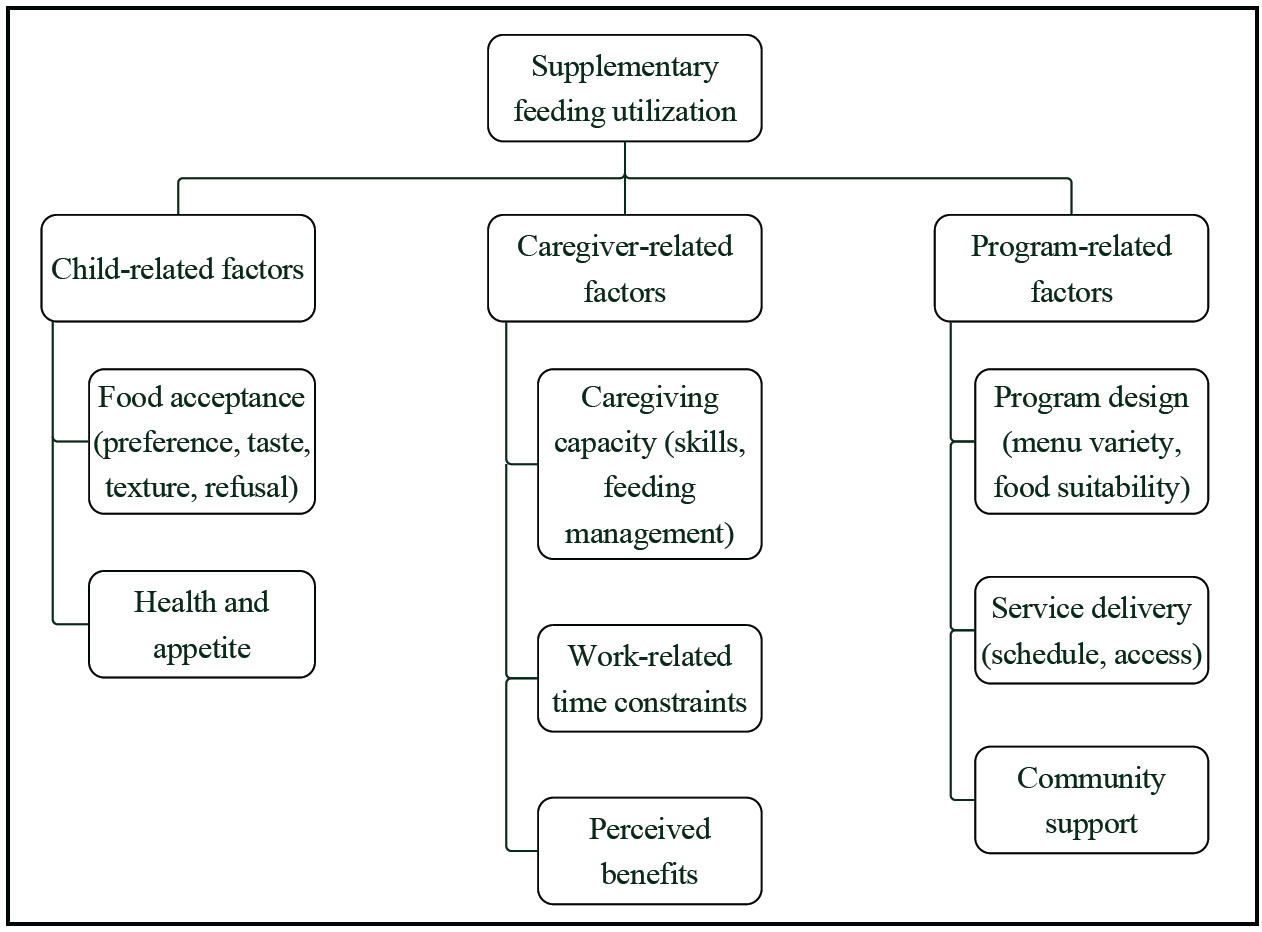
Thematic framework of factors influencing supplementary feeding utilization.
3.2.1. Child-related Factors
Selective eating behaviours emerged as a prominent barrier to utilization. Caregivers frequently reported that children refused to eat certain foods, limiting the likelihood of full consumption. This behaviour was reported across age groups, particularly among children accustomed to a limited range of foods.
“Sometimes my child disliked the menu.” (Caregiver_1)
“My child was bored with the side dishes, and there were some menu items they did not like.” (Caregiver_2)
“Because my child is often picky about food choices, he often does not finish his meals.” (Caregiver_19)
“Sometimes there is food my child does not like, so it is not finished.” (Caregiver_20)
Children’s responses to the sensory characteristics of food, especially taste, texture, and smell, strongly influenced acceptance. Children were more likely to reject foods perceived as having an unpleasant odor (e.g., fish-based products) or unfamiliar textures.
“The menu is often sweet, so my child does not really like it, and the fish dishes sometimes still have a fishy smell.” (Caregiver_7)
“The food is never finished because the texture is still too hard, and sometimes my child does not like it.” (Caregiver_18)
“The food is not to my child’s liking, for example, spicy dishes or fish with thin flesh that tends to have many bones.” (Caregiver_4)
“My child sometimes does not like food that has a fishy smell.” (Caregiver_9)
Children’s health status also affected food intake. A few children with multiple episodes of illness or reduced appetite had reduced consumption of supplementary foods, despite caregiver efforts to encourage intake.
“My child is quite a picky eater and has difficulty eating full meals, so besides providing a varied menu, I also need to give vitamins such as fish oil and honey to help increase appetite.” (Caregiver_10)
“The challenge is that my child’s appetite goes up and down because of illness.” (Caregiver_1)
“My child is sick, so it is difficult for her to eat.” (Caregiver_6)
3.2.2. Caregiver-related Factors
Caregivers’ ability to prepare and adapt the supplementary foods influenced utilization. Some caregivers acknowledged limited skills in modifying recipes to match children’s preferences, which often resulted in reduced acceptance and consumption.
“I’m confused about what side dish to cook.” (Caregiver_8)
“I can’t cook every day and often run out of ideas for what to make. My child also does not like chicken liver dishes.” (Caregiver_21)
“If my child does not want to eat, it is difficult to persuade her to eat, and sometimes I wonder what ingredients to use to make food she will like.” (Caregiver_22)
“I’m not very good at cooking.” (Caregiver_23)
Several caregivers who engaged in formal or informal work reported that time constraints hindered the consistent preparation and feeding of meals. They reflected that competing responsibilities reduced the ability to prioritise supplementary food preparation as recommended.
“For working mothers like me, time is a challenge in preparing raw ingredients, so it may be easier if they are provided already cooked.” (Caregiver_14)
“I work, so I feed my child after I come home from work.” (Caregiver_17)
“The challenge for me is that I cannot always be present or accompany my child during mealtimes because of work responsibilities. If possible, we eat together on days off.” (Caregiver_24)
“Food collection time conflicts with my working hours.” (Caregiver_12)
Despite these constraints, caregivers also described several perceived benefits of the programme. Some caregivers reported improved knowledge of food preparation, more ideas for menu variation, and reduced burden in providing meals during the SFP.
“I can learn about the types of healthy menus for children.” (Caregiver_13)
“It is very helpful for providing varied local meal ideas and helping meet my child’s nutritional needs.” (Caregiver_16)
“It is very helpful and makes things easier for me as a working mother. Sometimes I do not have time to buy food supplies for my child.” (Caregiver_3)
3.2.3. Program-related Factors
Most caregivers generally viewed menu variability as a facilitator that could help maintain children’s interest and reduce monotony in feeding. They perceived a varied menu as more acceptable and supportive of continued utilization.
“A variety of menus so that my child finishes their meals.” (Caregiver_5)
“There are many food ingredients that I rarely use, so with this program I get a variety of ingredients, which makes my child happy.” (Caregiver_15)
“The food variety makes children more interested in eating.” (Caregiver_11)
Some caregivers thought that access to the programme and support from community health volunteers played an important role in facilitating utilization. They felt that regular reminders, nutrition education, and the ease of food collection positively contributed to their engagement with the SFP.
“The community health volunteers always remind us, and the provider/shop makes the collection process convenient.” (Caregiver_4)
However, caregivers also identified several challenges when participating in the SFP. Many acknowledged key barriers, including inconsistent distribution schedules, limited caregiver availability due to work commitments, inconvenient delivery times, repetitive menu cycles leading to boredom, inconsistencies between planned and delivered menus, inappropriate portion sizes and taste, and additional preparation burdens for caregivers when ingredients required processing at home.
“It was difficult to know when we would meet the community health worker delivering it, because the schedule was often different.” (Caregiver_16)
“When I was working, I could not collect it on time” (Caregiver_24)
“It would be better if it were delivered in the morning so it could be eaten immediately.” (Caregiver_11)
“My child became bored because the same menu was sometimes given each week.” (Caregiver_13)
“Sometimes the menu written was different from what was actually given.” (Caregiver_10)
“Some portions were large, others were small, and once the food had no taste.” (Caregiver_8)
“The fish was still frozen and had scales, so it needed extra preparation” (Caregiver_21)
3.3. Integration of Quantitative and Qualitative Findings
Quantitative and qualitative findings provided complementary perspectives on SFP utilization. Only 33.9% of children were reported to have fully consumed the supplementary food. For 68.1% of children, the supplementary food was consumed by the child alone; for 30.6%, it was shared with other family members; and for 1.2%, it was consumed exclusively by family members. Qualitative findings provided context for these utilization patterns across three levels: child-, caregiver-, and programme-related factors. At the child level, selective eating, sensory preferences, and illness-related changes in appetite were reported as barriers to consumption. At the caregiver level, cooking skills, time constraints, feeding practices, and perceived programme benefits shaped food preparation and feeding. At the programme level, menu variety, accessibility, distribution schedules, and preparation requirements were reported as factors affecting utilization. Menu suitability, portion size, and consistency between planned and delivered menus were also identified as relevant programme considerations. Despite 87.5% of children having a dietary diversity score ≥5, qualitative findings indicated that utilization of the supplementary food could remain suboptimal. The integration of these findings is presented in Table 4.
| Quantitative Finding | Qualitative Finding | Integrated interpretation | |
|---|---|---|---|
| Theme | Description | ||
| Full consumption of supplementary food was reported for 33.9% of children, while 66.1% did not fully consume the food. | Child-related factors | Caregivers reported selective eating and food rejection related to taste, texture, and smell. Reduced appetite during illness was also reported as a barrier to consumption. | The low proportion of full consumption was consistent with qualitative reports that child food preferences, sensory responses, and health-related changes in appetite could limit consumption. |
| For 30.6% of children, supplementary food was reported to be shared between the child and other family members; for 1.2%, it was consumed exclusively by family members. | Caregiver-related factors | Caregivers described difficulties with food preparation and cooking, limited time for prepare and feed children, and challenges persuading children to eat. Some caregivers also reported perceived benefits, including greater menu ideas and reduced burden in providing meals. | Quantitative findings documented that supplementary food was not always consumed exclusively by the target child. Qualitative findings further indicated that caregiver skills, time availability, feeding practices, and perceived programme benefits shaped the preparation and provision of supplementary food. |
| For 68.1% of children, supplementary food was reported to be consumed by the child alone. | Program-related factors | Caregivers described menu variety and convenient collection as facilitators. Barriers included inconsistent distribution schedules, inconvenient collection times, repetitive menus, differences between planned and delivered menus, inappropriate portion sizes or taste, and additional preparation requirements. | Although most supplementary food was reported to be consumed by the child alone, qualitative findings indicated that utilization was also related to how the programme was implemented, including menu characteristics, accessibility, distribution arrangements, and preparation requirements. |
| 87.5% of children were reported to have a dietary diversity score ≥5. | Caregiver-reported benefits and menu variety | Some caregivers reported learning about healthy menus, gaining ideas for a variety of local foods, and perceiving that the programme helped meet their children's nutritional needs. | Dietary diversity and SFP utilization captured different aspects of child feeding. The relatively broad dietary diversity reported quantitatively did not necessarily reflect complete utilization of the supplementary food, as qualitative findings identified additional child-, caregiver-, and programme-related barriers. |
4. DISCUSSION
This study found that the use of locally produced supplementary feeding was suboptimal. Only one-third of children fully consumed the foods provided, while two-thirds partially consumed or did not finish them. In addition, for nearly one-third of children, supplementary foods were shared with other household members. Despite some positive caregiver perceptions regarding menu variety and benefits, these findings reveal a disconnect between acceptance and utilization. The findings indicate that child eating behaviour, caregiver capacity, and program delivery are key determinants of utilization, highlighting that program effectiveness cannot be assumed from food provision or perceived acceptability alone.
The quantitative findings demonstrate low levels of full consumption and substantial intra-household sharing. This pattern is consistent with previous studies showing that SFPs often face challenges related to adherence and sustained intake, even when food is successfully distributed [17, 18]. Prior research has highlighted that evaluations frequently emphasize distribution and availability while overlooking actual intake at the individual-child level [19, 20]. The observed sharing of food within households also aligns with evidence from low-resource settings, where food redistribution reflects household coping strategies and social norms [21-23], potentially undermining the impact of interventions.
The qualitative findings provide explanatory depth to these quantitative patterns. While caregivers valued menu diversity and reported that food variety could increase children’s interest in eating, several behavioral and contextual barriers limited optimal consumption. Child-related factors, such as selective eating, sensory sensitivity to taste, texture, and smell, and illness, emerged as key constraints, as found in previous studies [24-26]. These findings emphasized the role of child feeding behavior as a critical determinant of dietary intake [27].
Following earlier studies [28-30], caregiver-related factors such as limited time, food preparation challenges, and difficulty adapting menus to children’s preferences also influenced utilization. This highlights caregiver capacity as a central factor in child nutrition outcomes [31]. This study found that implementation-related barriers such as inconsistent distribution schedules, collection times that conflicted with work responsibilities, repetitive menus, and the additional preparation required for raw ingredients may have reduced programme uptake. These findings reflect broader evidence from implementation science, which underscores the importance of delivery systems in shaping intervention uptake [32].
Overall, the findings highlight a disconnect between acceptability and actual utilization. Positive perceptions of menu variety alone were insufficient to ensure full consumption. This study indicates that utilization was shaped not only by the foods provided but also by child eating behaviours, caregiver capacity, and programme delivery factors.
4.1. Program and Policy Implications
The findings have important programme and policy implications. This study suggests that efforts to improve supplementary feeding should move beyond food provision and menu quality alone. The efforts should also include caregiver support, practical feeding guidance, and strategies to address common child-feeding challenges, such as selective eating and poor appetite during illness. In addition, strengthening delivery systems through consistent scheduling, accessible collection or distribution mechanisms, and routine monitoring of actual child consumption may improve programme effectiveness. More broadly, the results suggest that supplementary feeding interventions are most likely to achieve nutritional impact when programme design is responsive to household conditions and implementation constraints.
4.2. Strengths and Limitations
This study has several strengths. First, the use of a convergent mixed-methods design allowed for a comprehensive analysis by integrating quantitative patterns with qualitative explanations, strengthening the validity of the findings. Second, the study captures real-world implementation conditions at the community level, enhancing its relevance for policy and program design. Third, the inclusion of both child- and caregiver-level factors provides a more holistic understanding of program utilization.
However, several limitations should be considered. The quantitative analysis was restricted to participants with sufficiently complete program, dietary, and anthropometric records. Participants with incomplete or invalid records were excluded, which may have introduced selection bias if the characteristics of excluded participants differed systematically from those included in the analysis. No formal sample size calculation was performed for the quantitative component, as all registered programme participants were eligible. The sample size was therefore determined by programme enrolment and data completeness rather than by a priori power or precision considerations. Child sex was not collected. Therefore, the authors could not describe the sample by sex or examine whether utilization of supplementary food, including intra-household sharing, differed between boys and girls, which may be relevant given evidence that gendered intra-household resource allocation affects child nutrition in some settings [33, 34]. Dietary consumption data were based on caregiver self-report and may be subject to recall and social desirability bias. The absence of direct observation limits the ability to capture feeding interactions between caregivers and children. The study did not quantify the amount of supplementary food consumed by other household members and therefore could not estimate the resulting distribution of energy or nutrients. Household sharing was consequently interpreted as an aspect of utilization and intra-household food allocation rather than quantified nutrient dilution. Reliance on caregiver-reported consumption may have introduced recall and social desirability bias. The descriptive nature of the study restricts causal inference, and findings from a single geographic context may limit generalizability to other settings.
CONCLUSION
This study demonstrates that the use of locally sourced supplementary feeding remains suboptimal. Only one-third of children fully consumed the foods provided, and for a substantial proportion of children, rations were shared within households. While menus were generally perceived positively, this did not consistently translate into full intake, indicating that acceptability alone is insufficient to ensure program effectiveness. Child eating behavior, caregiver capacity, and program delivery emerged as key determinants shaping utilization. The findings highlighted that the success of supplementary feeding interventions depends not only on food provision but also on how interventions are implemented and practised at the household level. These findings underscore the need to move beyond a food provision approach toward more behaviorally responsive and implementation-sensitive strategies. Strengthening caregiver support, addressing child feeding behavior, and improving program delivery processes are critical to enhancing program impact. Future research should employ longitudinal or intervention designs to better understand how acceptability, household practices, and program delivery interact to influence nutritional outcomes.
Percentages refer to the proportion of children (n = 248).
AUTHORS’ CONTRIBUTIONS
T.S.: Conceptualization and Methodology; T.S and V.D.W.: Investigation; B.A.P., T.S.: Data curation and Formal analysis; U.U., S.I.G., and I.Y.H.: Validation; T.S., B.A.P., and I.Y.H.: Writing – original draft; U.U., S.I.G., V.D.W., and M.P.R.: Writing – review & editing; T.S.: Funding acquisition; T.S.: Resources; T.S. and B.A.P.: Visualization.
LIST OF ABBREVIATIONS
| PMT Lokal | = Pemberian Makanan Tambahan Lokal |
| PRHR | = Pencegahan Capaian Rating Tinggi Nutrisi Gizi |
| SD | = Standard Deviations |
| SFP | = Supplementary Feeding Program |
| SFPs | = Supplementary Feeding Programs |
ETHICS APPROVAL AND CONSENT TO PARTICIPATE
This study received ethical approval from the Medical and Health Research Ethics Committee, Faculty of Medicine, Public Health, and Nursing, Universitas Gadjah Mada (Ref: KE/FK/1931/EC/2024).
HUMAN AND ANIMAL RIGHTS
All procedures involving human participants were conducted in accordance with the ethical standards of the committee responsible for human experimentation (institutional and national), and with the Helsinki Declaration of 1975, as revised in 2013.
CONSENT FOR PUBLICATION
Written informed consent was obtained from all participants prior to data collection. Confidentiality and anonymity of participants were strictly maintained throughout the study.
AVAILABILITY OF DATA AND MATERIALS
The data that support the findings of this study are available from the corresponding author, [T.S.], on special request.
ACKNOWLEDGEMENTS
The authors would like to express their sincere appreciation to the Sleman District Health Department for their support.