All published articles of this journal are available on ScienceDirect.

Prevalence and Associated Factors of Needlestick and Sharps Injuries among Healthcare Workers in Saudi Arabia: A Systematic Review and Meta-analysis

Abstract
Background
Needlestick and sharps injuries (NSIs) are a major occupational hazard for healthcare workers (HCWs) in Saudi Arabia, yet national-level data on their prevalence and associated factors remain limited.
Objectives
To estimate the pooled prevalence of NSIs among HCWs in Saudi Arabia and identify associated factors.
Methods
This systematic review and meta-analysis followed PRISMA 2020. Cross-sectional studies reporting NSI prevalence among HCWs in Saudi Arabia were retrieved from PubMed, EBSCOhost, Web of Science, and Google Scholar, and appraised with the JBI prevalence checklist. Prevalence was pooled using a random-effects Freeman-Tukey model, with a generalized linear mixed model (GLMM) as a sensitivity analysis and a 95% prediction interval. Subgroup analyses and meta-regression explored heterogeneity.
Results
Twenty-five studies (7,635 HCWs) were included. The pooled prevalence was 35.5% (95% CI: 23.9-48.0), with high heterogeneity (I2 = 98.7%) and a prediction interval of 0-93.8%, indicating no single underlying rate; a generalized linear mixed model gave 34.6%. Prevalence was higher in males (48.2%) than females (32.7%) and in the Eastern region (83.6%, k = 2). Needles caused 76% of injuries, and about 35% were unreported.
Discussion
The pooled estimate should be interpreted as the center of a wide distribution rather than a national rate, given the persistent heterogeneity within subgroups. Estimates from single or few studies are exploratory. High underreporting and the predominance of needle injuries are modifiable prevention targets.
Conclusion
NSIs remain common but highly variable among Saudi HCWs. Standardized surveillance, safety-engineered devices, and targeted training are needed, alongside methodologically consistent prospective studies.
1. INTRODUCTION
Needlestick and sharps injuries (NSIs) represent a significant occupational hazard for healthcare workers (HCWs) globally, carrying substantial risks of blood-borne pathogen transmission and psychological distress [1]. Globally, NSIs are among the most frequent work-related injuries among HCWs, with pooled prevalence estimates of approximately 43%-44.5% reported in international meta-analyses [2, 3]. NSIs account for a substantial share of occupational blood-borne infections, contributing to 39% of hepatitis C virus (HCV), 37% of hepatitis B virus (HBV), and 4.4% of human immunodeficiency virus (HIV) infections among HCWs; acute HBV infection affects about 5.3% of healthcare staff worldwide, and roughly 54% of HCWs in low- and middle-income countries carry latent tuberculosis infection [4-6]. The consequences of NSIs extend beyond physical harm, leading to psychological trauma, lost productivity, and increased financial burdens related to post-exposure prophylaxis [7]. With an average cost of approximately Int$747 per incident, NSIs represent a substantial yet potentially preventable financial burden on healthcare systems [8].
It is important to distinguish prevalence from incidence when interpreting the NSI literature. Incidence refers to the number of new injuries occurring over a defined period (e.g., injuries per person-year), whereas prevalence-the focus of the present review-refers to the proportion of HCWs who report having experienced one or more NSIs within a specified recall period. Because most primary studies in this field are cross-sectional and report the latter, the present synthesis is framed around prevalence.
Under Vision 2030, Saudi Arabia's healthcare sector has expanded rapidly, employing more than 900,000 healthcare workers, yet reported NSI rates remain highly variable and largely confined to individual healthcare facilities [9, 10]. To date, no national systematic review has synthesized the available evidence, limiting insight into the true prevalence of NSIs, their regional distribution, and the factors associated with them. Despite existing safety initiatives, NSIs remain common, reflecting underreporting, insufficient training, and restricted access to safety-engineered devices. Accordingly, this review addresses the following question: what is the pooled prevalence of NSIs among HCWs in Saudi Arabia, and which demographic, occupational, and study-level factors are associated with variation in reported prevalence? By consolidating existing studies, this review aims to quantify the burden of NSIs, identify evidence gaps, and inform occupational-safety policy as the Saudi healthcare system continues to expand.
2. METHODS
This systematic review and meta-analysis were conducted and reported in accordance with the PRISMA 2020 guidelines (Table S1). The review was not prospectively registered, as PROSPERO does not accept reviews of prevalence or incidence without an associated health outcome.
2.1. Eligibility Criteria
Studies were included if they met the following criteria: (1) reported the proportion of individuals who experienced any NSI event (one or more) within a specified recall period among HCWs in Saudi Arabia; (2) used a cross-sectional survey design; (3) were peer-reviewed publications in English; and (4) had full-text availability. Exclusion criteria were: (1) studies conducted outside Saudi Arabia; (2) retrospective reviews of clinical data, review articles, editorials, conference abstracts, or book chapters lacking primary data; (3) studies focusing solely on non-sharp occupational injuries (e.g., musculoskeletal disorders); (4) non-human research; and (5) duplicate publications or studies with overlapping datasets.
2.2. Search Strategy and Information Sources
A comprehensive search was designed to identify relevant studies through PubMed, EBSCOhost, Web of Science, and Google Scholar. The search combined controlled vocabulary and free-text keywords related to NSIs, healthcare settings, and Saudi Arabia. Key search terms included: (“needlestick injuries” OR “needlestick injury” OR “needle-stick injuries” OR “sharp injury” OR “sharp injuries”) AND (“Saudi Arabia” OR “KSA”). The search was restricted to titles and abstracts, with no filters applied for study design. Full per-database search strings are provided in Table S2. The most recent database search was conducted on 17 November 2025.
2.3. Study Selection, Data Extraction, and Quality Assessment
Study selection, data extraction, and quality assessment were performed independently and in duplicate by two reviewers (M.A.S. and a second reviewer acknowledged in the Acknowledgments), in line with the study protocol; any discrepancies were resolved by consensus. After duplicates were removed, titles were screened against the objectives and inclusion criteria, followed by abstract review to discard irrelevant reports. Finally, the full texts of eligible studies were examined, and the required information was captured in Microsoft Excel using a standardized extraction form. Extracted variables included author, year, data-collection duration, study design, setting, sample size, participant demographics, NSI prevalence, gender, reported NSIs, occupation, hospital ward, and device type.
The methodological quality of the included studies was assessed using the Joanna Briggs Institute (JBI) Critical Appraisal Checklist for Studies Reporting Prevalence Data, which evaluates nine domains: the appropriateness of the sampling frame and sampling method, sample-size adequacy, description of subjects and setting, coverage of the analyzed sample, validity and reliability of NSI ascertainment, appropriateness of the statistical analysis, and adequacy of the response rate [11]. Each item was rated “yes,” “no,” “unclear,” or “not applicable.” Based on the number of items rated “yes,” studies were classified as high (7-9), moderate (5-6), or low (0-4) quality, with higher scores indicating lower risk of bias.
HCWs were defined as individuals directly involved in patient care, including physicians, nurses, dentists, laboratory technicians, paramedics, and allied health professionals. To facilitate consistent interpretation across diverse roles, operational definitions were applied to key categories. The recall period was categorized as short-term (<=1 year, e.g., last 6 or 12 months) or long-term (>1 year, including lifetime or “ever”). Dental professionals included dentists, dental assistants, dental hygienists, and dental interns. Needles referred to hollow-bore needles (e.g., syringes, butterfly needles, insulin needles, IV catheters) and solid needles (e.g., surgical and suture needles). Outpatient settings encompassed obstetrics and gynecology clinics, general medicine clinics, dental clinics, and vaccination centers. The “Others” category retained the original labels and definitions used in the included studies. The term “national” referred to data collected from two or more cities across different regions of Saudi Arabia.
2.4. Data Analysis
A proportional meta-analysis was performed using a random-effects model with the Freeman-Tukey double-arcsine transformation to stabilize variances across the wide range of observed proportions [12]. Between-study variance (tau-squared) was estimated by restricted maximum likelihood (REML). Results were displayed as forest plots with 95% confidence intervals (CIs), and a 95% prediction interval was calculated to represent the expected dispersion of true prevalence across settings. Because the double-arcsine back-transformation can be sensitive to variation in study size, a generalized linear mixed model (random-intercept logistic regression) was fitted as a sensitivity analysis to confirm robustness to the modeling approach. Heterogeneity was quantified using the I2 statistic. Univariate meta-regression was used to explore potential sources of heterogeneity, including recall period, publication year, sample size, gender, and geographic region. Multivariable meta-regression was not undertaken because, with only 25 studies, such models would be overfitted and prone to spurious associations. Publication bias was assessed by visual inspection of the funnel plot and the Peters regression test [13]; a trim-and-fill analysis was performed as a sensitivity check. Given the extreme heterogeneity, funnel-plot asymmetry was interpreted with caution and not treated as definitive evidence of publication bias. The robustness of the pooled estimate was further examined using leave-one-out analysis and a Baujat plot [14, 15]. Subgroup meta-analyses were conducted by gender, geographic region, occupation, hospital ward, device type, and reporting status. Throughout, k denotes the number of studies contributing to a given pooled estimate; estimates based on a single study (k = 1) are reported as single-study point estimates rather than pooled values. All analyses were conducted in R version 4.5.1.
3. RESULTS
3.1. Study Characteristics
A total of 1,013 records were identified from four databases. After removing duplicates, 533 records were screened by title and abstract, and 56 reports were assessed for eligibility. Following full-text screening, 25 studies met the inclusion and exclusion criteria and were included in the review (Fig. 1) [16-40]. The characteristics of the included studies are summarized in Table S3. Quality assessment using the JBI checklist classified 17 studies (68%) as high quality and 8 (32%) as moderate quality; no study was rated low quality (Table S4).
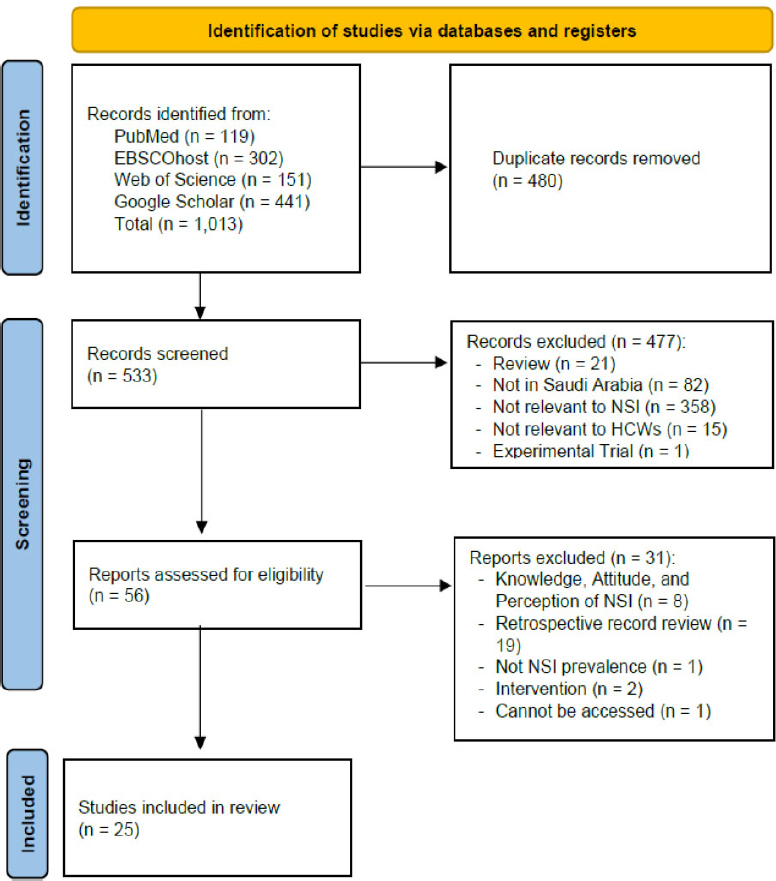
PRISMA flow diagram of study selection for NSI prevalence among healthcare workers in Saudi Arabia.
3.2. Meta-analysis of Prevalence
A random-effects meta-analysis estimated the pooled proportion of NSIs across 25 studies (N = 7,635) (Fig. 2) [16-40]. The pooled prevalence was 35.5% (95% CI: 23.9-48.0), with very high heterogeneity (I2 = 98.7%, tau-squared = 0.10). The 95% prediction interval spanned 0.0-93.8%, indicating that the true prevalence in any individual setting could fall almost anywhere across this range and that a single pooled value does not adequately summarize the evidence. The estimate was robust to the analytical approach: a generalized linear mixed model (random-intercept logistic regression) produced a comparable pooled prevalence of 34.6% (95% CI: 22.1-49.6). Visual inspection of the funnel plot and a significant Peters regression test (t(22) = 3.13, p = 0.0048) suggested asymmetry; however, under such extreme heterogeneity, asymmetry cannot be reliably distinguished from small-study effects or true between-study differences, and it should not be interpreted as definitive evidence of publication bias (Fig. S1). A trim-and-fill analysis imputed additional studies but yielded an unstable adjusted estimate and was therefore not interpreted as a corrected prevalence. In the leave-one-out and Baujat analyses, the study by Saad et al. was the most influential; nonetheless, its removal reduced the pooled estimate only modestly (to 32.0%, 95% CI: 22.3-42.5) and did not alter the overall conclusion, so results are presented for the full set of 25 studies (Fig. S2; Study Limitations) [39].
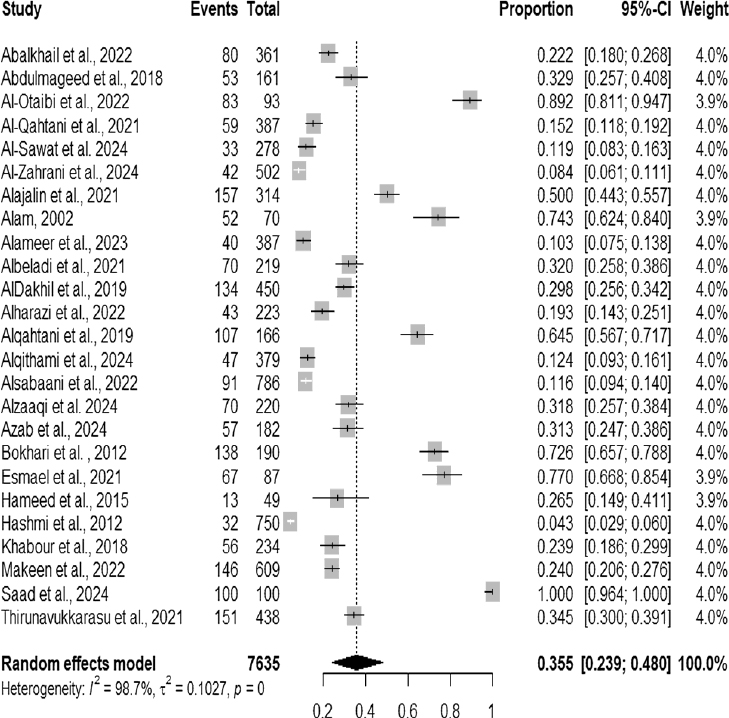
Forest plot showing the pooled prevalence of needlestick and sharps injuries among healthcare workers in Saudi Arabia (k = 25 studies).
3.3. Subgroup Meta-analysis
Subgroup analysis by recall period showed a higher pooled prevalence in studies using long-term or lifetime recall (42.9%) than in those using short-term recall (25.1%), although the difference was not statistically significant (Q = 2.76, p = 0.0966). Heterogeneity remained high across all models (I2 > 97%) (Fig. 3). Other subgroup analyses revealed varying prevalence across gender, region, occupation, device type, hospital ward, and reporting status. Men (k = 11) had a pooled prevalence of 48.2% (95% CI: 26.5-70.2), while women (k = 10) had a pooled prevalence of 32.7% (95% CI: 13.7-55.1) (Fig. 4).
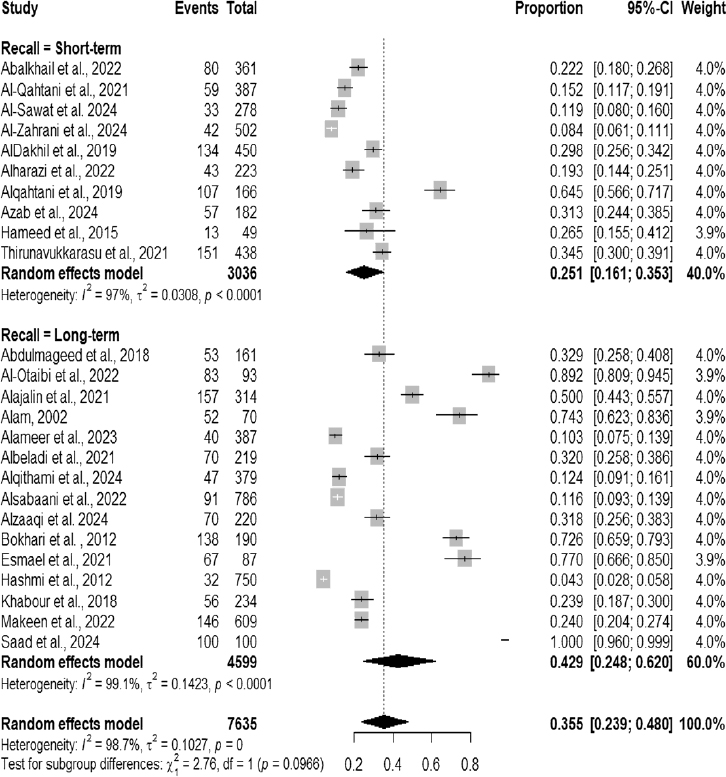
Subgroup forest plot of pooled prevalence of NSIs among healthcare workers in Saudi Arabia by recall period.
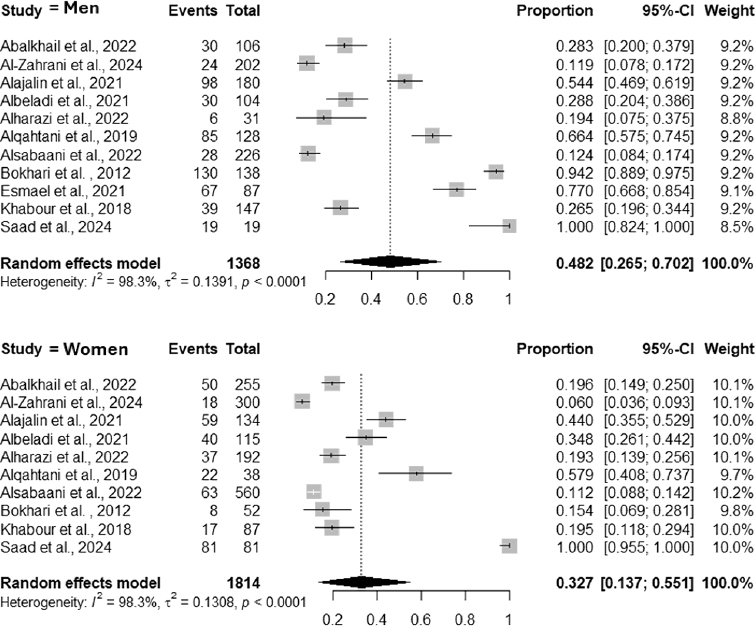
Subgroup forest plot of pooled prevalence of NSIs among healthcare workers in Saudi Arabia by gender.
Regionally, the Eastern region showed the highest pooled prevalence (83.6%, 95% CI: 70.1-93.8; k = 2, N = 180), followed by the Central region (55.5%, 95% CI: 2.5-99.9; k = 3). The Southern region showed a prevalence of 38.9% (k = 6), while the National and Western regions had lower estimates at 24.9% (k = 3) and 22.1% (k = 10), respectively. The Northern region was represented by a single study (34.5%, 95% CI: 30.1-39.0; k = 1) and is therefore reported as a single-study point estimate rather than a pooled value (Fig. 5). Because the Eastern and Northern estimates are based on only two and one studies, respectively, they should be interpreted with caution.
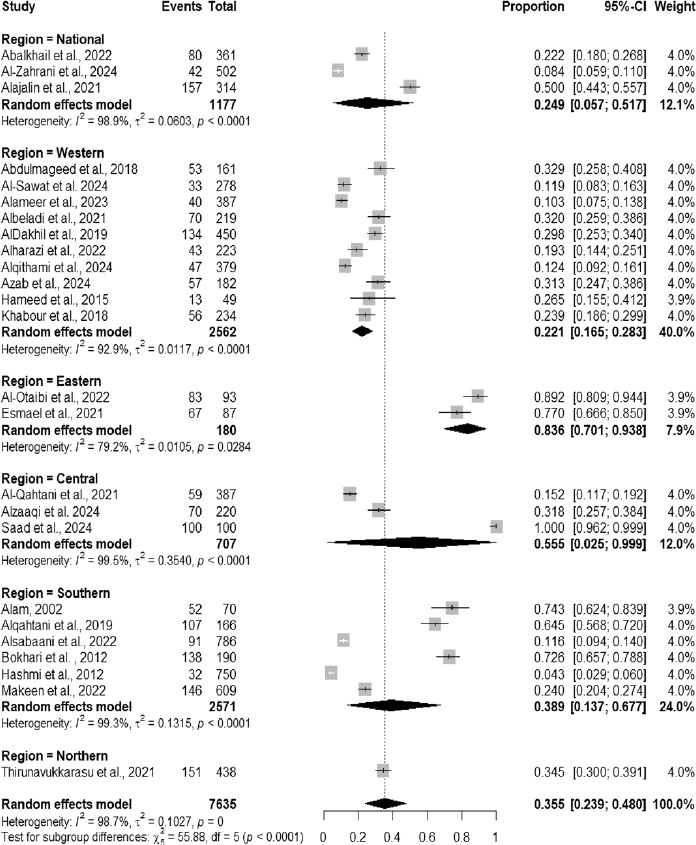
Subgroup forest plot of pooled prevalence of NSIs among healthcare workers in Saudi Arabia by region.
Among occupational groups, the highest values were observed for emergency medical technicians (77%) and residents (60%); however, the emergency medical technician estimate was derived from a single study (k = 1) and is reported as a single-study point estimate. Residents (k = 3) and dental professionals (36%, k = 4) followed, while nurses (k = 9) and physicians (k = 6) showed moderate values of 31% and 35%, respectively. Lower values were found among laboratory technicians, medical technicians, pharmacists (k = 1), and interns/students (Fig. 6a). By hospital ward, the highest pooled values were in surgery/operating room (OR) settings (36%, k = 5) and inpatient wards (36%, k = 2), followed by emergency departments (34%, k = 6) and outpatient settings (25%); the intensive care unit (ICU) (8%) and laboratory (10%) settings showed the lowest values (Fig. 6b). Regarding device type, needle-related injuries predominated (76%, k = 9), whereas scalpels (5%), glassware (6%), and scissors (6%) accounted for smaller proportions; the blade, plasticware, and pipette categories were each based on a single study (Fig. 6c). Among the 12 studies reporting on reporting behavior, an estimated 65% of injured HCWs reported their most recent NSI, while 35% did not (Fig. 6d).
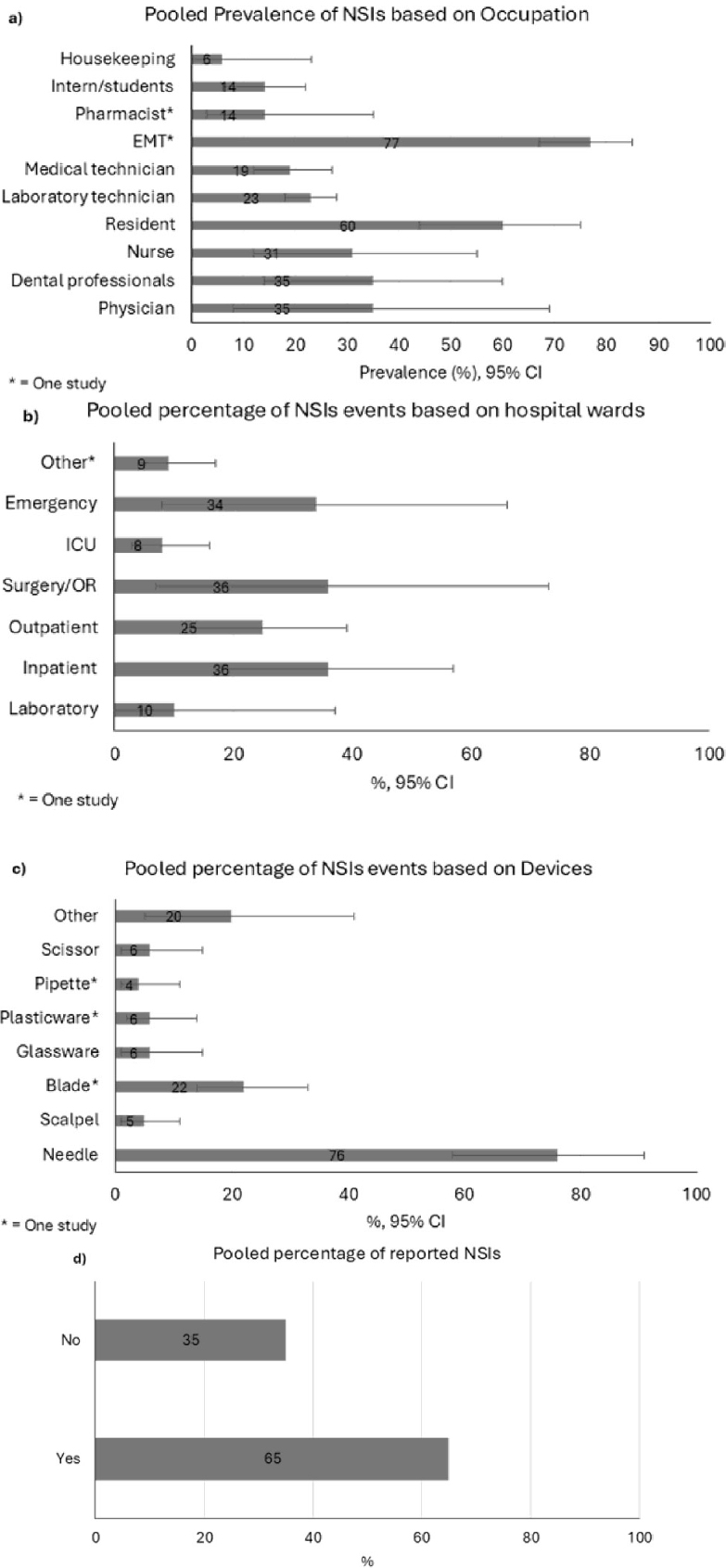
Subgroup analysis of pooled prevalence of NSIs among healthcare workers in Saudi Arabia by (a) occupation, (b) hospital wards, (c) device type, and (d) reporting status.
3.4. Meta-Regression
A series of univariate meta-regression models was fitted to identify moderators that might explain the observed heterogeneity. Sample size was a significant negative predictor of prevalence (beta = -0.0011, p < 0.01, R2 = 42.2%), indicating that smaller studies tended to report higher prevalence-consistent with a small-study effect and with the funnel-plot asymmetry noted above. Recall period was not a significant moderator (p = 0.1488), and publication year, gender, and geographic region likewise showed no significant associations. Because recall period was non-significant and some recall categories contained few studies, the corresponding forest plots are summarized rather than presented in full. All meta-regression analyses are exploratory and hypothesis-generating, given the limited number of studies and the extreme residual heterogeneity.
4. DISCUSSION
NSIs remain a major safety concern for HCWs worldwide. This analysis is the first systematic review and meta-analysis dedicated to estimating the burden of NSIs among HCWs in Saudi Arabia. Twenty-five studies involving 7,635 individuals from different regions met the inclusion criteria [16-40]. The pooled prevalence was 35.5%, which is broadly comparable to, though slightly lower than, the 43% and 44.5% reported in global meta-analyses [2, 3]. However, the very wide prediction interval (0.0-93.8%) and extreme heterogeneity (I2 = 98.7%) indicate that this pooled value should be read as the center of a broad distribution rather than as a single national prevalence; the true value in any given setting varies substantially with study population, healthcare setting, recall period, and region. Reassuringly, the estimate was robust to the analytical model, with a generalized linear mixed model producing a comparable value (34.6%).
The analysis suggested a small-study effect, whereby smaller studies reported higher prevalence. This pattern was supported by the meta-regression, in which sample size was a significant negative moderator, and is consistent with the funnel-plot asymmetry. Such asymmetry may reflect selective publication of higher-prevalence studies, methodological differences among smaller studies, or genuine between-study heterogeneity; under an I2 of 98.7%, these explanations cannot be reliably separated, and the publication-bias diagnostics should therefore be interpreted with caution.
Subgroup analyses provided a more granular view of factors associated with NSIs, although all such comparisons are observational and should not be interpreted causally. Contrary to global literature suggesting higher NSI prevalence among women, the present analysis found consistently higher prevalence among men [2, 3]. This may reflect context-dependent differences in workforce composition, occupational roles, and reporting practices [41]; however, only 11 of the 25 studies reported male-specific and 10 female-specific data, limiting firm conclusions about gender-related risk.
Regional variation was pronounced but is largely explained by the composition of the underlying studies rather than by geography per se. The Eastern-region estimate (83.6%) rested on only two studies of anesthesia and emergency services staff groups, whose high-tempo, procedure-intensive duties plausibly elevate injury risk [42]. In the Central region, estimates ranged from 15% among nurses in a primary-care center to 100% in a single acute-care study [19, 39], illustrating how case-mix and setting drive apparent regional differences. Beyond case-mix, systemic factors likely contribute to regional variation, including differences in healthcare infrastructure and staffing levels, the availability and procurement of safety-engineered devices, the intensity of infection-prevention training, and the maturity of institutional occupational-safety and incident-reporting cultures. These remain hypotheses to be tested in standardized multiregional studies. Comparable national or Gulf-wide syntheses are currently lacking, which limits direct regional benchmarking and represents an avenue for future collaborative research.
Occupationally, the highest value was observed for emergency medical technicians (77%), exceeding the global estimate of about 24% for this group [43]; however, this estimate derived from a single study and should be regarded as preliminary [32]. Residents also reported a high value (60%), consistent with evidence that trainees have greater exposure to NSI risk [44, 45]. Physicians (35%) and nurses (31%) showed moderate values, within the global range of roughly 20%-56% [2, 3]. These patterns are consistent with high-tempo, procedure-intensive environments contributing to NSIs.
Needle-related injuries were the most common (76%), confirming that needles are the primary source of injury and underscoring the importance of safety-engineered devices [2, 3]. Comparatively high values in surgery/OR (36%) and emergency departments (34%) reflect the risks of urgent, invasive procedures performed under time pressure [46]. Notably, an estimated 35% of injured HCWs did not report their most recent NSI. This underreporting reflects varied barriers-including lack of time, fear of disciplinary consequences, and a perception that the injury is not serious enough to warrant reporting-and is a critical concern because it undermines surveillance and the timely provision of post-exposure prophylaxis [47].
5. STUDY LIMITATIONS
This review has several limitations. First, and most importantly, heterogeneity was extreme (I2 = 98.7%) and persisted within subgroups, despite the use of the Freeman-Tukey transformation. As a result, the pooled estimate should be interpreted as the center of a wide distribution rather than a precise population rate; this variability reflects differences in sampling methods, measurement tools, NSI definitions, recall periods, and healthcare settings, and highlights the fragmented nature of NSI surveillance in Saudi Arabia. Second, several subgroup estimates were based on a single study or very few studies (e.g., emergency medical technicians, the Northern and Eastern regions, and the blade, pipette, and plasticware device categories); these are exploratory and should not be regarded as stable pooled estimates.
Third, all included studies were cross-sectional and relied on self-reported data, introducing potential recall, social-desirability, and underreporting biases, as well as variability arising from different recall windows. The cross-sectional design also precluded causal inference, and the meta-regression was underpowered by the small number of studies. Fourth, the search was restricted to English-language publications indexed in four databases. Because peer-reviewed health research from Saudi Arabia is very rarely published in Arabic, few eligible studies are likely to have been missed on this basis; restricting to English also avoids the translation-related inconsistencies and potential bias that can arise when pooling studies published in different languages. Nonetheless, studies indexed only in Embase, Scopus, or CINAHL, or those in which NSI data were embedded within broader occupational health surveys, may have been missed. The review was also not prospectively registered. Overall, the certainty of the pooled prevalence estimate should be regarded as very low, reflecting risk of bias in some studies, extreme inconsistency between studies, and imprecision.
Fifth, one study reported a prevalence of 100% and was identified as the most influential in the sensitivity analyses [39]. This value is anomalous and likely reflects the study's purposive (non-random) sampling, an instrument that did not include a “none” category for the number of injuries, and the authors' own description of the underlying prevalence as low. Furthermore, this study was retained in the primary pooled estimate rather than removing it post hoc, for three reasons: it met all a priori eligibility criteria; the leave-one-out and Baujat analyses (Fig. S2) showed that its exclusion reduced the pooled estimate only modestly, from 35.5% to 32.0% (95% CI: 22.3-42.5), without altering the overall conclusion of a high and highly heterogeneous prevalence; and selectively removing influential studies after the fact risks introducing selection bias into a prevalence synthesis. Its anomalous value is instead acknowledged as a documented source of heterogeneity, consistent with the sensitivity analyses reported in the supplementary material. Taken together, these limitations warrant cautious interpretation of the findings.
CONCLUSION
NSIs remain a serious occupational hazard among HCWs in Saudi Arabia, but the wide variation across studies precludes a single national prevalence estimate. The evidence nonetheless points to consistent, modifiable priorities: standardized NSI surveillance and reporting systems, broader adoption of safety-engineered devices, and targeted training for high-risk roles and settings. Because the current evidence base is cross-sectional and heterogeneous, these measures are best advanced alongside methodologically stronger research-prospective and longitudinal studies that track NSI rates before and after safety interventions, mixed-methods studies of the barriers to reporting, and economic analyses of the direct and indirect costs of NSIs in the Saudi financing context. Aligning such evidence-based interventions with the workforce-safety goals of Vision 2030 offers a realistic path to reducing NSI rates and strengthening healthcare-system resilience.
AUTHOR’S CONTRIBUTIONS
As the sole author, I was responsible for the study conception and design, data analysis and interpretation, and preparation and approval of the manuscript. Study screening, data extraction, and quality appraisal were conducted independently and in duplicate by a second reviewer, who is acknowledged below and not involved in drafting the manuscript.
LIST OF ABBREVIATIONS
| NSIs | = Needlestick and Sharps Injuries |
| HCWs | = Healthcare Workers |
| CI | = Confidence Interval |
| EMTs | = Emergency Medical Technicians |
| GLMM | = Generalized Linear Mixed Model |
| HBV | = Hepatitis B Virus |
| HCV | = Hepatitis C Virus |
| HIV | = Human Immunodeficiency Virus |
| ICU | = Intensive Care Unit |
| Int$ | = International Dollar |
| IV | = Intravenous |
| I2 | = I-squared (measure of heterogeneity) |
| JBI | = Joanna Briggs Institute |
| KSA | = Kingdom of Saudi Arabia |
| OR | = Operating Room |
| PRISMA | = Preferred Reporting Items for Systematic Reviews and Meta-Analyses |
| PROSPERO | = International Prospective Register of Systematic Reviews |
| R2 | = Coefficient of Determination |
| REML | = Restricted Maximum Likelihood |
| SE | = Standard Error |
| tau-squared | = Between-study variance |
| WHO | = World Health Organization |
AVAILABILITY OF DATA AND MATERIALS
All data used in this research were obtained from previously published studies. No new datasets were generated or analyzed.
ACKNOWLEDGEMENTS
The author gratefully acknowledges the invaluable contribution of Dr. Mohammed Alkharaiji, Assistant Professor and Director of the Health Sciences Research Center, Saudi Electronic University, who served as the second independent reviewer for study selection, data extraction, and quality appraisal.