All published articles of this journal are available on ScienceDirect.

Development of a Conceptual Model and Validated Tool for Assessing Hospital Readiness in Chemical Incidents
 iD
Authors Info & Affiliations
Abstract
Introduction
Chemical incidents pose a major threat to public health because of the wide availability of hazardous chemicals and their potential to cause mass casualties, often overwhelming health systems that lack specialized preparedness tools. This study aimed to develop and validate a conceptual model and a measurement instrument for assessing hospital readiness for chemical incidents in both military and civilian settings.
Methods
A sequential exploratory mixed-methods design was used. In the qualitative phase, semi-structured interviews were conducted with 9 experts selected through purposive and snowball sampling, and the data were analyzed in MAXQDA10 to identify codes and components. The resulting conceptual model was reviewed in two Delphi stages by the same expert panel. In the quantitative phase, a questionnaire was assessed for content validity by 10 specialists, and the finalized tool was assessed for inter-rater reliability by four independent evaluators.
Results
The analysis identified six core components — organizing and planning, structural facilities and physical space, medicines and medical equipment, communications and coordination, safety and security, and training and practice — comprising 28 sub-components, with decontamination emerging as a cross-cutting element. From 121 interview-derived candidate items, a 95-item preliminary questionnaire was developed; after content-validity review, deletion of 17 items, and modification/merging of 44 items, the final tool contained 66 items. Content validity was assessed by 10 specialists using CVR and CVI; the final tool was then assessed by four independent evaluators using inter-rater agreement and Cohen’s kappa.
Discussion
The six components reflect the multidimensional nature of hospital readiness for chemical incidents, with decontamination as the pivotal factor differentiating it from other disaster types. The model extends existing CBRN preparedness frameworks, such as the WHO Hospital Safety Index and the European TIER assessment tool, by incorporating elements specific to Iranian military-civilian healthcare settings.
Conclusion
This study offers a content-validated conceptual model and a preliminary assessment tool for hospital readiness in chemical incidents. Because construct and criterion validity and test–retest reliability were not established in the thesis, the tool should be regarded as a first step rather than a finished instrument; it nonetheless provides a structured starting point for evaluating and strengthening chemical-incident readiness. Future work should validate the tool against real incidents or simulations before it is used for accreditation or benchmarking purposes.
1. INTRODUCTION
Chemical incidents — industrial accidents, transportation mishaps, and deliberate acts such as terrorism or warfare — pose a profound threat to public health because of their potential for mass casualties and widespread contamination. Access to hazardous chemical compounds compounds this risk: the 1984 Union Carbide disaster in Bhopal, India, caused more than 2,500 deaths and 200,000 injuries [1], and in Iran, road-transport incidents involving dangerous materials rose from 61 in 2008 to 257 in 2012 [2]. Hospitals, as frontline responders, must manage surges of contaminated casualties, which requires specialized infrastructure and protocols to prevent secondary exposure and to ensure effective triage and decontamination. This is especially critical in military and civilian contexts alike, as illustrated by the lasting effects seen in survivors of chemical attacks during the Iran–Iraq War [3].
A conceptual model of hospital readiness for chemical incidents provides a structured representation of the components that enable hospitals to anticipate, mitigate, and manage chemical threats, integrating organizational and planning functions, structural facilities, medical equipment, communications, safety, and training [4-6]. Crisis management theory and the Hospital Incident Command System (HICS) frame such readiness as a dynamic, adaptive process that must address human, infrastructural, and logistical vulnerabilities together rather than in isolation [7]; this theoretical lens guided the identification and organization of components in the present study. Reviews of CBRN (chemical, biological, radiological, nuclear) events consistently identify coordination and training as recurring weak points [8-11], and the emphasis on decontamination is what most clearly distinguishes chemical-incident readiness from general disaster preparedness frameworks [12, 13].
Several international instruments already exist for related purposes [14] — most notably the WHO Hospital Safety Index [15] and the European TIER (Training for the Health Sector) assessment tool for CBRN emergencies [8, 16] — but both were developed for general or multi-hazard disaster settings rather than for chemical incidents specifically, and neither was designed for the resource and governance context of military-civilian hospitals in a country such as Iran. A 2022 systematic review of hospital preparedness instruments for chemical incidents concluded that none of the existing checklists or tools capture every dimension required for a comprehensive evaluation [17], and domestic surveys report that Iranian hospitals’ readiness is moderate for natural disasters but weak for chemical, human-made threats, with particular gaps in decontamination protocols and surge planning [18-22]. Surveys from other countries have likewise documented gaps in hospital preparedness for CBRN incidents and other disasters [12, 23-25]. These gaps motivate the present study: a tool built from the ground up around the realities of Iranian military-civilian hospitals, rather than adapted from a generic international instrument.
This study therefore aimed to develop a conceptual model and a validated tool for assessing hospital readiness for chemical incidents in both military and non-military hospitals. It addressed two research questions:
(1) What are the key dimensions and components of hospital readiness for chemical incidents, and how do experts validate a conceptual model built from them?
(2) What are the psychometric properties (content validity and internal-consistency reliability) of a tool derived from that model?
A sequential exploratory design was used: qualitative interviews with experts first informed the model’s components, which were then validated through a Delphi process before the resulting item pool was evaluated quantitatively. The Methods section below details the design, participants, and procedures; Results present the extracted components and the tool’s psychometric properties; Discussion interprets the findings against prior literature and limitations; and the Conclusion summarizes implications for policy and future research.
2. MATERIALS AND METHODS
This study used a sequential exploratory mixed-methods design to develop and validate a conceptual model and assessment tool for hospital readiness in chemical incidents. The qualitative phase gathered exploratory data through semi-structured interviews and a Delphi process; the quantitative phase evaluated the psychometric properties of the resulting instrument. The study was conducted at Baqiyatallah University of Medical Sciences, Tehran, Iran, and was guided by crisis-management frameworks, including the Hospital Incident Command System (HICS), to align the model with recogni-
zed dimensions of chemical-crisis preparedness. The six readiness domains of the resulting model are shown in Fig. (1) (see Results).
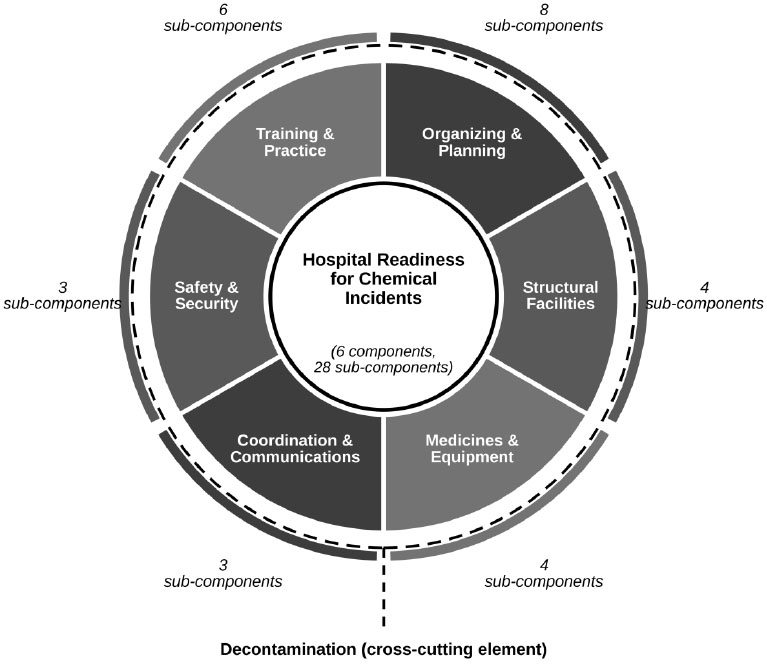
Conceptual model of hospital readiness for chemical incidents, redesigned to show sub-component counts per component and decontamination as a cross-cutting element (dashed ring), readable in grayscale.
Participants. Experts with relevant practical or research experience in chemical incidents, disaster management, toxicology, healthcare, or related fields were identified through purposive and snowball sampling. Twenty experts were initially approached; 11 declined because of limited time or insufficient familiarity with the topic. The qualitative sample therefore comprised 9 experts, and recruitment was closed when data saturation was reached. The thesis does not report additional formal inclusion or exclusion criteria beyond relevant practical/research experience. The same 9 experts who participated in the interviews also participated in the two Delphi stages. For the quantitative phase, a separate group of 10 specialists assessed content validity, while four independent evaluators assessed inter-rater reliability in a selected hospital.
Instruments and procedures. Semi-structured interview guides were developed from a systematic literature review and comprised open-ended questions covering six readiness dimensions. Interviews were audio-recorded with consent, transcribed immediately after each interview, and returned to interviewees for confirmation. Interview duration ranged from 36 to 66 minutes (mean 47 minutes). Data were analyzed in MAXQDA10 using directed content analysis. After two interviews, the interview questions and transcripts were reviewed by the research team before the remaining interviews proceeded. Extracted codes were also returned to interviewees for review and necessary correction. The preliminary conceptual model was then reviewed using the Delphi technique in two stages with the same nine experts. In the first stage, the components identified from the literature were presented to the experts and received 100% agreement. In the second stage, the preliminary model was circulated to the same panel and received 89% agreement, which the thesis considered sufficient for confirmation. The thesis does not describe a separate formal protocol for revising and re-circulating individual dissenting items beyond this aggregate review process.
In the quantitative phase, 121 candidate questions were initially generated from the interview material. After removing duplicate items and adjusting wording, a 95-item preliminary questionnaire was developed. Content validity was assessed by 10 specialists. For CVR, experts classified each item as essential, useful but not essential, or not necessary; a CVR of 0.60 was considered the minimum acceptable value for the 10-person panel. CVI was assessed at the item level using three criteria—simplicity, relevance, and clarity—on a four-point Likert-type scale; values above 0.79 were accepted, while lower values were subject to revision or deletion. Following review, 17 items were deleted, and 44 were modified or merged, resulting in a final 66-item tool. Item revision followed the specialists’ item-level ratings and comments: items that did not meet the CVR/CVI thresholds were revised or deleted; overlapping items were merged; and items judged unclear or covering more than one issue were reworded or split into separate items. Where the comments indicated that an item fitted a different readiness domain from the one to which it had first been assigned, it was reassigned to that domain. The domain-level item counts of the final tool therefore reflect the net result of deletion, merging, splitting, and reassignment rather than deletion alone. For reliability, the final instrument was applied in a selected hospital by four independent evaluators, and inter-rater agreement was examined using Cohen’s kappa. The thesis does not report Cronbach’s alpha or a modified-kappa procedure.
This study was part of a Master’s thesis in health services management at Baqiyatallah University of Medical Sciences (BMSU) and was approved by the BMSU Ethics Committee (No. IR.BMSU.REC.1396.447). The methodological details in this revised educational article were checked against the underlying Master’s thesis, including the qualitative sample, interview duration, Delphi process, questionnaire development, and reliability assessment.
3. RESULTS
The qualitative and quantitative phases together produced a conceptual model and a content-validated assessment tool for hospital readiness in chemical incidents. Six main components were identified — organizing and planning, structural facilities and physical space, medicines and medical equipment, communications and coordination, safety and security, and training and practice — comprising 28 sub-components (Fig. 1). Decontamination emerged as a cross-cutting element threaded through all six components rather than a stand-alone category, consistent with the theoretical emphasis on decontamination as the feature that most distinguishes chemical-incident readiness from general disaster preparedness.
Qualitative phase. Semi-structured interviews with the 9-expert panel (Table 1) produced 156 initial codes, which were consolidated into six components and 28 sub-components summarized in Table 2; the full list of extracted codes is provided in Supplementary Table S1. The coded-quote frequencies of the components, each calculated as the sum of its sub-component frequencies in Table 2, were 113 for organizing and planning, 32 for structural facilities, 21 for medicines and equipment, 17 for coordination and communications, 15 for safety and security, and 71 for training and practice (269 coded quotes in total; Fig. 2).
| Row | Gender | Academic Field | Job Position |
|---|---|---|---|
| 1 | Male | Physician, super-specialist | Professor, university faculty member |
| 2 | Male | PhD, military nursing | Assistant professor, university faculty member |
| 3 | Male | PhD, non-clinical basic sciences | Associate professor, university faculty member |
| 4 | Male | PhD, medical basic sciences | Assistant professor, university faculty member |
| 5 | Male | Physician, toxicology fellowship | Professor, university faculty member |
| 6 | Male | Physician | Head of treatment center |
| 7 | Male | Physician, toxicology fellowship | Assistant professor, university faculty member |
| 8 | Male | PhD, health in disasters | Associate professor, university faculty member |
| 9 | Male | PhD, environmental health | Professor, university faculty member |
| Component | Sub-component (Frequency) | Illustrative Quotation |
|---|---|---|
| Organizing and Planning (total: 113) | 1. Hospital Command Center / EOC (11) | “Some central authority must control these incidents through integrated management; without a functioning command center, responders arriving at the scene won’t know what has happened or what to do.” (P1, P4) |
| 2. Hospital Incident Command System (8) | “Organizing begins at the hospital entrance itself. Management is the single biggest challenge in any incident — chemical, explosive, or otherwise.” (P5, P8, P9) | |
| 3. Assessment of chemical threat and risk (25) | “Each hospital must map the chemical hazards likely to occur within its catchment area — for example, a 10 km radius — and allocate resources according to that risk profile; poor planning wastes resources exactly when they are needed most.” (P9) | |
| 4. Instructions and organizing standards (27) | “Every hospital intending to serve as a receiving center for chemical casualties must first have that role formally defined and recognized by the Ministry of Health or the national emergency organization, with resources allocated accordingly.” (P9) | |
| 5. Capacity-increase instructions (11) | “Every hospital needs a mass-casualty response plan; with proper triage, patients who don’t need secondary decontamination can be moved on to a second-level hospital, freeing capacity.” (P2, P4, P9) | |
| 6. Psychological and behavioral support (7) | “Personnel need the knowledge, attitude, and practice to manage a chemical casualty. After a chemical incident, everyone involved — patients, staff, and companions — experiences some degree of psychological distress that must be addressed.” (P3, P8) | |
| 7. Converting general to chemical emergency (12) | “Hospitals already functioning as trauma or poisoning centers are well placed for this role, but any hospital taking it on needs a pre-defined conversion plan and trained personnel.” (P4, P6, P9) | |
| 8. Chemical quick-response team (12) | “A rapid response team should be pre-designated — toxicologists, emergency physicians, triage and treatment nurses, rescuers, and HSE staff — equipped with PPE and specially trained.” (P4, P9) | |
| Structural Facilities (total: 32) | 1. Dual-purpose chemical-emergency design (15) | “Facilities should be designed for dual-purpose use — functioning normally day to day but able to convert rapidly into a chemical-response configuration, with signage and protocols ready to deploy.” (P1, P4, P9) |
| 2. Discharge and triage station (4) | “There must be a dedicated area outside the emergency department where a contaminated patient’s clothing and belongings are removed before decontamination.” (P2) | |
| 3. Decontamination station (9) | “A mobile, pre-planned decontamination zone is needed; the interface between pre-hospital and hospital care is one of the most important points for this.” (P2, P5) | |
| 4. Chemical waste disposal facilities (4) | “Hazardous chemical waste cannot be collected with normal waste; it requires dedicated incineration or a contracted disposal system, properly sealed and packaged, along with a system to neutralize contaminated wastewater.” (P9) | |
| Medicines and Equipment (total: 21) | 1. Antidotes and necessary drugs (5) | “Hospitals need a proper pharmaceutical protocol and antidote storage; policymakers must set stock levels for antidotes such as atropine and naloxone based on realistic capacity planning.” (P2, P5, P7) |
| 2. Personal protective equipment (5) | “PPE is essential wherever decontamination occurs; if a patient’s contaminated clothing has not been removed, responders must wear at least Level B protection.” (P4, P5) | |
| 3. Rescue equipment (3) | “Ambulances need to be properly organized, with dedicated drug and equipment bags for transporting chemically injured patients — something the country currently lacks.” (P2) | |
| 4. Drug and equipment supply instructions (8) | “Regional poisoning centers should hold antidote depots that hospitals can draw on as needed, coordinated through a network that tracks stock and consumption, rather than each hospital over-purchasing antidotes that may expire unused.” (P1, P5) | |
| Coordination and Communications (total: 17) | 1. Alert and hazard-announcement system (3) | “Response teams need a dedicated call code, so that once a chemical incident is announced, the right personnel know to report without further instruction.” (P2, P8) |
| 2. Information instructions (4) | “The referring center should communicate patient details to the receiving hospital in advance, including by phone for physicians in remote areas.” (P9) | |
| 3. Intra- and inter-organizational coordination (10) | “A hospital’s response cannot succeed in isolation; the whole chain from incident scene through pre-hospital and hospital care must be coordinated, with clear authority between the Ministry of Health and Ministry of Defense in military-related cases.” (P1, P2, P9) | |
| Safety and Security (total: 15) | 1. Risk assessment, environmental limitation and discharge (5) | “Protocols are needed for collecting, transporting, and disposing of contaminated waste, for purifying contaminated wastewater, and for auditing chemical-area ventilation systems; contamination should be classified separately by individual and by environment/equipment.” (P3, P9) |
| 2. Safety/security before and after decontamination (7) | “Equipment must be regularly evaluated through technical audit, and facilities must be kept fully operational on a set schedule; a response structure that isn’t maintained and ready is of no use.” (P9) | |
| 3. Medical/safety monitoring of decontamination staff (3) | “Responders must protect themselves first — a safety officer should confirm anyone entering the field is properly equipped, because a contaminated responder becomes another casualty rather than a help.” (P3, P8) | |
| Training and Practice (total: 71) | 1. Decontamination training and exercise (7) | “Facilities and equipment for field decontamination must be in place before a chemical patient is transferred; decontamination is typically repeated on arrival at hospital.” (P8) |
| 2. Triage training and exercise (6) | “Hospitals need at least minimal facilities for identifying chemical agents at ward level; most cases can be diagnosed clinically, but a meaningful minority need laboratory confirmation, so staff readiness for common scenarios is essential.” (P2, P5) | |
| 3. Treatment training per injury protocol (18) | “Education is the most important element of the treatment response; antidotes are expensive, have limited shelf life, and carry complications, so brief, application- and poster-based refresher training is needed because knowledge is easily forgotten.” (P3, P4, P5) | |
| 4. Personal-protection method training (7) | “The standing rule in every incident is safety first — responders must be confident in their own protection and properly trained in correct use of protective clothing before helping others.” (P5, P8) | |
| 5. Chemical incident management training (24) | “Primary decontamination must be performed and documented at the scene before the patient is sent onward; training must be repeated and tailored to each audience — first responders, security forces, and specialized hazmat units alike.” (P5, P6, P8, P9) | |
| 6. Full-scale operational exercises (9) | “Chemical response should be integrated into existing ground and air exercises rather than run separately, with clear scenarios defined for the chemical team; skilled personnel are one of the most basic elements of chemical-crisis readiness.” (P2, P3, P4) |
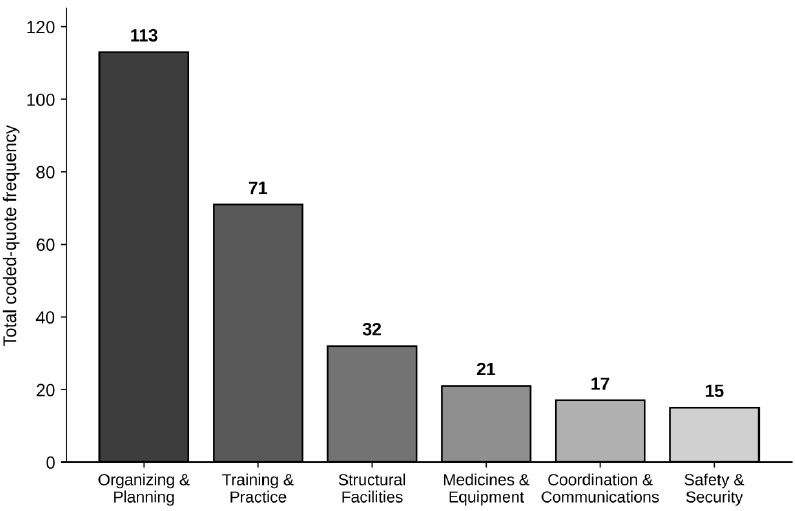
Total coded-quote frequency by readiness component, summed from the sub-component frequencies in Table 2.
A component frequency is the total number of coded quotations assigned to the sub-components of that component (the subtotals shown in Table 2 and plotted in Fig. 2). It differs from the other counts reported in this article: the 156 initial codes are distinct code labels before consolidation, the 28 sub-components are the consolidated categories under which quotations were counted, and the participant identifiers in Table 2 (e.g., P1, P4) indicate which experts contributed to the illustrative quotation, not how often a sub-component was coded.
For each main component, Table 2 lists the sub-components together with their coded-quote frequencies (component subtotals are given in the first column) and one representative, lightly edited illustrative quotation (edited only for grammatical clarity; the substantive content and speaker attribution are unchanged from the original transcripts).
Delphi validation. The preliminary conceptual model was reviewed in two Delphi stages by the same nine experts who participated in the qualitative phase. In the first stage, the literature-derived components received 100% agreement. The preliminary model was then circulated in the second stage and received 89% agreement. The thesis reports this level of agreement as sufficient to confirm the conceptual model. Inter-rater kappa statistics reported elsewhere in the study relate to the four evaluators who assessed the tool in the quantitative reliability phase and should not be interpreted as Delphi agreement.
Quantitative phase — content validity and inter-rater reliability. An initial pool of 121 questions was derived from the interview data. After removing duplicates and making wording adjustments, 95 questions formed the preliminary questionnaire. Ten specialists assessed content validity using CVR and item-level CVI. The final instrument contained 66 items distributed across the six domains as follows (Table 3): organizing and planning (16), structural facilities and physical space (10), medicines and medical equipment (9), communications and coordination (10), safety and security (10), and training and practice (11). Item counts did not change uniformly between the preliminary and final versions: they fell in four domains (organizing and planning, structural facilities, medicines and equipment, and training and practice), where most deletions and merges occurred, but rose from 8 to 10 items in each of the coordination and communications and the safety and security domains. These two increases resulted from the item-revision process described in the Methods: after the content-validity review, items that the specialists judged to cover more than one issue were split into separate items, and items that fitted these two domains better than the domain to which they had first been assigned were reassigned to them. Domain-level changes are therefore net values, whereas the tool as a whole decreased from 95 to 66 items. Reliability was subsequently assessed in a selected hospital by four independent evaluators using inter-rater agreement and Cohen’s kappa (Table 4).
| Domain | Preliminary Items (N) | Final Items (N) | Content-validity / Reliability Procedure |
|---|---|---|---|
| Organizing and Planning | 21 | 16 | Content validity assessed by 10 specialists; final tool reliability assessed by 4 independent evaluators. |
| Structural Facilities and Physical Space | 16 | 10 | Content validity assessed by 10 specialists; final tool reliability assessed by 4 independent evaluators. |
| Medicines and Medical Equipment | 10 | 9 | Content validity assessed by 10 specialists; final tool reliability assessed by 4 independent evaluators. |
| Coordination and Communications | 8 | 10 | Content validity assessed by 10 specialists; final tool reliability assessed by 4 independent evaluators. |
| Safety and Security | 8 | 10 | Content validity assessed by 10 specialists; final tool reliability assessed by 4 independent evaluators. |
| Training and Practice | 32 | 11 | Content validity assessed by 10 specialists; final tool reliability assessed by 4 independent evaluators. |
| Total | 95 | 66 | CVR: minimum 0.60 for 10 specialists; item-level CVI >0.79 accepted; reliability assessed with Cohen’s kappa. |
| Evaluator 1 | Evaluator 2 | Evaluator 3 | Evaluator 4 | |
|---|---|---|---|---|
| Evaluator 1 | — | 65.66% (p=0.525, κ=0.13) | 53.33% (p=0.124, κ=0.039) | 68.18% (p=0.0017, κ=0.25) |
| Evaluator 2 | 65.66% (p=0.525, κ=0.13) | — | 67.69% (p=0.0028, κ=0.13) | 71.21% (p=0.0001, κ=0.31) |
| Evaluator 3 | 53.33% (p=0.124, κ=0.039) | 67.69% (p=0.0028, κ=0.13) | — | 57.44% (p=0.001, κ=0.86) |
| Evaluator 4 | 68.18% (p=0.0017, κ=0.25) | 71.21% (p=0.0001, κ=0.31) | 57.44% (p=0.001, κ=0.86) | — |
Note: Table 4 reports pairwise percent agreement and Cohen’s kappa between each pair of the four evaluators who independently rated item relevance during content-validity assessment. Agreement ranged from fair to substantial (κ = 0.039–0.86); the lowest values (Evaluators 1 and 3) indicate a pair whose ratings diverged more than the others and may warrant a closer look at rating criteria in any follow-up validation. This table is retained separately from Table 3 because it reports rater-pair agreement rather than domain-level item statistics.
4. DISCUSSION
The six components identified here — organizing and planning, structural facilities, medicines and equipment, communications and coordination, safety and security, and training and practice — describe hospital readiness for chemical incidents as a multidimensional and interdependent construct rather than a checklist of unrelated requirements: a deficiency in one domain (for example, training) can amplify vulnerability in another (for example, safety monitoring). Decontamination emerged not as a seventh, separate component but as a thread running through all six, which is consistent with what differentiates chemical-incident management from general disaster response, where the priority is triage and immediate treatment rather than preventing secondary contamination of responders and facilities [12, 13].
These findings both align with and extend existing frameworks. They align with international CBRN competency models, such as the European TIER training framework, in emphasizing multifaceted, decontamination-centered training [8, 16]. They extend that work by incorporating context-specific elements — military-civilian coordination, resource constraints, and the organizational conversion of general emergency departments to chemical-response mode — that general international instruments, such as the WHO Hospital Safety Index, do not address [15]. Compared with earlier domestic literature reporting moderate readiness for natural disasters but weak readiness for chemical, human-made threats [18], the present model’s granular treatment of organizing/planning and training — the two components with by far the highest coded-quote frequency (Fig. 2) — helps explain where that domestic weakness is concentrated. Qualitative studies of barriers and strategies for hospital CBRN preparedness in Iran and in the Middle East and North Africa region likewise describe obstacles to preparedness and approaches for overcoming them [26, 27]. A very recent, independently conducted Iranian study using a comparable scoping-review-plus-Delphi design to model hospital preparedness against chemical weapons of mass destruction incidents [28] identified an overlapping but not identical set of components (with a stronger emphasis on psychological/ethical support and surge-capacity management), which suggests convergent validity for the broad domains identified here while underlining that no single model has yet been established as definitive for the Iranian context.
Practical implications for hospital administrators. The 66-item tool can be used as a structured checklist for reviewing hospital preparedness for chemical incidents and identifying areas requiring further planning, equipment, coordination, safety measures, training, and decontamination capacity. Because the thesis established content validity and inter-rater reliability rather than construct or criterion validity, the tool should not yet be interpreted using universal numerical cut-off scores or used as a formal accreditation standard. Hospitals can instead use the individual domains and items to identify specific preparedness gaps and guide subsequent training, planning, and resource allocation.
5. STUDY LIMITATIONS
Several limitations should be considered when interpreting these findings.
- All nine experts interviewed in the qualitative phase were male (Table 1), and the panel was drawn predominantly from senior physicians, faculty, and PhD-level specialists rather than frontline nursing, technician, or allied-health staff; the model may therefore under-represent perspectives from those groups and from female clinicians.
- Experts were selected through purposive and snowball sampling from Iranian military-civilian institutions, which limits the generalizability of both the model and the tool beyond this context; applicability to civilian-only systems, to other countries, or to resource settings very different from Iran’s has not been tested.
- The tool has not yet been validated against real chemical incidents or full-scale simulations, so its predictive and criterion validity remain unknown; only content validity and internal-consistency reliability have been established at this stage.
- Because items were generated and rated by experts rather than observed in practice, it is possible that some components (for example, training or safety measures) reflect experts’ perceptions of importance rather than hospitals’ actual, current implementation of those measures.
- The study did not assess whether hospitals have the financial, staffing, or infrastructure resources needed to implement all 66 retained items; resource feasibility is a separate question from content relevance and should be assessed before the tool is used for planning or benchmarking.
Future research should test the tool’s criterion and predictive validity against real-world or simulated chemical incidents, assess its test–retest reliability, explore whether it needs adaptation for civilian-only or non-Iranian settings, and develop empirically grounded score thresholds that distinguish levels of readiness.
CONCLUSION
This study identified a six-component, 28-sub-component conceptual model of hospital readiness for chemical incidents — organizing and planning, structural facilities and physical space, medicines and medical equipment, communications and coordination, safety and security, and training and practice — derived from semi-structured interviews with 9 experts and validated over two Delphi rounds. A 66-item questionnaire derived from this model met the pre-specified content-validity thresholds (CVR ≥ 0.60 across a 10-specialist panel; item-level CVI > 0.79) and showed fair-to-substantial inter-rater reliability among four independent evaluators (Cohen’s kappa 0.04–0.86; Table 4). Decontamination emerged as the feature that most clearly distinguishes chemical-incident readiness from readiness for other disaster types.
These findings offer hospitals and policymakers — particularly in high-risk regions and in military-civilian healthcare systems — a structured, locally grounded starting point for evaluating and strengthening chemical-incident readiness, and may usefully inform training priorities, resource-allocation decisions, and future national guidelines. Because the tool has so far only been content-validated, it should be treated as a preliminary instrument: future studies should test its predictive and criterion validity in real-world or simulated chemical events, assess its applicability outside the Iranian military-civilian context, and establish evidence-based thresholds for classifying hospital readiness before the tool is used for accreditation or benchmarking purposes.
AUTHORS’ CONTRIBUTIONS
The authors confirm their contributions to the paper as follows: study conception and design: AM, SMHS; data collection: HH, AS; analysis and interpretation of results: AA, NSMS; draft manuscript: NS, SMSH. All authors reviewed the results and approved the final version of the manuscript.
LIST OF ABBREVIATIONS
| CBRN | = Chemical, Biological, Radiological, and Nuclear |
| CVI | = Content Validity Index |
| CVR | = Content Validity Ratio |
| EOC | = Emergency Operations Center |
| HCC | = Hospital Command Center |
| HICS | = Hospital Incident Command System |
| MAXQDA | = Max Qualitative Data Analysis |
| PPE | = Personal Protective Equipment |
| WHO | = World Health Organization |
ETHICS APPROVAL AND CONSENT TO PARTICIPATE
This study was approved by the Ethics Committee of Baqiyatallah University of Medical Sciences (Ethics Code: IR.BMSU.REC.1396.447)
HUMAN AND ANIMAL RIGHTS
No animals were used in this research. All procedures performed in studies involving human participants were in accordance with the ethical standards of institutional and/or research committees and with the 1975 Declaration of Helsinki, as revised in 2013.
CONSENT FOR PUBLICATION
Written informed consent was obtained from all participants prior to their involvement in the study.
AVAILABILITY OF DATA AND MATERIALS
The data supporting the findings of this study are available from the corresponding author (S.M. Hosseini Shokouh) upon reasonable request, subject to institutional data-sharing policies of Baqiyatallah University of Medical Sciences.
ACKNOWLEDGEMENTS
Declared none.